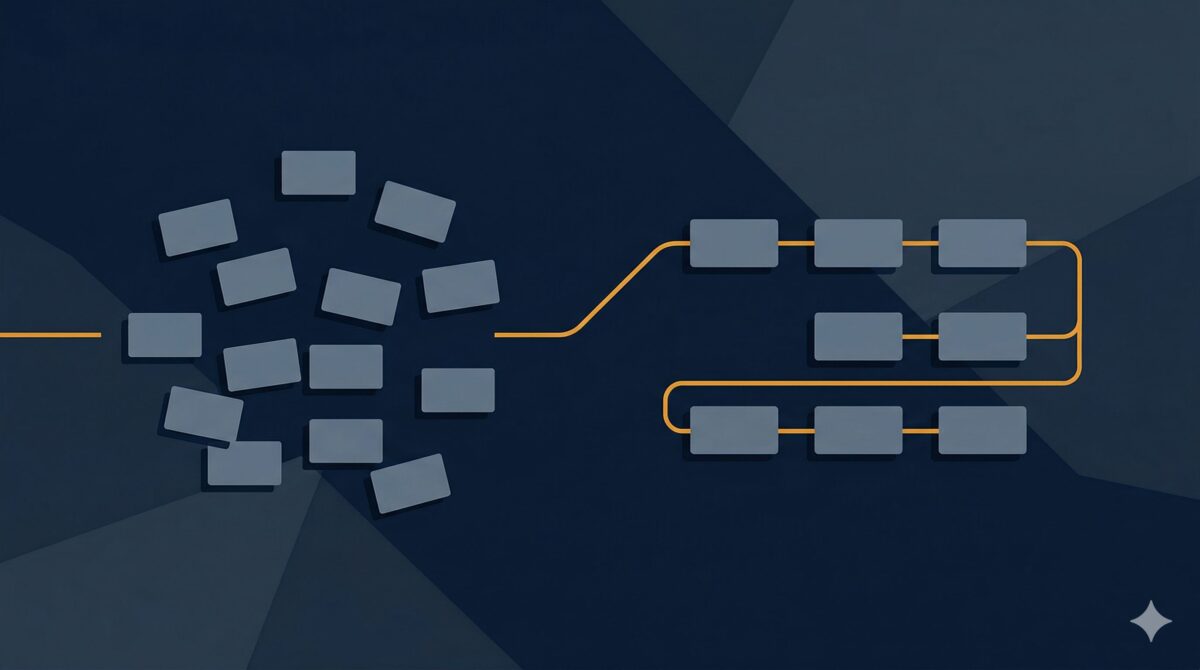
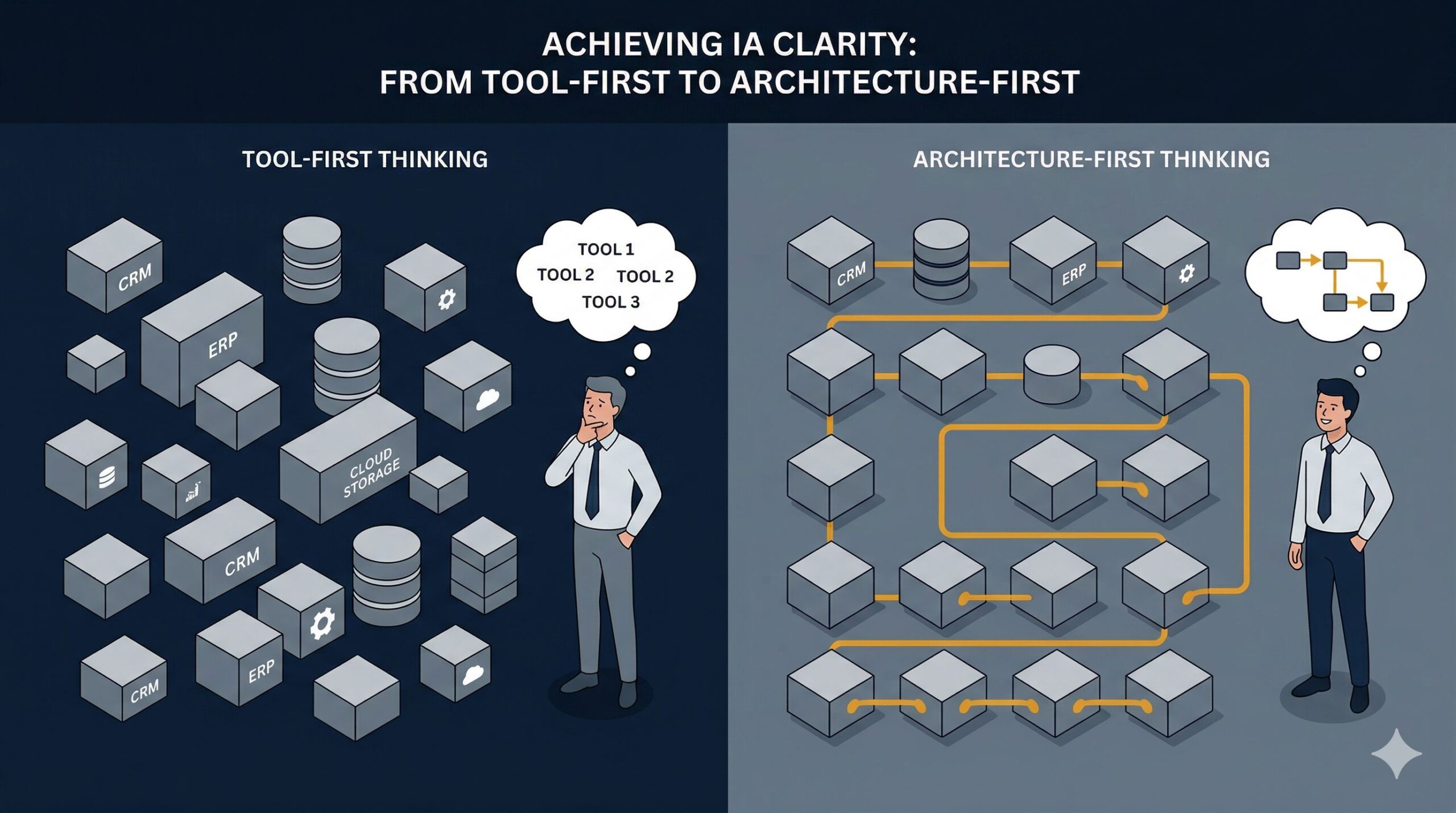
Information architecture — the way data flows between your systems, your people, and your decisions — is failing in most organisations. Not because of the wrong tools. Because of the wrong design.
Why Information Architecture Is a Leadership Skill, Not a Technical One
Information architecture is one of those concepts that sounds technical but is, at its core, a leadership skill. And most leaders who struggle with AI adoption aren’t missing technical knowledge — they’re missing a framework for thinking about how information actually moves through their organisation.
A managing director once told me she’d spent three years assuming her AI problems were technology problems. Every time something broke down — a report that was outdated, a decision built on contradictory data, a workflow that needed someone physically present to operate it — her instinct was to buy a better tool. She’d bought a lot of tools. The problems persisted.
What she was missing wasn’t technical knowledge. She understood her business precisely. What she lacked was a framework for thinking about where information moves, where it stops, and who — or what — stops it. That’s not a technology skill. It’s a thinking skill. And it has a name: information architecture.
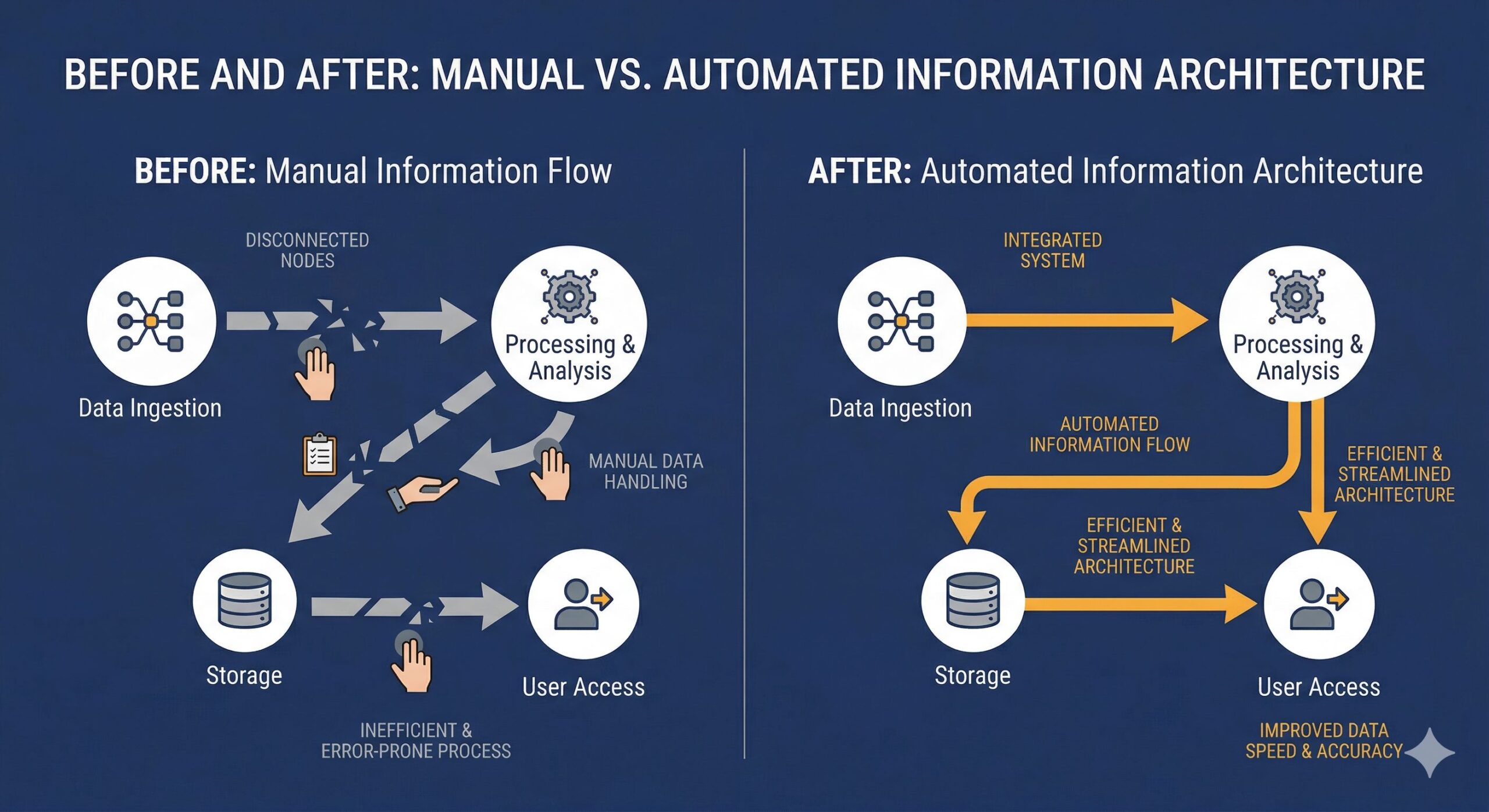
The question is never ‘do we have the right tools?’ The question is: does the information flow correctly between the tools we have?
A tool that processes customer data cannot help you if the customer data is being entered manually three days after the interaction happened. An AI assistant cannot make better decisions than the data it has access to — and if that data is partial, siloed, or manually maintained, the assistant will fail reliably.
Here is that framework. Three questions. No technical knowledge required.
Question 1: Where Does Your Information Architecture Stop?
Ask this of any workflow: where does information leave one system and get entered, by a human, into another? You’re looking for the moments where a digital process hands off to a person who then types.
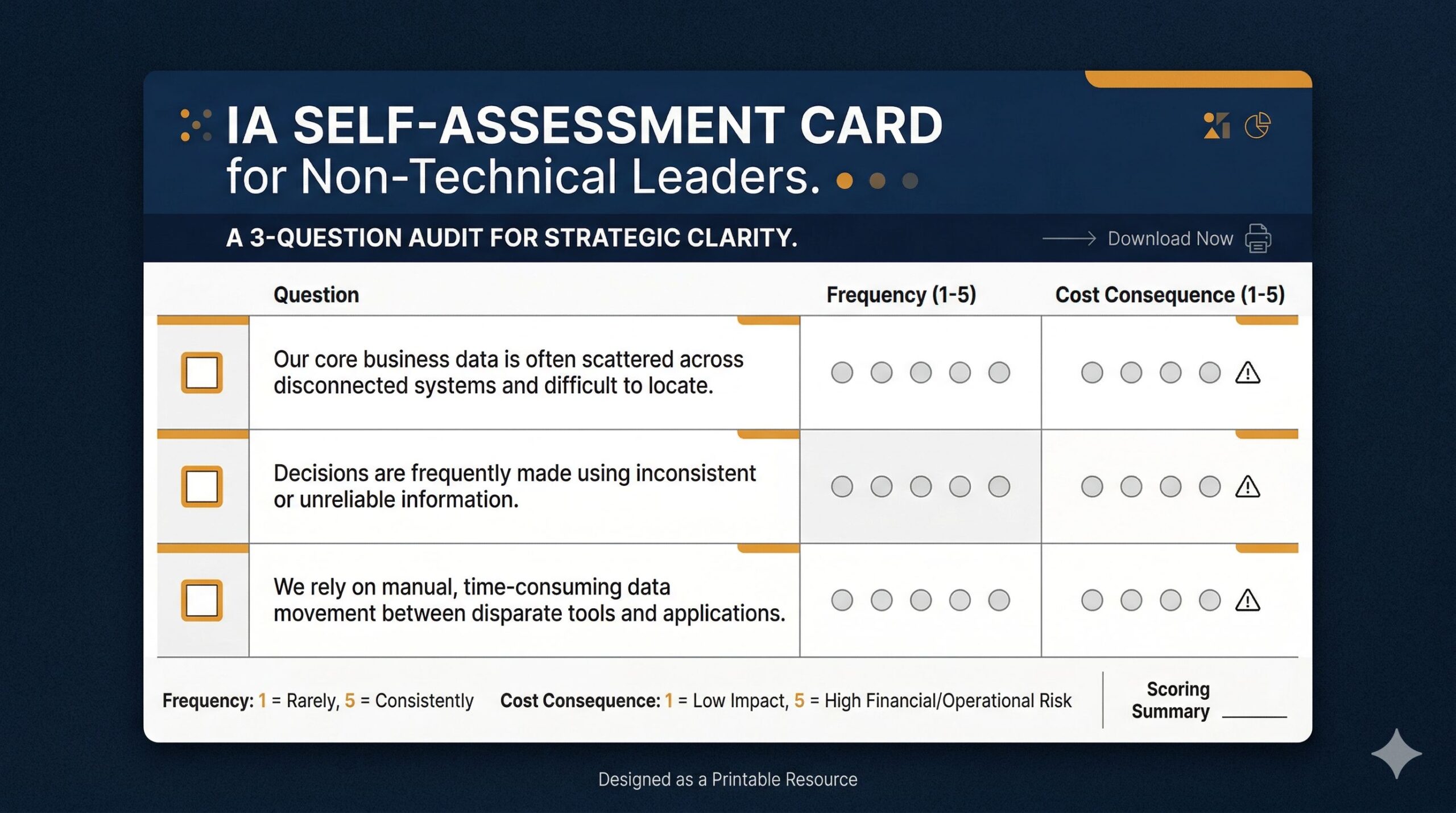
Consider these common examples: an email copied into a CRM, a sales report assembled from three different spreadsheets, an invoice re-keyed from one accounting system into another, or a customer complaint entered into a ticketing system from notes taken in a meeting.
Each of these is a stop. At every stop, the information is at best a day old — often older. Moreover, at every stop, there is a risk of delay, error, or loss. This is also where your smartest employees become your most significant vulnerability. The people who have learned to work around architectural gaps are often the most valuable — and the least likely to flag the problem, because the workaround has become invisible to them.
Question 2: Is Your Information Architecture Slowing Your Decisions?
If someone compiles a report manually before you see it, that report is at best a day old. If it draws from a system updated weekly, it’s a week old. And if it requires sign-off from three people before it reaches your desk, the picture you’re making decisions from may be several working days out of date.
In a well-designed information architecture, important decisions draw from real-time or near-real-time data. That’s not a technology achievement. It’s an architecture one. The gap between what happened and what you know about it is a design choice — often an accidental one.
The analysis paralysis trap is often blamed on cognitive load or risk aversion, but stale, incomplete, or contradictory data is frequently the actual cause. You simply cannot make confident decisions from uncertain inputs.
Question 3: Who Exists Just to Move Information?
This question needs care. It’s not an indictment. It’s a diagnostic. In your organisation, are there roles — or significant parts of roles — that exist primarily to transfer information between systems that should, in principle, connect automatically?
Because when a human being’s primary function is to shuttle data from one tool to another, you have an information architecture gap that’s expensive enough to warrant full-time employment. That’s the most direct possible measurement of what poor information architecture costs.
The answer isn’t to make those roles redundant. Instead, the goal is to redesign their work so it requires human judgement — which is irreplaceable — rather than human information transfer, which is not. The emotional states that distort professional judgement are most dangerous precisely when decisions are being made on incomplete information — which poor information architecture guarantees.
Turning These Answers Into an Information Architecture Brief
Once you’ve worked through these three questions honestly, you’ll have something more useful than a list of problems. You’ll have what any competent technical partner needs to start work: a clear picture of where information stops, where decisions depend on stale data, and where your organisation is paying human beings to do what systems should do automatically.
You produced it with three questions and a clear-eyed look at your own business.
For the structured 5-day audit process that formalises this exercise — with templates and stakeholder prompts: How to Run an AI Systems Audit in 5 Working Days. For the complete 4-week implementation methodology including the 20-question diagnostic framework: AI Systems Audit: The 4-Week Diagnostic Process.
Turn Your Information Architecture Audit Into Action
The Decision-Making Implementation Pack includes structural frameworks for translating information architecture findings into prioritised action plans — practical tools for non-technical leaders managing technical change. Nine frameworks, six worked examples, a 30-day habit installer.
Also available: the MBA Alternative Reading Kit — free, 57 pages, the mental models that make this kind of analysis second nature.
Before You Go
Of the three questions, which one surfaces the most uncomfortable answer in your own organisation? Most leaders I work with already know before they’ve finished reading the question.
If you found this useful, these posts continue the thinking: How to Run an AI Systems Audit in 5 Working Days gives you the structured process. The 6 Emotional States That Distort Professional Judgement covers the human side of decision-making that information architecture must support.
On Medium, the series continues with The Real Cost of AI Tool Sprawl and How to Run an AI Systems Audit in 5 Working Days.
Comment below — I’m curious where the weight tends to sit.