
🛑 Get the AI Audit Template: Gumroad | Ko-Fi
This post contains the full AI systems audit methodology: 20-question diagnostic, scored prioritisation matrix, Architecture Brief template, and the framework that decides what to fix first.
Why the AI Systems Audit Comes Before Everything Else
Running an AI systems audit before designing your architecture is not optional — it is the correct sequence. Most organisations discover this the hard way.
When a client sees the AI systems audit map for the first time, they look at the diagram — every tool in their organisation, every place where information stops moving automatically and a person takes over — and they say some version of: ‘I knew it was bad. I didn’t know it was this specific.’
That specificity is the point. Not bad news. Not a list of failures. A precise picture of where the problems are, named clearly enough to become a solvable engineering task rather than a vague organisational anxiety.
If you haven’t read the 5-day process first: How to Run an AI Systems Audit in 5 Working Days — start there, then return here for the complete methodology. The non-technical foundation for understanding why information architecture matters is covered in Information Architecture for Non-Technical Leaders: 3 Questions.
Most AI implementation projects start with architecture: what should connect to what, in what sequence. However, the correct sequence is audit first, then architecture. You cannot design a connected system without an accurate map of what exists, where the gaps are, and which gaps are causing the most damage.
Before you begin, it’s worth understanding what integration debt actually costs your organisation — the pattern of expensive AI failures is consistent enough to be instructive. The AI systems audit is how you avoid joining that list.
📥 Download: The AI Audit Template
The diagnostic tool described in this article is available as a downloadable Google Sheets file — the same template used in client engagements. It includes the 20-question diagnostic with scoring rubric, priority matrix, and Architecture Brief template.
Ko-Fi Practitioner members can download the template directly at ko-fi.com/afulcrum/tiers. If you want the framework that completes the audit process — the decision logic, prioritisation system, and worked implementation examples — that’s the Decision-Making Implementation Pack on Gumroad. The audit tells you what’s broken; the pack tells you how to fix it in sequence.
Week 1 — Discovery: Build the Complete Picture
Week one is inventory and observation. You are not solving problems yet. Your goal is to see everything.
- Inventory: Every tool the organisation uses — including shadow tools and free-tier accounts not on the approved list.
- Workflows: Every recurring process that produces or consumes information.
- People: Who does what, at what frequency, and where human judgement is in use versus human data transfer.
The observation element is important and underused. Sit with the people who do the work — not the managers who describe the work. Ask them to show you, not tell you, what they do on a typical day. The gap between the described workflow and the actual workflow is almost always illuminating. This connects directly to why your smartest employees make the riskiest decisions — the people closest to the problem often can’t see the architecture failing because they’ve adapted to it.
Discovery output: A raw map. Not polished. Not prioritised. Everything. You will use this as the raw material for week two.
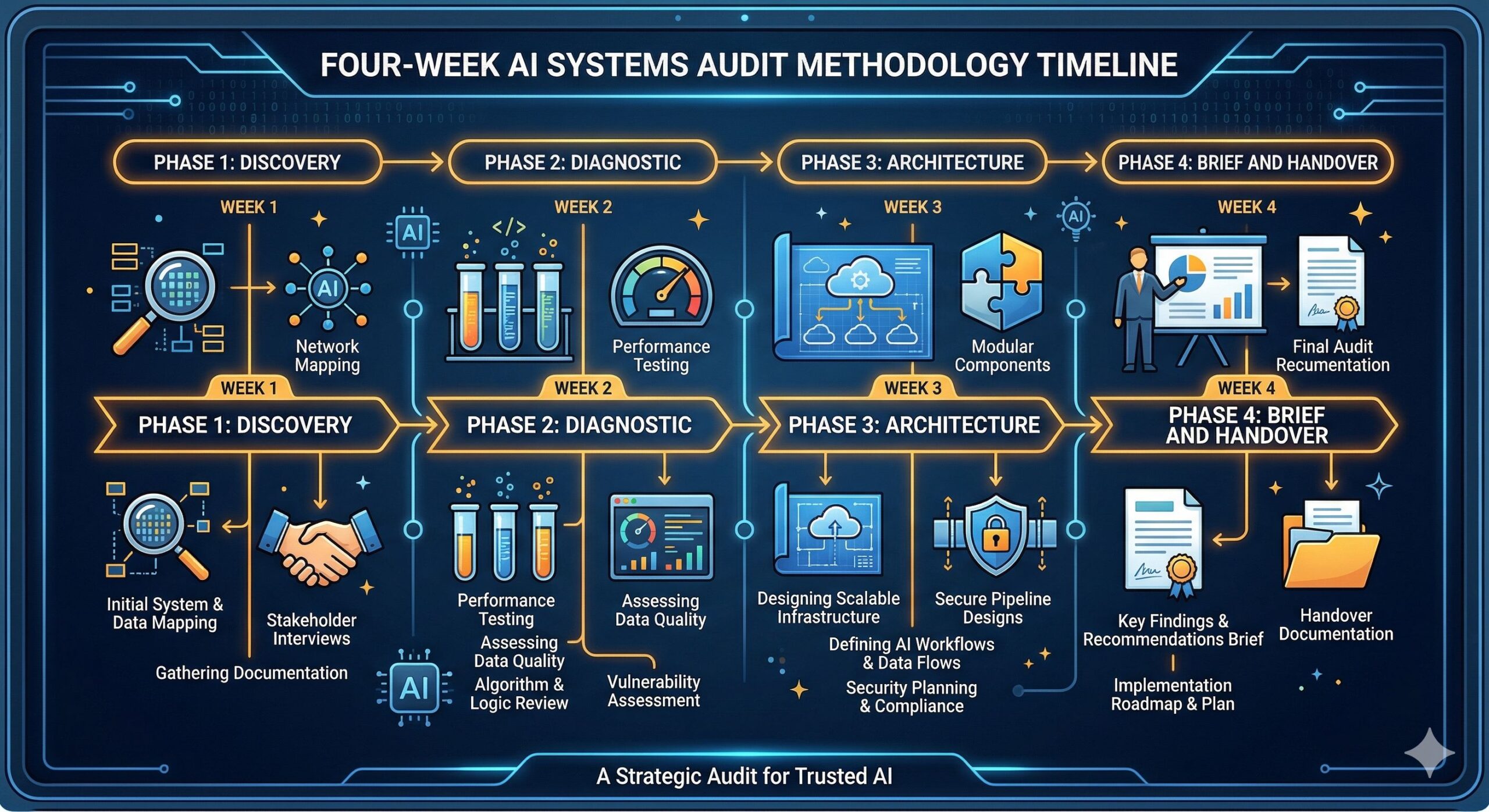
Week 2 — Diagnostic: Score Every Gap in Your AI Systems Audit
The 20-question diagnostic framework scores your organisation across three categories: Information Flow, Decision Quality, and Workflow Efficiency. Score each question: 0 = no issue · 1 = minor · 2 = significant · 3 = critical
Information Flow (Questions 1–7)
- How many tools in your stack share data automatically, without human intervention?
- How often does information leave a digital system and get re-entered by a person downstream?
- Where does your organisation rely on email as a data transfer mechanism between systems?
- How many systems hold a version of the same record (customer, project, invoice) that can fall out of sync?
- What happens when a key person is absent — how many workflows stop or degrade?
- How frequently do meetings exist primarily to transfer information that could have been automated?
- Where does information that enters your organisation digitally get converted to analogue (print, handwriting) before being re-digitised?
Decision Quality (Questions 8–13)
- Which recurring decisions in your organisation rely on manually compiled reports?
- How much lag exists between an event occurring and the relevant decision-maker having the information needed to respond?
- Where do decisions happen on outdated data because the update process is manual?
- Which decisions do individuals make without access to the full information set needed to make them well?
- Where does institutional knowledge live in individuals’ heads rather than in accessible systems?
- How often do decisions get revisited or reversed because new information emerges that should have been available earlier?
Workflow Efficiency (Questions 14–20)
- What proportion of staff time described as ‘admin’ involves moving information rather than creating or acting on it?
- Which tasks require a human specifically because two systems don’t communicate?
- Where does approval or sign-off create a bottleneck that better information routing could resolve?
- What recurring tasks do staff complete identically each time, with no judgement required — and without automation?
- Where does your organisation generate reports that one person reads and another acts on — with no intermediate automation?
- Which onboarding or offboarding steps require manual system access changes across multiple platforms?
- What does your organisation do weekly that it would stop doing if it cost three times as much in staff time — and hasn’t stopped because the true cost is invisible?
Scoring Rubric
- 0–15 total: Low integration debt. Focus on the highest-scoring individual questions — these are your priority interventions.
- 16–30 total: Moderate integration debt. Systematic issues exist in one or two categories. Architecture work will have clear ROI.
- 31–45 total: High integration debt. Multiple categories are compromised. Prioritise by cost consequence, not by technical ease.
- 46–60 total: Severe integration debt. Organisational efficiency is significantly impaired. Treat this as an infrastructure problem, not a tooling problem.
Priority Matrix
Use the scored results to map each gap onto two axes: Impact (how much does this gap cost in time, quality, or decision accuracy?) and Complexity (how difficult is it to resolve, given current systems and resources?).
- High impact, low complexity: Fix first. These are your quick wins and will build organisational confidence in the AI systems audit process.
- High impact, high complexity: These are your architecture priorities — the core of the four-week methodology.
- Low impact, low complexity: Batch and schedule. Worth doing, but not at the expense of high-impact work.
- Low impact, high complexity: Defer or deprioritise. The return does not justify the effort at this stage.
Interpreting Your AI Systems Audit Results
A high score in Information Flow points to infrastructure problems — systems that don’t connect, data that doesn’t move. The fix is typically integration and automation.
A high score in Decision Quality points to architecture problems — the right information isn’t reaching the right people at the right time. In this case, the fix often involves redesigning how data surfaces, not just how it moves. The analysis paralysis trap is particularly dangerous at this stage — the temptation to wait for perfect information before designing anything.
A high score in Workflow Efficiency points to process problems — humans doing what systems could do. The fix is automation, but good design requires understanding the workflow before specifying the tool.
The distribution across categories tells you where to start. Most organisations have a dominant category; that’s where the root cause sits.
The full implementation kit — including worked examples, scored case studies, and a completed Architecture Brief template — is available to Practitioner members at ko-fi.com/afulcrum/tiers. The tier includes access to the downloadable Google Sheets AI systems audit tool and the complete prioritisation framework.
Week 3 — Architecture: Designing the Connected System
By week three, you have a scored diagnostic. You know which gaps are highest priority, which decisions are most compromised, and where human effort goes toward unnecessary information transfer. Architecture week translates the diagnostic into a design.
For each high-priority gap, the architecture answers: what should connect to what, via what mechanism, triggered by what event, with what exception handling?
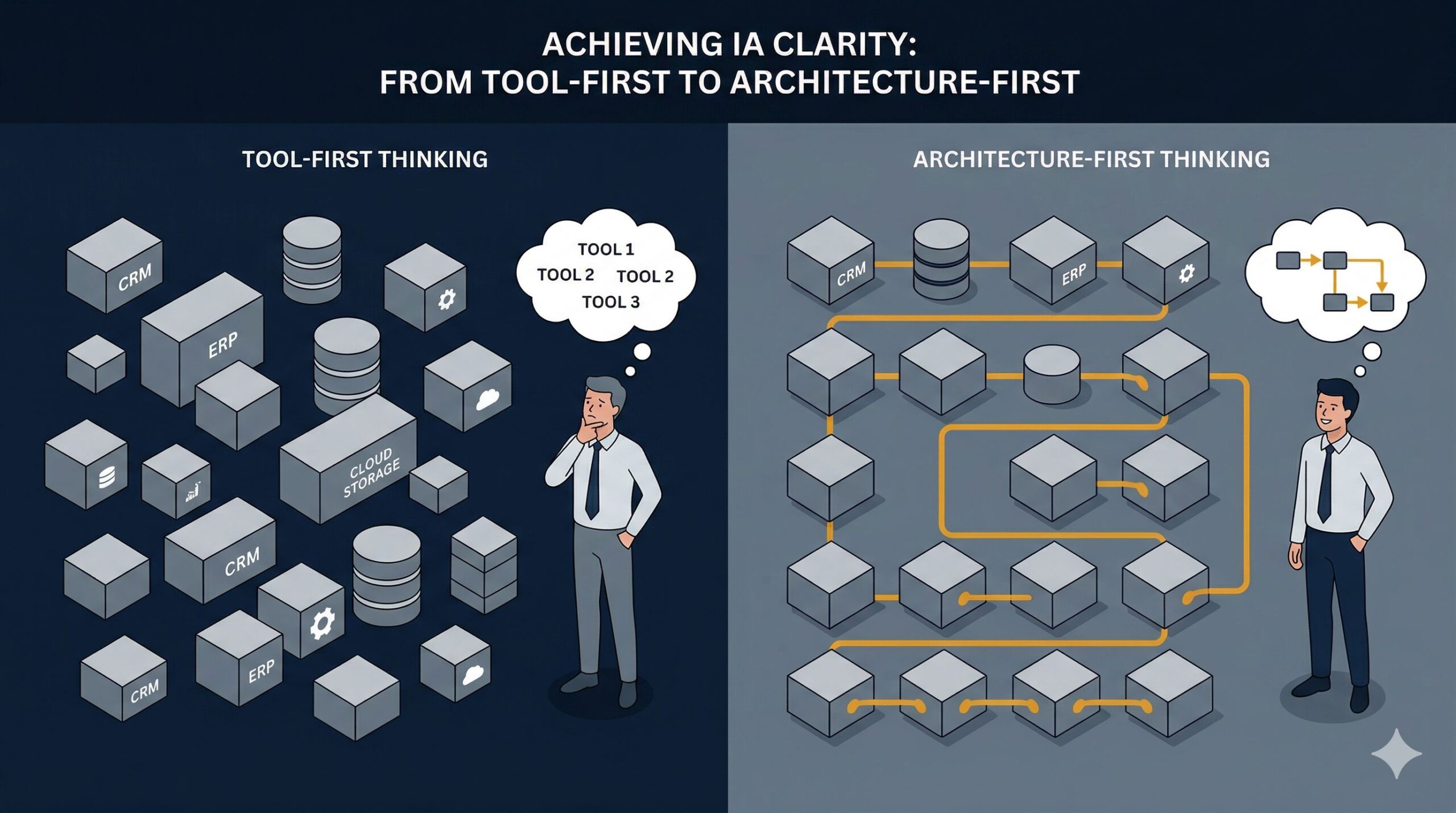
This does not require technical knowledge to draft at the conceptual level. It requires systems thinking — the ability to trace information from its source through every transformation and handoff to its final use in a decision. The architecture brief is written in plain language, not code.
The most common mistake is designing the ideal state without accounting for the sequence of changes needed to reach it. Good architecture is phased. It builds from the most important gap outward, one connection at a time.
Week 4 — Brief and Handover: The Four-Section Output
The Architecture Brief has four sections. Together, they give any implementation specialist, automation developer, or fractional AI architect everything needed to begin work.
- Gap Summary: Three to five prioritised gaps with frequency and cost consequence.
- Connection Specifications: What connects to what, via what mechanism, with what exception handling.
- Dependency Map: Which connections must be in place before others can function.
- Implementation Roadmap: Quick wins first (high impact, low complexity). Medium-term changes second (high impact, high complexity). Deferred items last (low priority, or dependent on upstream changes).
This brief turns vague organisational anxiety about the AI setup into a manageable engineering project with clear deliverables and measurable outcomes.
From Audit to Action: The Implementation Pack
The Decision-Making Implementation Pack contains nine frameworks, six worked examples, and a 30-day habit installer — including the decision logic and prioritisation system that turns AI audit findings into a phased action plan. Built specifically for professionals who operate with high autonomy and high stakes.
Also: the MBA Alternative Reading Kit (free, 57 pages) and the Ko-Fi Practitioner membership for the downloadable Google Sheets audit template.
The Reading Shelf for AI Systems Audit Thinking
What I’d recommend to anyone building this skill from scratch — the intellectual foundation of the audit methodology, and the books that shaped how it was designed.
- Thinking in Systems — Donella Meadows (Bookshop.org). The foundational text for understanding why systems fail in predictable ways and what leverage points actually change them.
- Smart Choices — Hammond, Keeney & Raiffa (Bookshop.org). The PrOACT decision framework provides the most rigorous structure for the Decision Impact Analysis section of the Architecture Brief.
- The Information — James Gleick (Bookshop.org). The history of how information has been structured, transmitted, and transformed.
- The Design of Everyday Things — Don Norman (Bookshop.org). On how systems communicate with the people who use them — and why most fail.
These titles also appear in the A Fulcrum MBA Alternative Reading Kit — the systems thinking and information architecture volumes there provide the intellectual foundation for everything in this audit methodology.
The AI systems audit connects directly to the human side of decision-making: the emotional states most likely to distort professional judgement are most dangerous precisely when decisions are made on stale or incomplete data — which is what this audit is designed to fix. On Medium, the companion piece examines the real cost of AI tool sprawl and how a fractional AI architect actually operates.
Before you go: Of the three diagnostic categories — information flow, decision quality, or workflow efficiency — which produces the highest scores in your own organisation? The distribution tells you something important about where the root cause sits. Comment below.