

The night a batch of transmission housings failed because one exhausted operator trusted his own discipline instead of the checklist, I stopped believing in routines — and started believing in systems over willpower.
It was 11:40 p.m., second shift, on the floor at a transmission plant outside Dayton, when my best line lead made a call his training told him not to make. He’d done everything right that morning — up at 5, coffee, the same drive he’d made for eleven years. None of it mattered. A machine doesn’t care how virtuous you were at 6 a.m. He skipped a torque re-check on a run of housing bolts because he’d run that press a thousand times and trusted himself more than the checklist. Twenty minutes later we scrapped eighteen hundred units, and I spent the next three weeks tracing a catastrophic failure back to a decision that took four seconds.
That’s the night I stopped believing in discipline.
The internet will sell you the opposite story. Wake at 5. Lemon water. Meditate. Journal. Run. Read ten pages. String enough pristine mornings together, the gurus promise, and the rest of your life falls in line. I spent four decades in rooms where that logic gets people hurt. In my industry, when something goes wrong, nobody asks whether the operator had a good morning. They ask what in the system let a tired, ordinary, imperfect human make an extraordinary mistake.
We don’t build systems that require people to be at their best. We build systems that work when they’re not.
Call it Default Design: engineering your environment so the right outcome happens automatically, without you having to be disciplined, motivated, or even awake enough to make the good choice on purpose.

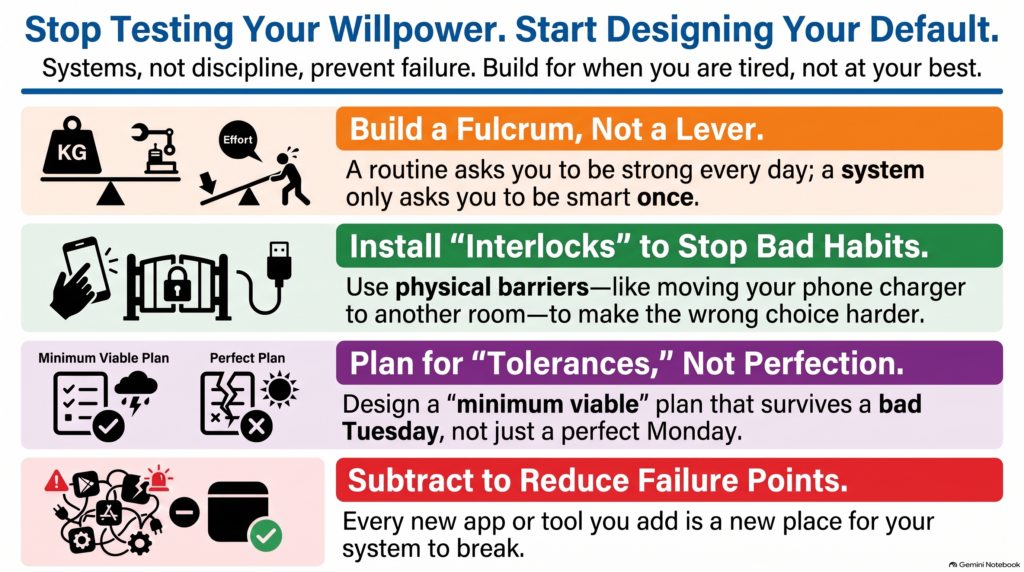
Your morning routine is the opposite of Default Design. It’s a lever — and you’re the one lifting it, every single day, under your own power, until your arm gives out. Archimedes had the better idea: give me a lever long enough and a fulcrum to rest it on, and I will move the world. Nobody remembers that he still had to push. What made it possible wasn’t his strength. It was the fulcrum doing the multiplying. A routine makes you the lever. Default Design builds you a fulcrum.
A routine asks you to be strong every day. A system only asks you to be smart once.
Friction Isn’t the Enemy. It’s the Fix.

Everything about modern life is engineered to be frictionless — one tap, one swipe, zero resistance between impulse and action. In quality assurance, frictionless is often the most dangerous word in the room. When a process has zero margin for error, we don’t make it easier to execute. We build in interlocks — physical or procedural barriers that force a pause exactly where a bad decision is most likely to happen automatically.
If you’re trying to kill a bad habit, you are not short on willpower. You are short on interlocks.
Doom-scrolling in bed isn’t a discipline failure. It’s a design failure — the phone is six inches from your hand. Move the charger to the kitchen and the interlock does the work your 11 p.m. self never could. Eating badly at 7 p.m. isn’t a discipline failure either. It’s that the junk food is in the house. Take away the option and you’ve removed the decision, not just resisted it.
Default Design doesn’t make you stronger. It makes the wrong choice further away. That’s the whole promise of systems over willpower.
Systems Over Willpower: The Habit Myth Nobody Wants to Hear
We’re told 30, 60, or 90 days of repetition makes a habit unbreakable. I’ll admit I tried the 5 a.m. thing myself once, out of curiosity more than belief — two weeks in, a work trip and a bad flight wrecked the streak, and I felt like a fraud for a week after.
That’s not a willpower story. That’s physics.

Environments change. In a plant, machines drift out of tolerance, materials vary batch to batch, people get tired — and a process engineered for perfect conditions shatters the first time conditions aren’t perfect. A process engineered with tolerances bends instead.
Your systems need tolerances too. If your fitness plan only works as a 60-minute gym session, it breaks the first time you travel, or work runs late, or a kid gets sick. Build the minimum viable version instead: the 15-minute bodyweight circuit, the 10-minute walk, the version so small it survives a bad week.
Default Design isn’t about the best version of the plan. It’s about the version that can’t be killed by a Tuesday.
Subtraction Beats Every App You’ve Bought to Fix This
When people feel behind, the instinct is to add: a new app, a new planner, a new framework promising to finally make it stick. In four decades of root-cause investigations, I can count on one hand the number of times the fix for a failing process was more complexity. Nearly every real fix was subtraction — one fewer handoff, one fewer decision point, one fewer tool competing for the same five minutes.
Every tool you add is a new place for the system to fail. Look at what you’re managing right now — not doing, managing — and cut it.
You’re Measuring the Wrong Thing
Most people track lagging indicators: hours worked, boxes checked, miles run. Those tell you what already happened. They tell you nothing about why. Psychologist James Reason built the “Swiss cheese model” of accident causation studying exactly this — catastrophic failures are almost never one bad decision, they’re several thin, ordinary weaknesses lining up by accident. You don’t prevent that by grading the final result harder. You prevent it by watching the layers.
Are you tracking the environment that produces your output — your sleep, your actual focus windows, how many decisions you’re forced to make before noon — or just the checklist at the end of the day? Audit the system that generates the outcome, not the outcome.
The One-Week Default Audit
You don’t need a life overhaul. You need to find and fix your weakest link.
- Name the one commitment you keep dropping. Not the whole routine — the single specific thing. Writing daily. The gym. Not ordering takeout.
- Ask “why” until you hit the environment, not the excuse. You didn’t skip the workout because you’re lazy. You skipped it because you were tired. You were tired because you were up late. You were up late because — keep going until you reach something you can actually change.
- Install one interlock at that exact point. Not a new goal. A physical or procedural barrier that makes the failure harder to repeat than the success.
That’s it. One week, one weak link, one interlock. That’s systems over willpower in practice.
Want to skip the DIY? I packaged the exact six worksheets and the day-by-day protocol from this audit into The Default Design Field Kit — the same root-cause method I used for 40 years, in a fillable PDF you can work through in a week.
At 11:40 p.m. on that floor outside Dayton, I used to think the fix was a better operator — someone more disciplined, more alert, more careful than the one who made the call that cost us eighteen hundred units. It wasn’t. The fix was a system that didn’t need him to be superhuman at 11:40 p.m. That’s still true standing in my kitchen at 6 a.m., deciding nothing, because I moved the charger to the other room a long time ago.
You don’t need a better version of yourself tomorrow morning. You need one fewer decision for that version to get wrong.
If this is your kind of thinking, I send more of it — factory-floor logic aimed at ordinary life — from my newsletter. You can subscribe here.
Get the Field Kit

You just read the method. The Default Design Field Kit is that method built into something you can actually use: six worksheets that walk you from your one dropped habit to a fixed system, the one-week day-by-day audit protocol, The Interlock Library with 24 ready-to-steal examples, and a one-page Default Design reference card. It’s a fillable PDF — type into it on any device, or print it and write. Built by a 40-year quality-assurance engineer, for the version of you who’s tired at 11:40 p.m.