

How to Handle Workplace Betrayal Professionally: An Introduction
Knowing how to handle workplace betrayal professionally is something most career guides skip entirely. Yet workplace betrayal doesn’t usually arrive with a dramatic confrontation.
It rarely looks like what you see in films — a shouting match in the corridor, a formal accusation, a visible falling-out. Instead, it tends to arrive quietly. A pattern you explain away for months. A colleague who consistently seems to be working at cross-purposes to you in ways that are hard to name. A project that keeps losing momentum in ways that trace back, if you look carefully enough, to the same person.
By the time most people recognise they are dealing with genuine betrayal in a professional relationship — not a misunderstanding, not a personality clash, but a deliberate pattern — they have usually already absorbed months of its effects. Their confidence has taken a hit. Their professional reputation may have been subtly shaped. And they are behind, because they have been extending trust to someone who was operating in bad faith.
There is a specific cognitive mechanism behind this delay. It’s what I’ve written about elsewhere as the silent divider between career momentum and career damage — the line between what you can see and what you’re willing to act on is almost always a bias problem before it’s a courage problem.
This guide on how to handle workplace betrayal professionally is for the moment you’ve crossed that line. The moment when you know — not suspect, but know — that something deliberate is happening, and you need to figure out what to do about it without making your situation worse.
If you want the unfiltered personal account of what it looks and feels like when a trusted professional relationship breaks down — including an email sent at 11 PM that ended an eleven-year working friendship — I wrote about that in detail on Medium here →. This post is the tactical framework behind that story.
What Workplace Betrayal Actually Looks Like

Before anything else, it is worth being precise about what we mean.
“Workplace betrayal” is a broad term that people apply to everything from a colleague taking credit for one idea to a years-long pattern of systematic sabotage. These are not the same thing, and they do not call for the same response.
The kind of betrayal this guide is designed to address has three consistent characteristics:
It is a pattern, not an incident. A single missed credit, a single poorly timed comment, a single redirected conversation — these are workplace friction. Unpleasant, sometimes, but not betrayal. Betrayal is characterised by repetition and escalation.
It involves a breach of established trust. This distinguishes betrayal from ordinary competition or conflict. The person was someone you trusted — a collaborator, a mentor, a long-term colleague — and they exploited that trust specifically because of what it gave them access to: your ideas, your blind spots, your professional reputation, your deference.
It is deniable. This is perhaps its most defining feature. Real workplace betrayal almost never operates in ways that are provable to an outside observer without documentation. It tends to operate exactly at the threshold of deniability — the “I was just trying to help” framing, the warm and collaborative public behaviour that contradicts what’s happening in private.
Toxic positivity in workplace culture actively enables this pattern: environments that reward the performance of harmony over the naming of problems create ideal conditions for deniable undermining.
Step One: Stop, Observe, and Document Before You Do Anything Else
The single most common mistake people make when they first recognise workplace betrayal is to act on the recognition immediately.
Resist this instinct — for long enough to build a factual record. Here is what to start doing immediately:
Keep a dated incident log. After every relevant interaction — a meeting, a conversation, an email exchange — write a brief factual note. Date it. Record who was present, what was said, and what specifically concerned you. Keep this somewhere private, not on a work device or platform.
Note the context, not just the incident. “Marcus redirected the client conversation away from my proposal” is less useful than “In the Tuesday meeting with [client], Marcus said the timeline I’d proposed ‘might need revisiting’ without context, then presented an alternative he hadn’t mentioned to me beforehand. The client responded to his framing.” Specificity is what turns a feeling into evidence.
Save relevant written records. If there are emails, messages, or documents that are relevant, save copies to a personal device or account. Do this calmly and routinely.
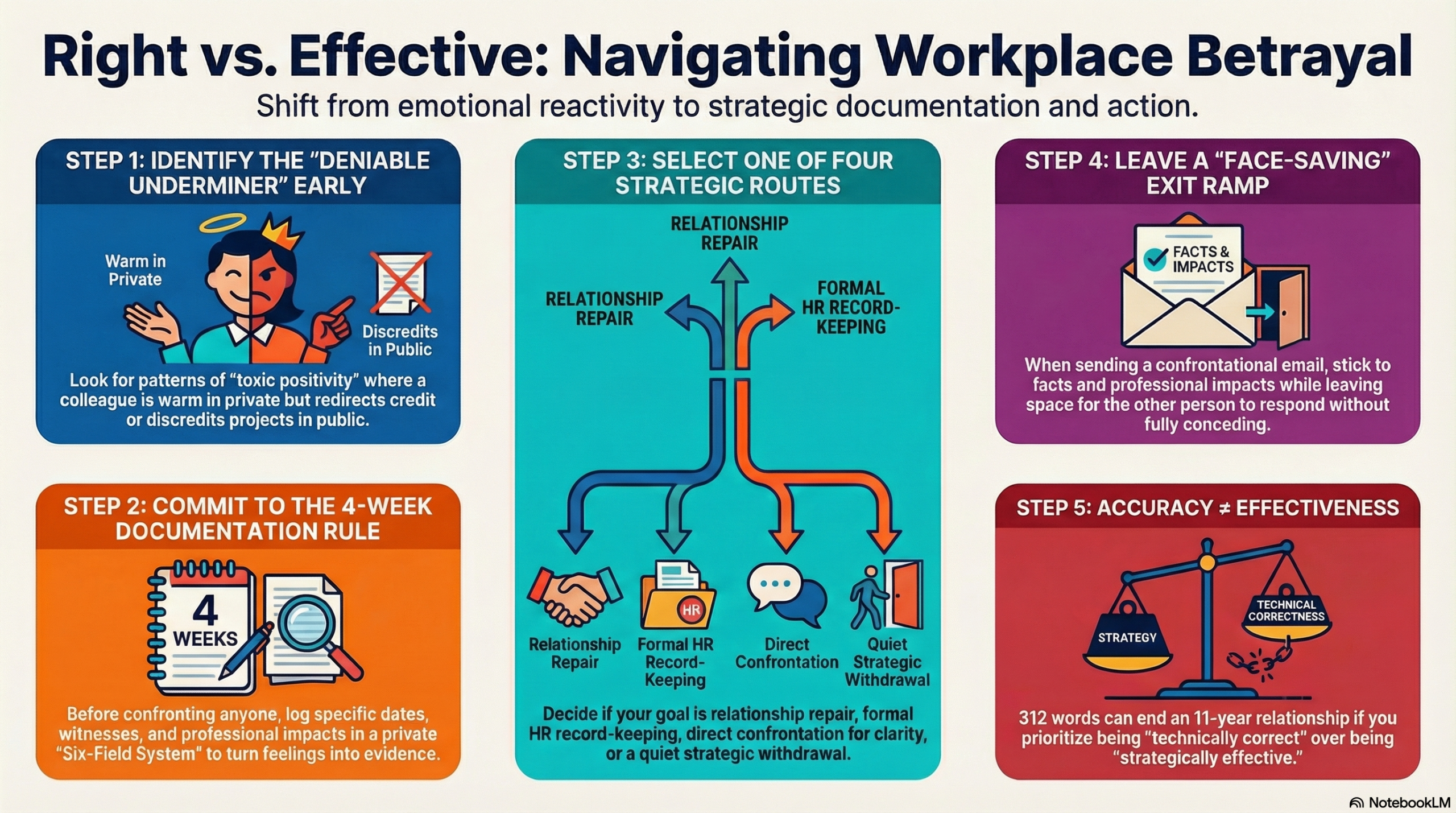
Give it at least four weeks. You are looking for a pattern. Four weeks of documentation will tell you more than acting on your suspicion today.
The discipline this requires is similar to the Three-Question Pause that smart professionals use before any high-stakes decision: slow the instinct, interrogate the evidence, then act deliberately. The reason most people skip this step is the same reason smart people make risky decisions — expertise and emotional investment both create pressure to act before the foundation is solid.
Step Two: Assess What You Are Actually Dealing With
Once you have four to six weeks of documentation, read it back as if you were reading about someone else’s situation. This is a critical step in learning how to handle workplace betrayal professionally — because emotional distance is what turns raw data into a clear assessment.
Ask yourself the following:
- Is there a consistent pattern, or do the incidents cluster around a specific project, period, or type of interaction?
- Is the behaviour consistent across different contexts — with you alone vs. in groups vs. in meetings with senior people?
- Is there a plausible alternative explanation that you have been too emotionally close to see? (Incompetence, pressure, a personal crisis in their life?)
- What is the impact on your work? On your reputation? On your relationships with other colleagues?
- Has the pattern escalated, plateaued, or reduced over the period you have been observing?
This is also the moment to consult someone you trust outside the organisation. Not for permission — for the psychological anchor. The analysis paralysis trap that affects senior professionals in high-stakes situations is real: the more capable you are, the more interpretations you can generate, and the harder it becomes to commit to one read of the situation. An external voice helps.
What you are ruling out at this stage is your own confirmation bias. If the pattern holds under scrutiny: proceed. If it is more ambiguous: hold and continue observing.
Step Three: How to Handle Workplace Betrayal Professionally — Deciding Your Objective
This is the step most people skip, and it is the one that determines whether the rest goes well or badly.
Before you confront the situation in any form, answer one question honestly: what outcome do I actually want?
The possible objectives are meaningfully different:
I want the behaviour to stop, and I want to preserve the relationship if possible. This calls for a direct, private, non-accusatory conversation — naming the impact of the behaviour without yet naming intent. You are giving the other person a route back before you close it.
I want the behaviour documented with HR or management, regardless of what happens to the relationship. This calls for a formal route — a meeting with your manager or HR, with your incident log as support.
I want to name what has happened clearly, even knowing it may end the relationship. This is the confrontation route — a direct statement of what you have observed, with specificity, leaving the other person to respond however they choose. It is the highest-risk, highest-clarity option.
I want to protect myself and disengage quietly. Sometimes the right answer is to stop trusting someone, rebuild your relationships with others in the organisation, and reduce your exposure without a confrontation.
None of these is categorically right or wrong when figuring out how to handle workplace betrayal professionally. The error is to proceed without having consciously chosen — which usually results in a confrontation that looks like option three but was intended to achieve option one. Career advice that actually holds up consistently returns to this: clarity of objective before action is the single variable that most separates effective from ineffective professional responses to difficult situations.
Step Four: Have the Conversation (If That Is What You Have Chosen)
If you have decided on a direct conversation — verbal or written — here are the principles that separate a productive confrontation from one that simply creates more chaos.
Be specific, not general. “I’ve felt undermined” is easy to deflect. “In the Meridian meeting on Tuesday, you changed the framing of my proposal without discussing it with me beforehand, and the result was that the client rejected it” is not.
Name the impact, not just the incident. What did this cost you professionally? What was the consequence? This is not about escalating the emotional temperature — it is about establishing that what happened was not minor interpersonal friction but something with real professional stakes.
Name what you need going forward. A confrontation without a clear statement of what you need from the other person is venting, not communication.
Be prepared for silence. Some people, when confronted with a clear and documented account of their behaviour, simply withdraw. This is its own kind of answer.
The Decision-Making Implementation Pack includes a dedicated framework for exactly this kind of high-stakes professional confrontation — including a pre-mortem for what can go wrong, a script for the conversation itself, and decision trees for each of the four response types you might receive. It grew directly out of the pattern of professionals who are accurate in their diagnosis but ineffective in their response because they conflated the two.
Step Five: Manage the Aftermath
Whatever form the confrontation takes, the aftermath will require active management. The professionals who handle workplace betrayal professionally are those who treat the recovery phase with the same deliberateness as the confrontation itself.
With your other colleagues: You do not need to explain what happened. You do need to continue showing up competently, and relationships will naturally recalibrate. If the other person is spreading their version of events, the most effective counter is your continued professional presence — not a rebuttal campaign.
With your own psychology: Professional betrayal has a specific emotional signature that does not match the scripts we have for other kinds of loss. No one sends flowers. You are expected to continue performing normally in a context that has fundamentally changed. Two years of recovery from one year of burnout is not unusual when the underlying dynamic has been sustained and unacknowledged — because you were managing something that had real psychological weight, even if you didn’t name it that way at the time.
With your work: The period immediately after a confrontation is the most important time to produce visible, high-quality output. Not because you have anything to prove, but because your professional reputation is the asset most worth protecting.
With your own clarity: The Clarity Mastery System was built specifically for the professional recalibration phase — when the dynamic that was consuming your energy is gone and you need to redirect that capacity into something productive. The five-module system covers strategic visibility, communication architecture, and the kind of deliberate positioning that makes excellent work visible to the people who need to see it.
The Role of Professional Development in Conflict Prevention
Most workplace betrayal dynamics escalate because the people involved lack the frameworks to either identify the pattern early or act on it effectively once they do. This is not a character problem — it is a skills and systems gap.
The MBA Alternative Reading Kit — free to download — is built around exactly this: the seven foundational books that give senior professionals the mental models to navigate ambiguity, power dynamics, and high-stakes decisions with greater clarity. It’s the curriculum. The Premium Implementation Pack is the toolbox on top of it.
Why your smartest employees make the riskiest decisions — and why the same dynamic applies to how we respond to betrayal — is something I’ve written about extensively on this site. The expertise that makes you good at your job creates the same cognitive biases that make it hardest to act well when a trusted relationship turns against you. Knowing the bias exists doesn’t automatically immunise you against it. That’s what frameworks are for.
A Note on What This Process Cannot Give You When Handling Workplace Betrayal Professionally
This guide on how to handle workplace betrayal professionally can help you act well. It cannot guarantee a good outcome.
The person who betrayed your trust may never acknowledge it. The relationship may end without resolution. The organisation may not respond the way you hoped. The confrontation may cost you more than staying silent would have, at least in the short term.
What the process above can give you is this: a clear conscience, a factual record, and the knowledge that you responded to a difficult situation with clarity rather than reactivity. The people who never struggle — who have never had to navigate a genuinely difficult professional dynamic — lack something that people who have been through this and come out the other side possess: a tested, calibrated sense of what they can absorb and how they want to show up under pressure.
Being right about what happened is not the point. What you do with that rightness is.
For the pre-mortem approach to professional decision-making — thinking through what can go wrong before you act — it remains the most underrated tool available to professionals in exactly this kind of situation.
Download: The Professional Conflict Playbook
If you are in the middle of this right now and need a practical tool to work through, the Professional Conflict Playbook covers the full process: a 19-point recognition checklist, a cognitive bias audit, a six-field incident log, a conflict decision architecture, a 20-point email checklist, conversation scripts, HR navigation guidance, reputation protection framework, and a post-conflict recovery timeline.
Download the Professional Conflict Playbook →
No cost. No sales pitch. Just the framework I wish I’d had.
For the personal account behind this framework — including the eleven-year professional friendship that ended at 11:04 AM on a Tuesday, and the 312-word email that caused it — read the full story on Medium →.