
A companion piece to I Got Replaced by ChatGPT — Then Rehired at Triple the Rate
Experience compounds or decays. The difference isn’t the years — it’s whether you know exactly what you’ve built.
The worst professional mistake I’ve made wasn’t a bad decision. It was describing myself wrong for a decade.
I was good at what I did. I knew it. The people around me knew it. But when I had to explain my value to someone who didn’t know me yet — a new client, a job panel, a restructured organisation deciding who stays — I reached for my job title, listed my responsibilities, and hoped the CV would do the rest.
It didn’t. Not reliably. And the times it failed were always the times it most needed to work.
That pattern is not rare. It is, in my experience, almost universal among people with ten to twenty years behind them. The skills are real. Nobody has built the language to describe them yet.
This article is the audit I wish I’d had. If you want the full scored version — with positioning profiles, case study templates, and a structured 30-day repositioning plan — the complete Human Premium Framework is available here as a free download. What follows is the thinking behind it.
Why Mid-Career Is the Most Dangerous Moment to Be Vague
Junior professionals get a pass on vagueness. They’re defined by potential. Senior executives get a pass because the title does the heavy lifting.
Mid-career is the gap in the middle where neither is true. (On the line between career momentum and career damage.)
You’re too experienced to lead with potential, and too far from the top to let the letterhead speak for you. You have to make the case yourself — clearly, specifically, and in terms that connect your past to someone else’s problem. Most people at this stage describe themselves by function:
“I lead operations.”
“I manage product teams.”
“I run communications.”
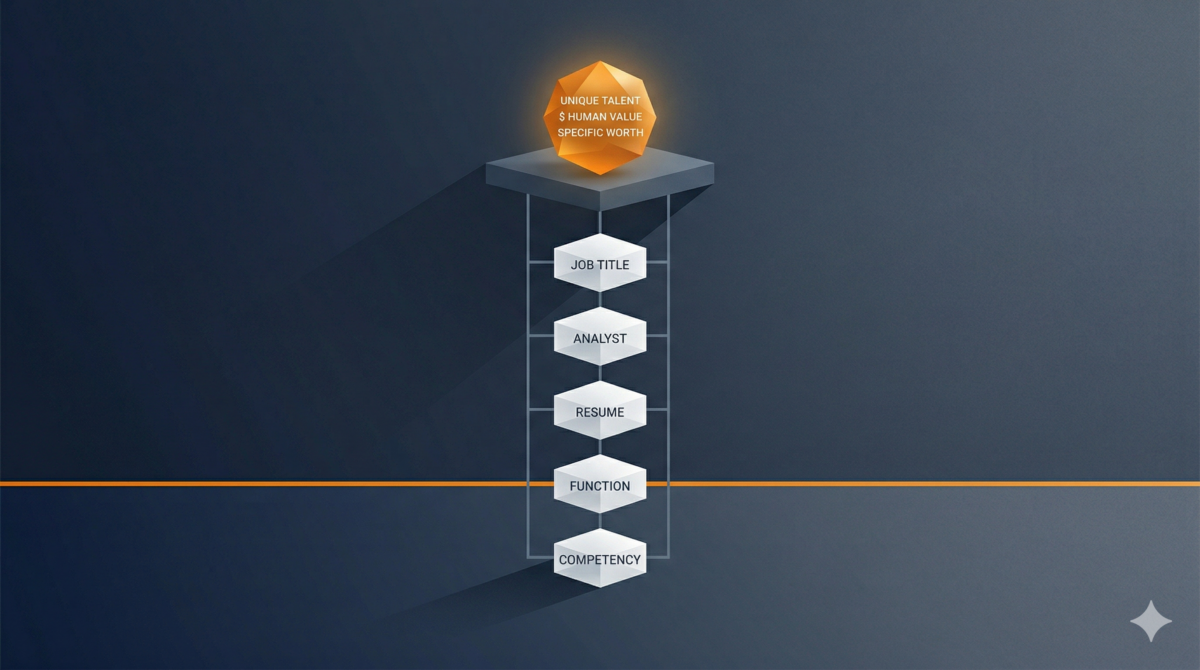
These are not value propositions. They are job descriptions. And job descriptions are, structurally, a list of things someone else can also do.
The question that actually matters — and that almost nobody answers cleanly — is: what happens that wouldn’t happen, or wouldn’t go right, without your specific judgment?
“The question isn’t what you do. It’s what collapses without you.” — A Fulcrum
The Four Things That Are Genuinely Yours
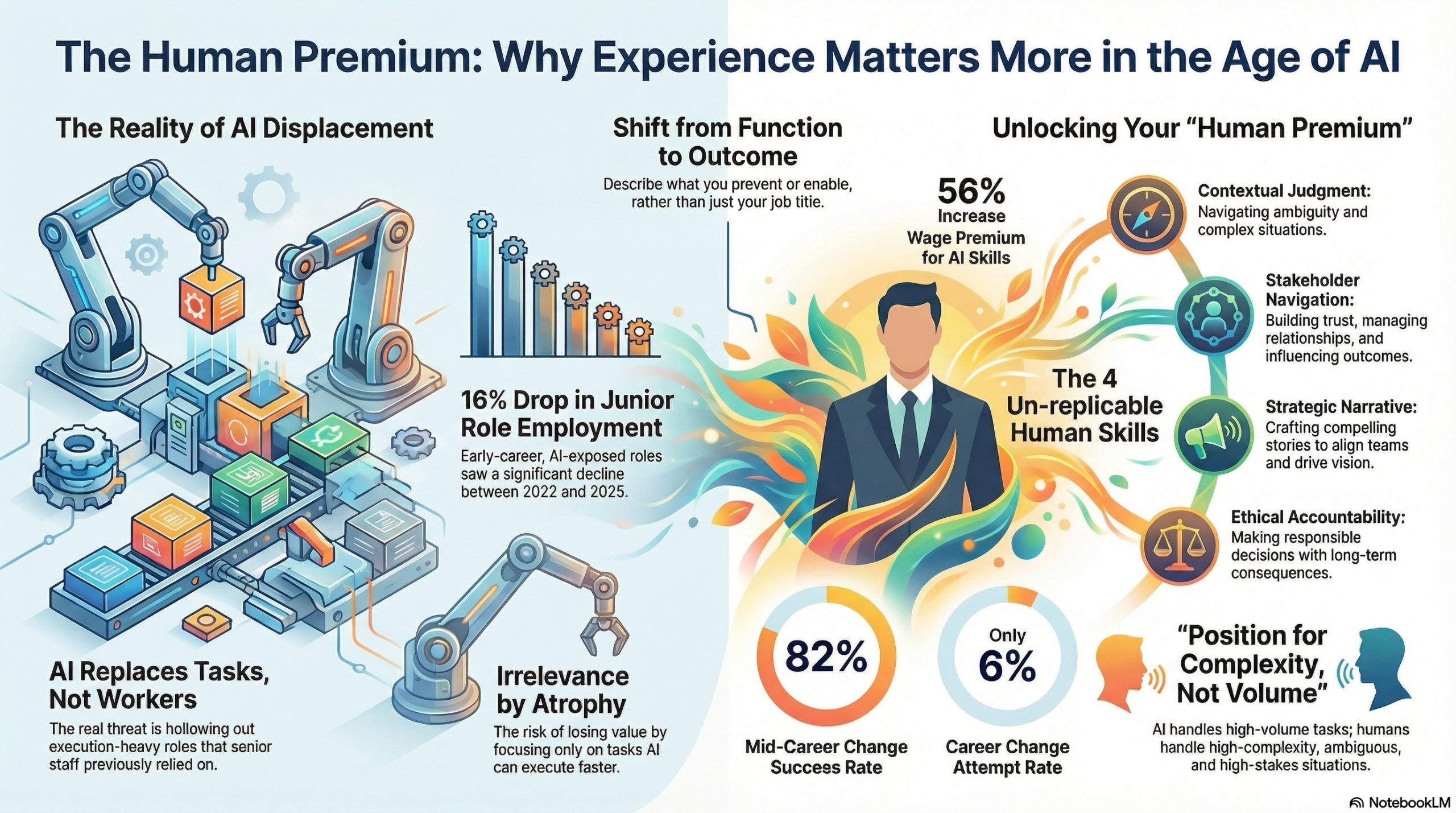
Experience accumulates in four forms. Most professionals consciously own one of them and have the others sitting unexamined.
1. Contextual Judgment Under Pressure
What it is: Not what to do when the situation is clear — anyone can handle clarity. The specific way you read an ambiguous situation, identify the constraint that isn’t obvious, and make a call that holds. (On why intelligence sometimes works against decisive action.) You build this from exposure to enough failures that the pattern-matching becomes instinctive. You cannot inherit it or accelerate it. It takes time. It is therefore rare.
The signal that you have it: colleagues consistently ask for your read on ambiguous situations rather than looking the answer up or asking someone more junior. (See also: The 3-Question Pause That Saves Careers.)
2. Stakeholder Navigation
What it is: Reading a room. Managing a decision-maker who has publicly committed to a position they’re wrong about. Holding trust across functions that are in conflict. This looks like a soft skill from the outside. From the inside, it is highly technical — a set of moves developed through repetition in high-stakes situations. Most people who have it don’t realise they’re doing something others simply cannot.
The signal that you have it: you’re brought into difficult conversations not to deliver information, but to manage the dynamic. (On what this skill looks like when AI enters the team.)
3. Strategic Narrative Construction
What it is: The ability to take genuinely complex, contradictory, politically loaded reality and build a story coherent enough that other people can act on it. Not spin — clarity. This is what boards pay for. It is what restructures turn on. It is almost always a mid-career skill, not a junior or executive one.
The signal that you have it: you’re asked to explain complex situations to senior audiences, or to make the case for decisions that other people struggle to articulate.
4. Ethical Accountability Under Social Pressure
What it is: Being the person who says “we can’t do this” — and being right, and being trusted enough that the room pauses. (Why the most competent people are often the last to be noticed doing this.) This requires scar tissue. It requires having been in situations where the stakes were real and the pressure was genuine. You cannot manufacture it, and you cannot document it on a CV. But clients and organisations feel its absence immediately.
The signal that you have it: you have, at least once, been the person who prevented something significant — and been recognised for it, even informally, by someone with authority.
The Five Questions That Do the Audit
No workshop required. No career coach, no personality framework, no £400 assessment tool.
These five questions, answered honestly, will show you exactly what you have — and whether you’re currently being paid for it. In the full framework, you score each question 1–5 on a scale of specificity: from “I cannot answer this with any specific example” at one end, to “I can answer this precisely, with evidence, communicable to someone who doesn’t know me” at the other. Your total gives you a positioning profile. But even without the scoring, the questions themselves are the diagnostic.
The Five Audit Questions
One. In your last role, what decisions could only you make — ones that would have gone differently without your specific read of the situation?
Two. What do colleagues ask you that a capable junior hire couldn’t answer as well?
Three. What are the three most expensive mistakes you’ve prevented in your career, and what specifically allowed you to see them coming? (A structured method for thinking this through: How to Predict Failure Before It Happens.)
Four. When did your presence in a room change the outcome of a negotiation, a restructure, or a crisis?
Five. What would quietly degrade in your organisation if you disappeared for 30 days — not the work you do, but the things you hold together by being there?
The honest answers to those five questions are not your job title. (The Career Framework for People Who Outgrow Their Roles takes these questions into a practical positioning structure.) They are not your technical qualifications. They are the precise, difficult-to-name things that are genuinely irreplaceable about you — and they are the foundation of a positioning statement that actually commands a price.
The full Human Premium Framework scores each answer and maps your total onto one of four profiles: the Unlabelled Expert (your value is real but your language is borrowed), the Partially Positioned Professional (you land well with people who already know you, but not reliably with strangers), the Premium Ready (your language is specific enough to be credible but not yet sharp enough to hold a number), and the Human Premium (the full stack — clarity, evidence, and language precise enough to price). Each profile comes with its own 30-day focus. The scored version is free — it takes about ten minutes to complete.
Why the Reskilling Conversation Is Mostly a Distraction
There is a large and well-funded industry built on the idea that mid-career professionals need to be retrained. Most of its output isn’t wrong — but it answers the wrong question. (Your Job Isn’t Disappearing Because of AI. It’s Disappearing Because of This.)
Reskilling assumes the problem is a capability gap. In my experience, it rarely is. The problem is a positioning gap. (This is the same argument made from personal experience in I Got Replaced by ChatGPT — Then Rehired at Triple the Rate, which covers the moment of displacement and what came after.) Your skills are already there. You simply haven’t built the language to articulate them, price them, and direct them at the right problems yet.
Deloitte research suggests learners lose 70% of training knowledge within 24 hours without reinforcement. This is not an argument against learning. It is an argument against treating an expensive course as a substitute for understanding what you already have.
The figure worth sitting with: 82% of career changers over 45 succeed. Only 6% make the attempt. The gap between those numbers is not capability. It is the false belief that experience has been devalued — when in most cases it has simply been mislabelled by the person who holds it.
How to Stop Describing Yourself by Function
The shift from function language to outcome language is uncomfortable because it requires specificity that feels like exposure.
“I’m a quality director” is safe. It’s also invisible. (Related: The Silent Divider Between Career Momentum and Career Damage.)
“I prevent decisions that destroy regulated products and the careers attached to them” is not the same job. One is a function. The other is a value proposition with a price tag on it.
The practical movement is straightforward, even if it’s slow:
- Stop using function language in your bio, your introductions, and your proposals.
- Start describing the outcomes your judgment produces.
- Quantify what a bad decision in your domain actually costs — in time, money, reputational damage — and make that number part of how you talk about your work.
- Position for complexity, not volume.
- Build your case studies using this structure: the situation, what you saw that others didn’t, and what happened because you saw it.
That last structure is the one. Here is what it looks like across three different industries — drawn from the worked examples in the full framework.
Three Real-World Transformations
The HR Director
Before:
“I lead the HR function and manage a team of twelve across recruitment, L&D, and employee relations.”
After:
“I prevent the conditions that produce employment tribunals, regulatory action, and cultural attrition — by identifying the management behaviours that create them before they set.”
- Situation: A high-performing sales director had been generating complaints for eighteen months. HR had logged them. Legal had reviewed them. Nobody had taken action because his numbers were exceptional and the business was mid-acquisition.
- What I saw: The complaint types weren’t interpersonal disputes. They were systematic boundary violations of a kind that, in my experience, tend to accelerate rather than stabilise under acquisition pressure. I also saw that the acquiring business had a different risk threshold and would not inherit this situation quietly.
- Outcome: I made the case to the CEO — not on the basis of existing complaints, but on the basis of what the acquisition would surface. The director left before completion. That acquisition then proceeded without the liability. The CEO told me it was the most commercially significant HR intervention of the year.
The Supply Chain Manager
Before:
“I oversee end-to-end supply chain operations for a £40M division.”
After:
“I identify supplier concentration risks before they become operational crises — specifically the kind that compound invisibly until a geopolitical event makes them visible at the worst possible moment.”
- Situation: The business had 64% of its critical component sourcing concentrated in a single country, with two primary suppliers who were also primary suppliers to each other’s competitors. The business had flagged this risk two years prior and deprioritised it due to cost pressure.
- What I saw: I mapped the actual dependency chain rather than the nominal supplier list and found we had effectively one point of failure dressed as three. I also identified that a geopolitical development in the region — which our commercial team was tracking for different reasons — was likely to tighten export controls within 18 months.
- Outcome: I proposed and built a dual-source programme over nine months. Fourteen months later, the export controls came in. Three competitors experienced 6–10 week supply interruptions. We did not. The MD attributed £1.2M in protected revenue to the programme.
The Operations Director
Before:
“I’m responsible for operational efficiency across three business units.”
After:
“I reduce the cost of complexity in scaling businesses — specifically the operational drag that compounds invisibly in the gap between function heads and shows up in margin 12–18 months later.”
- Situation: A business scaling from £20M to £45M in three years had added headcount and process at pace but hadn’t updated its decision rights or cross-functional accountability structure. Leadership attributed the symptoms — margin erosion, missed delivery commitments — to market conditions.
- What I saw: I recognised the pattern from two prior businesses. The margin erosion wasn’t market-driven, it was friction-driven — specifically the cost of decisions that required three people to agree and were therefore either delayed or made twice. The delivery failures were a symptom of the same root cause.
- Outcome: I led a decision-rights redesign across three units over six months. Margin recovered 2.3 percentage points in the following two quarters. Delivery performance improved from 71% to 88% on-time.
That’s the human premium, described precisely enough to be priced. The full framework includes a case study template in this exact format — Situation / What I Saw / Outcome — with guidance on how to write yours, what to cut, and how to test whether it works with someone who doesn’t already believe in you. It’s part of the free download.

The 30-Day Plan
Most positioning advice stops at the diagnosis. The framework goes further: a four-week plan in which each week’s output is the raw material for the next.
Week 1 — Evidence Gathering: Work through the five audit questions in writing, speak to two colleagues who’ve seen you operate under pressure, and pull any written evidence from performance reviews or post-mortems. The output is an unfiltered record of every specific example you can find.
Week 2 — Language Construction: Identify your strongest Human Premium category, draft your outcome language statement, and test it with a trusted contact until the answer to “does this make you want to know more?” is yes.
Case Studies (Week 3): Select three examples from your Week 1 evidence and write each in the Situation / What I Saw / Outcome format, targeting 150–200 words per case study, until they work with people who don’t know you.
Deployment (Week 4): Update your bio, preparing positioned introductions for three specific upcoming contexts, having one deliberate conversation using your new language, and reviewing what landed and what to refine.
Thirty days. One focused 90-minute session per week, plus shorter follow-up time. The output is a positioning statement precise enough to hold a price.
The A Fulcrum Reading Stack
Five books. Each develops one or more of the four Human Premium categories directly. Not a general career booklist. These are books I’ve read more than once and returned to. Not books I was paid to mention.
So Good They Can’t Ignore You — Cal Newport Newport’s central argument — that passion follows mastery, not the reverse — is the intellectual foundation for the Human Premium framework. His concept of “career capital” maps directly onto contextual judgment and strategic narrative construction. The chapter on “control” as a career outcome is particularly useful for mid-career professionals weighing whether to stay or move. Develops: Contextual judgment; Strategic narrative construction.
On Strategic Thinking and Decision-Making
Good Strategy / Bad Strategy — Richard Rumelt The clearest account available of what strategy actually is, as distinct from what most organisations call strategy. Rumelt’s “kernel” framework — diagnosis, guiding policy, coherent actions — is a direct tool for building the kind of narrative that boards and leadership teams can act on. The chapter on bad strategy is a useful diagnostic for why your current positioning may not be landing. Develops: Strategic narrative construction.
A New Way to Think — Roger Martin Martin’s essays on management thinking are most useful for developing judgment and stakeholder navigation. His consistent argument — that most management tools optimise for the wrong thing because they were built for a context that no longer exists — is a direct prompt to examine your own judgment for the same blind spots. Develops: Contextual judgment; Stakeholder navigation.
On Negotiation and Stakeholder Skills
Let’s Get Real or Let’s Not Play — Mahan Khalsa & Randy Illig Positioned as a sales book, which undersells it. The most practical guide available to navigating decision-makers who have not yet decided, managing organisations that say they want change but are structurally resistant, and building the kind of trust that causes people to act on your judgment. The “intent” framework in Chapter 2 is worth the price alone. Develops: Stakeholder navigation.
Managing the Professional Service Firm — David Maister The definitive text on how professional expertise is priced, and why the best professionals command prices the market cannot easily justify. Maister’s analysis of the “trusted advisor” relationship is the clearest description of ethical accountability under social pressure available in print. Chapter 12, on the anatomy of a trusted relationship, is the starting point. Develops: Ethical accountability under social pressure.
If you want the full annotated reading list — including which chapters to start with for each Human Premium category — it’s included in the framework document alongside the Decision-Making Toolkit and the MBA Alternative Reading Kit.
What This Actually Requires
None of the above is technically difficult. The audit questions are not hard to understand.
What makes them hard is that answering them honestly requires you to look at your career as evidence rather than autobiography. It requires separating what you’ve done from what you’ve built — and then being specific enough about the latter that it can be communicated to someone who doesn’t already believe in you.
That specificity is the work. You need no course. No certification. No pivot.
Just a clear-eyed account of what you’ve actually become, and the willingness to say it plainly.
Read the Origin Story First
This framework grew out of a specific experience — being replaced by AI, then rehired at triple the rate. The full account of what happened, what I learned, and how I priced the transition is in the companion piece on Medium: I Got Replaced by ChatGPT — Then Rehired at Triple the Rate. If this audit is the framework, that piece is the evidence it came from.
One Question to Sit With
What’s one decision you made this year that required something genuinely yours — and have you been paid, positioned, or recognised for it in any way?
The Full Framework — With Coaching and Depth
The free download covers the audit and the positioning framework. If you want to go further — structured implementation support, the full case study library, and direct access — the complete Human Premium Positioning Framework is also available as a paid resource on Ko-Fi and Gumroad.
The complete Human Premium Positioning Framework — with the scored audit, four positioning profiles, case study templates, and the 30-day repositioning plan — is available free. If you want to go further, the Decision-Making Toolkit runs the same diagnostic logic with additional depth for high-stakes positioning decisions.
If this was useful, this is how you support independent writing that doesn’t carry advertising: ko-fi.com/afulcrum