
This is the companion piece to Your Brain Has a Creativity Mode. You’ve Been Accidentally Shutting It Off Every Day. on Medium. That article makes the case. This one gives you the implementation — including a downloadable 30-Day Cognitive Rest Tracker at the end.
There is a specific kind of professional emptiness that doesn’t announce itself as burnout.
It arrives quietly. You’re hitting your targets. Your inbox is managed. Your calendar is full of the right meetings. By every visible metric, you are performing.
But you sit down to write a proposal — or a strategy document, or even an email that requires a genuinely original response — and nothing comes. Not nothing dramatic. Just nothing that surprises you. Nothing you haven’t thought before.
Most people respond to this by consuming more input. More podcasts. More productivity books. More frameworks for doing things better and faster.
This is, neurologically speaking, the worst possible response. And this article will explain precisely why.
What you are experiencing is not a motivation problem, a discipline problem, or a focus problem. It is a Default Mode Network problem. And the solution is not more input. It is less.
Part One: The Neuroscience (Without the Hype)
What the Default Mode Network Actually Does
The Default Mode Network is a set of interconnected brain regions — primarily the medial prefrontal cortex, the posterior cingulate cortex, and the angular gyrus — that activate together when the brain is not engaged in directed external tasks.
For most of neuroscience’s history, this network was treated as noise: the brain idling between meaningful states. The assumption was that unfocused states were cognitively inert.
Two decades of research have comprehensively reversed that assumption.
The DMN is now understood to support the most sophisticated cognitive functions the brain performs — specifically the ones that cannot be replicated by AI tools, productivity systems, or structured focus sessions:
Cross-domain integration. The DMN draws connections between ideas stored in different memory systems — across domains, timeframes, and contexts that directed attention keeps in separate compartments. This is the mechanism behind the shower insight: the problem you’ve been pushing against for days resolves because the brain has been allowed to search its full associative database rather than the narrow slice activated by directed focus.
Mental simulation and scenario modelling. The DMN runs prospective simulations — imagining future scenarios, modelling other people’s responses, testing hypothetical outcomes before acting on them. These are the cognitive foundations of strategic planning, social intelligence, and ethical reasoning under uncertainty.
Memory consolidation and integration. The DMN processes autobiographical memory and integrates new experience into existing knowledge structures. Learning solidifies not during focused study, but in the spaces between it.
Metacognitive processing. The DMN supports the brain’s capacity to reflect on its own states — to ask not just “what is the answer?” but “what kind of problem is this, and am I the right person solving it in the right way?” This is one of the capacities AI cannot replicate. It requires the brain to model itself as an agent operating in a specific context with specific stakes.
None of these functions operate under cognitive load. The DMN and the brain’s task-positive networks are anti-correlated: when one activates, the other suppresses. This is the brain managing competing resource demands — not a flaw, but a fundamental architectural constraint.
The practical implication is direct and uncomfortable: every hour of constant cognitive input is an hour of suppressed cross-domain thinking, weakened scenario modelling, and disrupted memory integration.
These are not abstract costs. They show up as the inability to see patterns. The reluctance to commit to decisions under uncertainty. The gradual, near-invisible disappearance of ideas that genuinely surprise you.
The parallel with analysis paralysis is precise: a brain saturated with input cannot step back far enough to see the shape of the problem it is trying to solve. More information does not always produce better decisions — it often produces the reverse, a trap that catches the most experienced, high-functioning thinkers most severely.
Why Smartphones Structurally Destroyed This
The smartphone did not create the problem of insufficient cognitive rest. Before ubiquitous mobile connectivity, idle time was structurally enforced by circumstance: waiting rooms, commutes without entertainment, meals without screens. The brain received guaranteed DMN time, even for people who would not have chosen it voluntarily.
Mobile connectivity eliminated enforced idle time almost completely. Every gap is now fillable. Every transition mediatable by content.
This is not a moral failure — it is a rational response to an environment that made stimulation cheaper than silence. But the cognitive offloading that results — the externalisation of memory, attention, and judgment to devices and platforms — compounds the DMN suppression in a specific way: we are not just filling the gaps. We are training ourselves to find gaps intolerable.
And an intolerance for cognitive vacancy is, functionally, an intolerance for original thought.
Part Two: The Historical Evidence
Three People Who Understood This Without the Neuroscience
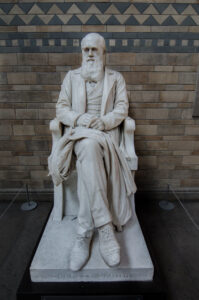
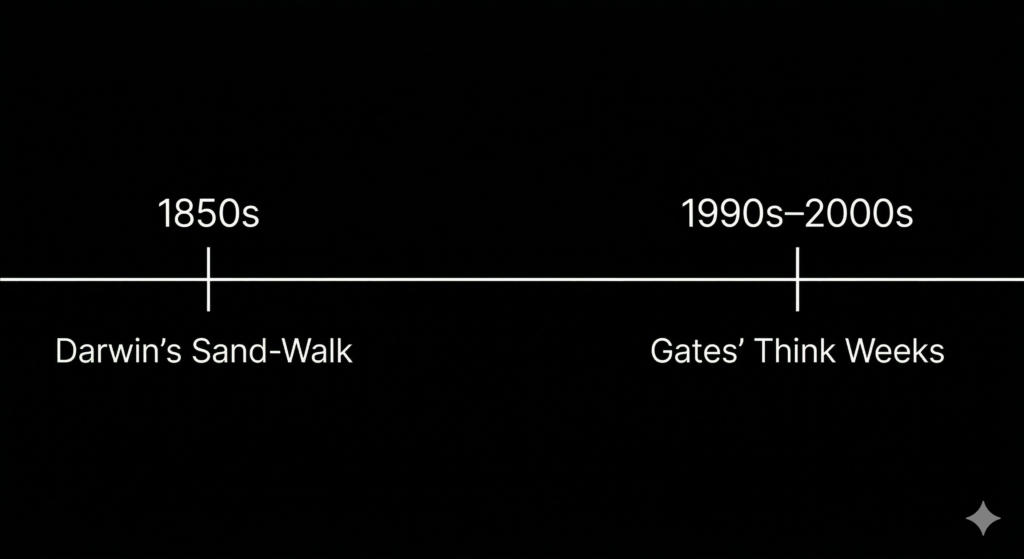
Darwin’s sand-walk. Charles Darwin maintained a 457-metre gravel path at Down House in Kent that he walked multiple times every afternoon, alone, without input. He used a system of flint stones to count circuits — one stone kicked aside per lap — so his body could maintain the habit without his mind needing to track it. His journals record the specific kinds of thoughts that arrived: lateral connections, unexpected reversals, moments when two ideas he had been holding separately suddenly resolved into a third thing he hadn’t anticipated.
The Origin of Species took twenty years from first hypothesis to publication. Much of that time was walking.
 Gates’ Think Weeks. Bill Gates maintained biannual retreats throughout his years running Microsoft — a remote cabin, paper documents, no staff, no internet. The pattern produced several of the company’s most significant strategic decisions, including the 1995 “Internet Tidal Wave” memo that reoriented the company’s entire product architecture. The mechanism Gates consistently describes: the first days are consolidation. The thinking that matters arrives later, when the brain has been quiet long enough to connect things it didn’t expect to connect.
Seneca’s otium. The Roman Stoics practised otium — structured vacancy — not as the opposite of productive work, but as its cognitive precondition. “Retire into yourself as much as possible,” Seneca wrote in his Letters. Not as escape, but as a return to the mental state that makes good judgment possible.
Pre-mortem analysis — Kahneman’s method of examining decisions before they’re finalised by imagining they’ve already failed and working backward — is a structured version of this capacity. Both require cognitive vacancy. Neither is accessible under full cognitive load.
The common thread across all three is not personality or privilege. It is the deliberate protection of unstructured cognitive space against the immediate pressures that would otherwise fill it.
Part Three: The Protocol
Why This Works, and Why Thirty Days
The protocol below is designed to move you through four neurologically distinct phases:
Days 1–7: Withdrawal. The discomfort of unfilled time. The brain, trained to expect constant input, generates restlessness and mild anxiety in its absence. This is not failure. This is the suppression signal — evidence of how thoroughly the pattern has been internalised.
Days 8–16: Adaptation. The DMN begins running with less interference. Ideas start arriving that were not consciously summoned. The walk feels different. The silence becomes more tolerable.
Days 17–23: Integration. The abstract neuroscience becomes personally legible. You begin tracing specific professional insights back to specific moments of vacancy. This is your data.
Days 24–30: Refinement. You decide what continues. You design the architecture.
The combined daily time commitment is under one hour. What it requires is not time — it is protection.
The Three Core Practices
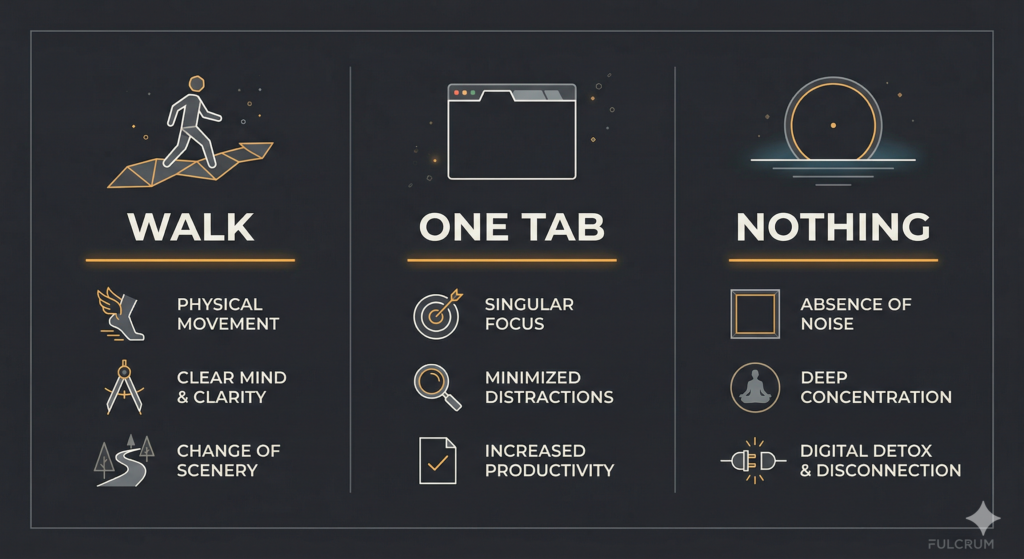
Practice 1: The Untethered Walk (20 minutes daily)
Walk outside. Leave the phone at home — not silenced, not face-down in your pocket. Left at home.
This is not optional. Research from the University of Texas confirms that the mere presence of a smartphone — face-down, switched off — partially occupies working memory. The awareness of a device’s potential for input is enough to suppress the DMN. The phone must be absent, not quieted.
No audio content. No destination requirement. No step-count target. Walk without receiving anything.
The physical movement is incidental — what matters is sustained motion without directed attention. This combination reliably activates the DMN. The mechanism is consistent across the research literature.
What to expect: Days 1–7, the walk feels wrong. Unproductive. Slightly guilty. Around days 9–11, it begins to feel different — less effortful, more generative. Ideas arrive that you did not produce consciously. Note them when you return home, not during the walk.
Practice 2: The One-Tab Rule (2 hours daily)
A defined two-hour window — any two hours, not your most productive ones — during which only one browser window is open. Not minimised. Closed.
This is not a deep-work session. You are not trying to maximise focused output. You are eliminating the cognitive background noise of anticipatory task-switching — the low-level attention drain of knowing that five other tabs are open and potentially requiring your response.
Research on task-switching shows that the anticipation of switching (not just the switching itself) maintains a partial allocation of attention to potential interruptions, even when you are not actively switching. The One-Tab Rule eliminates this background drain.
What to expect: Within the first week, tasks that normally take longer complete more quickly. The mechanism is not increased focus — it is reduced interruption overhead.
Practice 3: Scheduled Nothing (30 minutes daily)
Thirty minutes on your calendar. Blocked with a title that signals importance — “Strategy,” “Research,” “Development.” Not “Do Nothing.” No agenda, no task, no device. If you feel compelled to do something during the session: stare at the wall.
This is not meditation. Meditation involves directed attention toward a specific object — breath, sensation, mantra. This practice is undirected. It is deliberate cognitive vacancy.
The hardest part: The first week, thirty minutes of deliberately doing nothing will feel like an inefficient waste of time. Sit with that discomfort carefully. The professionals who look busiest are not always the ones making the best decisions — the ones who produce the most durable work are often those who have protected the space to think before acting.
No journaling during the session. No planning. If thoughts arrive, let them arrive. Note them immediately after — not during.
The 30-Day Tracking Framework
→ Download the 30-Day Cognitive Rest Tracker — a comprehensive fillable PDF workbook with daily diagnostics, weekly reflection prompts, an insight log, and your end-of-month review worksheet. This is the tool this protocol requires. It took longer to build than the article.
If you want to track the protocol without the workbook, the minimum daily log is:
Week 1 (Days 1–7) — Daily questions:
- Untethered Walk completed? (Y / N / Partial)
- One-Tab Window completed? (Y / N / Partial)
- Scheduled Nothing completed? (Y / N / Partial)
- Decision quality today, 1–10. (Quality of thinking behind decisions — not task volume.)
- One idea or connection that arrived today that you did not consciously produce. If none: what did the absence tell you?
Week 2 (Days 8–16) — Add: 6. One thing you noticed today that you wouldn’t have noticed two weeks ago. Be specific. 7. Originality of your thinking today, 1–10. (Were ideas familiar pattern-matches, or did something genuinely new arrive?)
Week 3 (Days 17–23) — Add: 8. Did an insight arrive during unstructured time that you acted on professionally? Describe the context — which practice preceded it, what the conditions were.
Week 4 (Days 24–30) — Add: 9. Which practices will you continue permanently? What adjustments will you make? 10. Decision quality this month vs. last month, 1–10.
The end-of-month review: Set aside 45 minutes on day 30. Review the tracker in full. Look for three things:
- Is there a correlation between days with all three practices completed and higher decision quality ratings?
- Which practice produced the most unexpected insights?
- What was the weekly time cost of the protocol? (Most people find it is 3–4 hours per week — less than the average person spends on social media per day.)
Part Four: Common Obstacles (Answered Directly)
“I can’t justify 30 minutes of doing nothing when my workload is this heavy.”
The 30 minutes would not otherwise be 30 minutes of productive output. It would be task-switching that produces the feeling of productivity without the substance. The Scheduled Nothing does not cost you productive time. It costs you the illusion of productive time — which is different.
“My mind won’t stop racing during the walks and Nothing sessions.”
Good. A racing mind during enforced vacancy is a symptom of DMN suppression, not evidence the practice isn’t working. The protocol does not require you to stop the racing. It requires you to stop feeding it. The racing decreases by week two for most people.
“I tried something like this before and nothing happened.”
Two causes: duration was insufficient (fewer than 14 consecutive days rarely produces the adaptation phase), or the conditions were contaminated — phone in your pocket during the walk, journaling during the Nothing session. The conditions must be clean. A mildly quieter walk is not the same as an untethered walk.
“I feel guilty. Like I’m falling behind.”
Yes. This is worth examining carefully — the guilt response to unstructured time is a diagnostic signal, not a directive. It reveals how thoroughly the performative motion trap has been internalised. Note it. Do not act on it. Continue.
Part Five: Further Reading
The texts that underpin this framework, in the order I would read them:
On cognitive rest and the DMN: Rest: Why You Get More Done When You Work Less — Alex Soojung-Kim Pang. Rigorously researched, historically grounded, intellectually honest.
Hyperfocus — Chris Bailey. The most accessible treatment of attention management currently available, with serious engagement with unfocused thinking as a distinct productive mode.
On decision quality: Thinking, Fast and Slow — Daniel Kahneman. Foundational. If you haven’t read it in full, the MBA Alternative Reading Kit includes a guided reading structure that extracts the most practically applicable material without requiring all 500 pages. Available at Gumroad.
The Intelligence Trap — David Robson. The research on why high-functioning, intelligent people make systematically worse decisions under cognitive saturation. Directly relevant to everything above.
On Stoic frameworks: Letters from a Stoic — Seneca. Letter II specifically. On avoiding cognitive restlessness. Reads as if written for 2026.
The Uncomfortable Conclusion
The research, the history, and the protocol all converge on the same finding:
The conditions most knowledge workers maintain for their thinking are among the worst possible conditions for the quality of thinking they need.
The DMN is being suppressed. Cross-domain integration is being interrupted. The capacity for original thought is being traded, slowly and invisibly, for the feeling of being productive.
The most experienced professionals — those whose value rests on contextual judgment, exception handling, and the ability to think in ways that cannot be automated — have the most to lose from this pattern, and the most to gain from reversing it.
The 30-day protocol is a starting point. The goal is to reach day 30 with personal, first-hand evidence of what your thinking looks like when your brain is given adequate space — and to use that data to make a deliberate professional choice.
If you want the structured decision architecture for integrating these habits into a schedule with real delivery requirements, the Decision-Making Toolkit covers this in its Advanced module. It was built for serious professionals who have already optimised for speed and are now, finally, optimising for quality.
→ Download the 30-Day Cognitive Rest Tracker PDF workbook
Or subscribe below — monthly Fulcrum analysis, directly to your inbox.
☕ If this framework is useful to you, you can support the work at Ko-Fi.
What part of your schedule would you have to protect to run this for 30 days? That answer usually reveals more than the protocol itself.