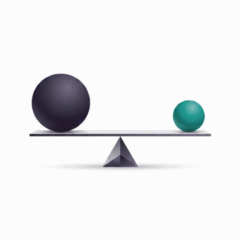
The fastest way to improve a system isn’t adding the right thing. It’s removing the wrong one.
This is the core principle of via negativa — and it may be the most powerful mental model for focus and productivity that most people have never applied.
When Steve Jobs returned to Apple in 1997, the company was forty days from bankruptcy.
He sat down with his team and looked at the product matrix.
Dozens of Macintosh models. Performa this. PowerMac that. Variants and sub-variants and limited editions, sprawling across a chart that nobody — including Apple’s own employees — fully understood.
Jobs walked to a whiteboard and drew a 2×2 grid.
Two rows: consumer, professional. Two columns: desktop, portable.
Four boxes. Four products.
He killed everything else.
Seventy percent of Apple’s product line — gone. Most of the engineers protested. Many of the doomed products were profitable. The decisions seemed insane.
The company was not failing because it had too few products. It was failing because it had too many.
Three years later, Apple was profitable again. Twenty years after that, it was worth more than most countries.
The most famous turnaround in modern business history was, in its bones, an act of subtraction.
Jobs didn’t add the iPod yet.
He removed the noise that was preventing it from existing.

The trap of additive thinking
The default response to any productivity problem in modern life is to add something.
Can’t focus? Add a Pomodoro app. Can’t sleep? Add a sleep tracker. Can’t write? Add a writing course. Can’t keep track of your tasks? Add a new task manager. (You will not, in fact, use this task manager. You’ll use it for three weeks and then, as a treat, add another one.)
Every “add” creates two costs you didn’t budget for: a setup tax (time to install, learn, integrate) and a maintenance tax (the lifetime cost of keeping it working alongside everything else).
As a result, we are trying to put out a fire by gently introducing more wood to it.
The deeper problem is conceptual. We frame productivity as a resource problem — I don’t have enough time, focus, energy, tools.
It is almost never a resource problem. It is almost always a friction problem.
The signal is plenty strong. It’s just buried under noise.
Via Negativa: the philosophy of subtraction
There’s an old idea, threaded through theology, philosophy, medicine, and risk management, called via negativa — the negative way.
The principle goes like this: we don’t actually know with certainty what makes things succeed. Success has a thousand causes, most of them invisible, many of them luck. However, we know with reasonable certainty what makes things fail.
Failure modes are easier to identify than success modes. Consequently, the highest-leverage move is usually not adding the right thing — it’s removing the wrong one.
“We know a lot more what is wrong than what is right.” — Nassim Nicholas Taleb, Antifragile
The doctor who advises a patient to quit smoking is doing more good than the one who prescribes another supplement. Similarly, the investor who avoids ruin outperforms the one chasing alpha. And the writer who cuts the bad sentences gets to the good ones faster than the writer who adds more clever ones.
The principle is older than capitalism. It shows up in apophatic theology (defining God by what God is not), in classical medicine (first, do no harm), and in Buddhist concepts of letting go.
For our purposes, the lesson is simpler:
You don’t have a focus problem. You have a noise problem disguised as a focus problem.
The biology fighting against you
Here’s a piece of cognitive science you need to know.
It’s called attention residue, from the work of researcher Sophie Leroy.
When you switch from one task to another — even briefly, even just to “quickly check” your email — a portion of your attention stays stuck on the previous task. Your body has moved on. Your brain, however, hasn’t.
You are now operating on partial cognitive bandwidth, and you don’t realize it. This is not a metaphor. It’s measurable.
Now stack this. If your workflow involves five tools, five inputs, five places where pings can arrive — your attention is permanently split into five smudgy slices. As a result, you never get to 100% on anything. You’re a CPU running at 22%, wondering why everything feels slow.
This is directly related to what researchers call the Default Mode Network — your brain’s creativity and deep-thinking system. As I explored in Why Being Productive Every Day Is Making You a Worse Thinker, the constant drive to stay busy actively suppresses the neural system responsible for your best ideas.
This is why subtracting tools doesn’t just feel cleaner — it produces measurably better cognitive performance. You’re not just eliminating distractions. You’re collecting up the residue and putting it back where it belongs.
If you want to go deeper on the neuroscience, the 30-Day Cognitive Rest Tracker is a structured protocol for rebuilding your brain’s capacity for original thinking — with a daily workbook and a Google Sheets dashboard built around exactly this research.
Willpower is a losing strategy
The advice you usually hear is: Be more disciplined. Just don’t check your phone. Just close the tab. Just resist.
This is rotten advice. It asks you to win an unwinnable fight.
Your phone is engineered, by some of the most talented designers on the planet, to be irresistible. It is bottomless, infinitely refreshing, perfectly tuned to your dopamine system. By contrast, you are a small, tired, slightly hungry mammal. The phone is a multi-billion-dollar machine optimized for your weakness.
You will not “just resist.” Some afternoons you’ll resist. Other afternoons the phone wins. And over a full year, the days the phone wins will be most of the days.
Via negativa productivity skips the willpower contest entirely.
Instead of fighting temptation, you remove its access to you:
You don’t need to ignore your phone. You need to put your phone in another room.
You don’t need to resist Slack. You need to quit Slack.
You don’t need to avoid the news. You need to delete the bookmark.
Subtraction is a one-time decision. Willpower, on the other hand, is a daily war. You will lose the war. The decision will hold. Discipline is finite. Design is permanent.
The Subtracting Routine
Before you start your most important task, don’t ask the usual question (what do I need to be productive?). Ask the inverse:
What can I kill in the next 60 seconds that will make this easier?
Here’s a worked example — every morning, before I write:
First: Kill the tabs. Close every browser tab except the document I’m working in. Not “minimize.” Close.
Next: Kill the noise. No music with words. No “lo-fi study beats.” No podcast in the background. The brain is a pattern-finding machine; if you pipe in patterns, it works on those instead of yours.
Then: Kill the options. Decide, before you start, exactly what the next 60 minutes is for. Not “writing.” Not even “writing the article.” Specifically: the first three sections of this article.
Finally: Kill the phone. Different room. Face down. Airplane mode. Yes, all of it. And no, the watch doesn’t help — that’s just a smaller phone.
The whole ritual takes about ninety seconds. It will save you several hours.

The paradox of constraint
There’s a piece of this that surprises almost everyone who tries it: working with fewer options is more enjoyable, not less.
We tell ourselves we want freedom — more tools, more choices, more tabs. We believe, on some half-conscious level, that the optionality itself is the prize.
It isn’t. The optionality is the trap.
Psychologists have a term for this — choice overload — and the research is by now exhaustive. People given too many options choose worse, choose later, or fail to choose at all. Moreover, the same dynamic plays out in your daily work. With fifty productivity tools, you spend forty minutes choosing how to start. With one notebook and one task, you have nothing to do but begin.
Constraint is not the enemy of focus. It is the substrate of focus.
Furthermore, every great work in human history was made under conditions of severe constraint — limited time, limited tools, limited information. You will not focus harder by giving yourself more freedom. You will focus harder by giving yourself less to manage.
This connects directly to what I explore in The Analysis Paralysis Trap: the brain doesn’t perform better with more options — it seizes up. Removing choices is, paradoxically, a form of cognitive generosity to yourself.
What you’re actually trying to find
There’s a quote often attributed (somewhat dubiously) to Michelangelo, about how he sculpted David: he simply removed everything from the marble that wasn’t David.
Whether or not he ever said it, the idea is correct.
The focus is already there. So is the flow state. The capacity to think long, hard, original thoughts has never left you. None of these things need to be acquired. They have to be uncovered.
Every app you delete, every meeting you cancel, every notification you mute is a chip of marble falling away from the figure underneath. The figure was always there. You were simply busy adding more marble.
The takeaway
Stop looking for the secret to focus.
There is no secret. There is no perfect app, no perfect routine, no perfect supplement that unlocks the deep, sustained concentration you remember being capable of as a kid. As a result, focus is not something you find.
It’s what’s left when you’ve removed everything else.
Close the tab. Quit the tool. Delete the app. Cancel the meeting. Walk the phone into a different room.
Then sit down, in the silence you’ve made, and notice what your mind has been waiting to do.
Want to put this into practice? The 30-Day Cognitive Rest Tracker gives you a structured 30-day protocol — with daily worksheets, a decision-quality scoring guide, and a Google Sheets dashboard — to systematically rebuild your brain’s capacity for deep thinking. Start from $5 on Ko-Fi.
If this resonated, you might also enjoy: Why Being Productive Every Day Is Making You a Worse Thinker and Your Brain Has a Creativity Mode. You’ve Been Accidentally Shutting It Off Every Day.
P.S. This essay was written in a single 60-minute session. Phone in another room. One tab open. No music. The result is shorter and clearer than it would have been otherwise. The method is the message.