
Watch the short companion video on YouTube, or read on for the full essay. This piece also lives on Medium.
I used to be a proud member of the 5 AM club. At 11:43 PM on a Tuesday, I was answering emails that could have waited until Thursday. Not one of them was actual work.
11:43 PM. Tuesday. I was hunched over a laptop in a dark kitchen, the harsh blue light illuminating my exhausted face as I replied to an endless, sprawling thread about a slide deck that nobody in the history of our company would ever open.
My chest was tight with that specific, vibrating anxiety familiar to anyone who works in the modern knowledge economy. I had been at it for twelve solid hours, and I felt absolutely nothing that resembled achievement. I didn’t feel productive. I didn’t feel essential. I felt caught in a machine of my own making, pedaling furiously just to keep the lights on.
As far as the internet was concerned, I was doing it perfectly.
The alarm was set for 5:00 AM. I took the cold showers. I had a morning routine with a snappy name and its own hashtag. I had absorbed enough LinkedIn “grindset” content, enough podcasts about biohacking my productivity, and enough TED talks about grit to recite them in my sleep. Which was convenient, because I was barely getting any. I was the poster child for modern hustle culture, perfectly optimized for maximum output.
And yet, I was going backwards.
What eventually moved my career forward was not a new productivity system, a complex Notion template, or a highly regimented morning routine. It was a Roman politician who advised an emperor who later ordered him to die. A man who spent his working life arguing a deeply uncomfortable truth that cuts through every modern productivity hack on the market: the busiest people alive are also the laziest.
Nobody is stealing your time. You are handing it over, in small, polite, calendar-sized increments, to people who never even asked for it.
The Busiest People You Know Are the Laziest (And a Roman Proved It)

Seneca was one of the richest men in Rome. As the tutor, and later the core advisor, to the volatile Emperor Nero, he knew the complex machinery of looking important from the absolute inside of it. He lived in a world of endless social obligations, morning greetings, political favors, and performative busyness.
Crucially, he also knew exactly what that machinery cost a human soul.
In his essay On the Shortness of Life, Seneca uses a phrase that has been rattling around my head for two years: desidiosa occupatio.
Busy idleness. Occupation without work.
He is describing people whose calendars are blocked solid from 8:00 AM to 6:00 PM, whose days are utterly consumed by meetings, and whose professional lives amount to almost nothing. Why? Because every single hour was spent on something that felt urgent but produced absolutely nothing of lasting value.
His argument is blunt, timeless, and humiliatingly accurate for the modern remote worker. We guard our money with paranoid care. We will aggressively defend a parking space. We lock our doors, check our bank balances, and negotiate our salaries to the final dollar. Then, we turn around and give away the only genuinely non-renewable asset we own—our time—to literally anyone who sends a calendar invite. We let a blinking cursor or a Slack notification dictate the rhythm of our brief lives.
I read that essay and thought about my Tuesday night in the dark kitchen.
The twelve hours of exhaustion were real. The tightness in my chest was a physiological fact. But when I sat back, closed my laptop, and tried to specifically name what I had produced that day, the list was embarrassing. I could name three things: a minor formatting adjustment to a slide, a passive-aggressive reply to a convoluted email thread, and a status update in a project management tool.
Nobody used any of them. I was the living, breathing embodiment of busy idleness.
The Trap of “Proof-of-Effort”
If you look closely at your week, you will likely find a terrifying truth: half of your working hours produce nothing except evidence that you were working. I have started calling this phenomenon proof-of-effort.
Proof-of-effort is any task whose only real deliverable is proof that you were trying.
-
It is the status update meeting that changes no strategic decision.
-
It is the 40-page pitch deck rebuilt from scratch for a catch-up meeting that gets cancelled anyway.
-
It is the reply-all at 11:43 PM whose actual content is not information, but a desperate, flashing signal to your boss: I am here, I am awake, I am one of the good ones, please do not lay me off.
It looks exactly like work. Honestly, it feels harder than work, because actual work has an endpoint. You write the code, you design the graphic, you close the sale, and it is done. Proof-of-effort does not have an endpoint. It is a bottomless pit of corporate anxiety, and it is the single largest line item in most professional weeks.
Once you have a name for this, you cannot unsee it. You start noticing the colleague who narrates his impossibly heavy workload in every morning standup but ships absolutely nothing for an entire quarter. Worse, you start noticing yourself doing a smaller, more embarrassed version of the exact same thing when you feel insecure about your performance.
Measuring the Wake vs. Measuring the Position
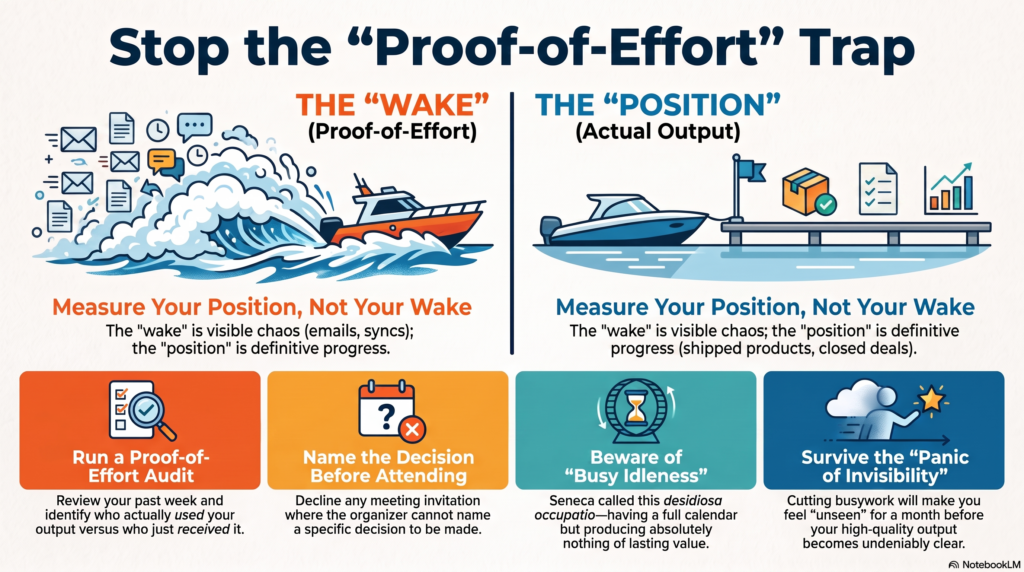
You can measure a ship in two ways: by the wake it leaves behind, or by its actual position on the map.
| The Wake (Proof-of-Effort) | The Position (Actual Output) |
| Visually loud, turbulent, and chaotic. | Quiet, definitive, and easily measurable. |
| Slack messages, CC’d emails, endless syncs. | Shipped products, closed deals, finalized decisions. |
| Requires constant, frantic motion to maintain. | Remains valuable even when you log off for the day. |
| Promotes exhaustion as a badge of honor. | Promotes leverage, clarity, and sustainable pacing. |
Hustle culture exclusively measures the wake. It measures the churn behind you, the visible disturbance in the water, the froth. The 5 AM Club sells you a bigger wake. Every productivity influencer standing in front of a whiteboard on YouTube is selling you tools to generate more froth. None of them will tell you where the ship is actually going, because the wake is easier to photograph for Instagram.
Seniority is the exact point at which leadership stops measuring your wake and starts measuring your position. Most people never reach true seniority because they get so incredibly good at making froth that nobody ever thinks to check the map.
Doing Less Will Cost You (And Anyone Saying Otherwise is Lying)

Two weeks into taking Seneca’s advice seriously, I put it to the test: I declined a Thursday sync that had no agenda. I simply clicked “Decline” and went back to deep work.
The decision I was supposed to weigh in on got made without me. A colleague named Maya sent the meeting notes at six that evening. The summary was three lines long, and one of them quietly reversed a strategic direction I had spent a month building toward.
I sat with that email for a while. The honest version of this story is that I nearly broke. I hovered my mouse over the “Reply” button, ready to unleash a torrent of context and corrections. I nearly went right back to the hustle.
The online “withdrawal narrative” of quitting the grind is always portrayed as very clean—you set a boundary, people immediately respect it, the heavens open, and you have time to do yoga in the middle of the afternoon.
My situation was not clean. It was messy and stressful. Every self-help essay you have ever read about doing less skips this part, because the part where boundary-setting immediately backfires does not fit the hero’s arc. Sometimes, when you step back, things fall apart.
But instead of panicking and reverting to my old habits of micro-management and over-attendance, I changed the nature of the request going forward. I stopped asking to be invited to meetings, and started asking what decision the meeting would produce.
-
If nobody could name a decision, I did not go.
-
If somebody could name one, I went, and I went armed with a position already written down.
The meetings I attend now are far fewer, and considerably more dangerous. I am no longer there to passively absorb information or generate froth; I am there to steer the ship.
The 3 Practices That Actually Moved My Career
Forget the 5 AM alarm. Plunging into an ice bath at dawn won’t save you from a bloated calendar, and writing in a gratitude journal won’t stop your manager from pinging you at midnight.
Here are the three practices that actually moved the needle. Be warned: each of these will cost you social comfort before they pay you anything in career capital.
1. Run a “Proof-of-Effort” Audit
Open your calendar and your ‘Sent’ folder for the last seven days. Next to every single item, write the name of the person who actually used the output of that hour.
Notice I didn’t say who received it. Who used it to make a decision, advance a project, or generate revenue?
When I first did this, most of my week came back completely blank. That blank column is a terrifying mirror. It is your real workload, and it is the workload nobody in your company will ever ask you to stop doing. You have to stop it yourself. If an hour produces no usable output, ruthlessly cut it the following week.
If that blank column sounds familiar, that is exactly what the printable version of this audit is built to catch, and I go into the meeting-decline story in more depth in a discussion on Quora.
2. Name the Decision Before You Accept
Start replying to vague meeting requests with one polite, devastating question:
“Thanks for the invite. To make sure I’m prepared, what specific decision are we making in this block of time?”
Roughly a third of my meetings evaporated on contact with that question. The organizers realized they just wanted to chat, or brainstorm aloud, or spread the anxiety of a project across multiple people. The people who could answer the question clearly turned out to be the only people worth working with. Guard your calendar like it is your bank account.
3. Practice the Loss Before It Arrives (Praemeditatio Malorum)
Seneca called this praemeditatio malorum (the premeditation of evils), and it is the least comfortable of the three practices.
Spend five minutes, once a week, imagining the worst-case scenario. Assume your role is suddenly eliminated tomorrow. Assume your flagship project is cancelled due to budget cuts. Sit with that reality. Really feel the weight of it.
Then, write down what you would actually miss doing, as opposed to what you would miss being seen to do.
The gap between those two lists is the exact size of your proof-of-effort problem. This practice broke something open for me. I realized I wouldn’t have missed building a single slide deck or attending a single all-hands sync. I would have missed about four hours a week of genuine, quiet, strategic problem-solving—which was exactly the four hours I had been sacrificing to protect the endless stream of slide decks.
Calm Reads as Seniority (There is Nothing Mystical About It)
The person who gets promoted to the executive suite is rarely the person with the fullest calendar. It is almost never the person answering emails at 11:43 PM. It is the person whose output is legible without a voiceover narration.
If you have to constantly explain to your boss, your team, and your peers how hard you worked, your work is not speaking for itself. And work that does not speak for itself is usually just proof-of-effort wearing a corporate lanyard.
When you finally stop generating froth, two distinct things happen in sequence.
Month 1: The Panic of Invisibility
This phase is deeply unpleasant. For about a month, you feel entirely invisible. The dopamine hit of visible exertion—the ping of a late-night email, the instant gratification of a Slack reaction—is a real chemical addiction, and you will miss it. You will feel lazy. You will feel a creeping paranoia that you are falling behind, that your boss thinks you’re slacking off, that you are going to be fired. You have to endure this phase. Do not break.
Month 2: The Clarity of Output
Then the second thing happens. Because you are no longer kicking up sand, the water clears. The only things anyone can see are the things you actually shipped. And those things are unusually sharp, precisely because there is no chaotic wake obscuring them. Your signal-to-noise ratio becomes unmatched. You become known not for being busy, but for being effective. People start coming to you for answers, not for updates.
Nero eventually ordered Seneca to die. The man who wrote more clearly than anyone in the ancient world about the theft of time had his own time brutally taken by the volatile employer he had spent decades trying to manage. He knew the absolute risk of his position. He wrote the essays anyway, leaving behind a philosophy that outlived the emperor by two thousand years.
Last Tuesday, at 11:43 PM, I was asleep.
The slide deck eventually got built during normal working hours. The email thread resolved itself without my midnight intervention. Nobody emailed the next morning to ask where I had been.
For a few days, I found that genuinely humiliating. My ego was bruised by my own lack of indispensability. I was humiliated until I finally understood what it actually meant, and what Seneca had been trying to say all along:
Nobody had been watching in the first place.
That is the grand tragedy of the modern corporate grind. But if you are brave enough to accept it, it is also your ultimate release.
Further Reading:
If this piece landed with you, these two adjacent essays go deeper on the same exposed nerve:
-
Custody of the Call: Why nobody in the modern corporate structure teaches you how to own a final decision, and how to start claiming them.
-
Eating the Loss: The rare, painful leadership skill of absorbing a failure or a cost without passing the anxiety down to your team.
Watch the short version on YouTube Shorts, get the printable audit on Ko-fi, or join the discussion on Quora.