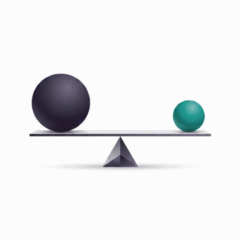

Borrowed gravity is the reason almost nobody read this page. I spent six weeks agonizing over a domain name.
I am not exaggerating for the sake of a relatable opening hook. I built a shortlist. I cross-referenced a spreadsheet of available top-level domains. I applied a weighted scoring system based on memorability, brevity, brand potential, and lack of hyphenation. I treated the process with the immense gravity of naming a firstborn child, rather than selecting a string of characters to house my thoughts on the internet.
Why this matters now: zero-click search for news queries just crossed 69%, up from 56% a year ago, the floor is giving way while most of us are still standing on it, wondering why the room went quiet. (I also posted a version of this piece on Medium, if that’s where you read.)
Then came the design phase. I tweaked the CSS variables until my eyes went dry and my vision physically blurred. I hunted for the exact, hyper-specific hex code of off-white that would subtly signal to readers that they had arrived somewhere important, somewhere curated. I colour-coded a six-month content calendar, meticulously mapping out a trajectory of essays that would firmly establish my authority in the space.
Finally, I hit publish on a flagship piece I was absolutely certain would land. I leaned back in my chair, cracked my knuckles, and waited for the internet to do what I had been told the internet was supposed to do. I waited for the traffic to roll in.
I got four visits that first week.
When I dug into the analytics dashboard, the server logs told an incredibly grim story. Three of those visits were automated scrapers—bots aimlessly crawling the web for data to index or steal. The fourth visit was me, refreshing the page from my phone on a cellular connection to check if the analytics script was actually working.
It wasn’t the writing. It wasn’t the typography or the off-white background, either, though I spent a good month telling myself it might be. Blaming the design gave me a tangible problem to solve, something I could fix by writing more code and pushing another update. But the problem was older, heavier, and far dumber than aesthetics or prose.
I had spent two months building a beautiful, bespoke house on a road that nobody drives down anymore.
The Fiction of 1989 and the Evacuation of the Open Web
“Build it, and they will come” is a line a ghost whispered to Kevin Costner in a cornfield. Somewhere along the way, the tech industry, the creator economy, and an entire generation of writers mistook Hollywood dialogue for a viable business plan.
For a decade, we were sold a very specific, very comforting story about digital independence. The formula went exactly like this: Build a lovely digital home you own outright. Write something true and deeply valuable. Tidy up your technical SEO, ensure your site loads fast, use the right keywords, and an audience will naturally, eventually find its way to your front door.
That isn’t a strategy. That is the plot of a 1989 baseball film, and it was fiction there, too.
The open web didn’t crash in a sudden, spectacular dot-com bubble burst. It emptied out quietly, one un-clicked search at a time. We keep referring to this lack of traffic as “obscurity,” treating it as a badge of indie-web integrity. We tell ourselves that being hard to find means we haven’t sold out to the algorithm.
But obscurity isn’t integrity. It’s just a room with the lights off.
The road to your standalone website didn’t just get quiet. It got actively, systematically evacuated. Look at the raw data surrounding how human beings currently navigate the internet. Similarweb tracks searches that end without a single click to an actual website—what the industry calls “zero-click searches.”
For news and information queries, that number climbed from 56% in May 2024 to 69% just a year later.
Why? Because Google stopped being a search engine and started acting as an answer engine. When the machine synthesizes the answer, extracts the value from your article, and pastes it at the very top of the page, the user’s journey ends before they ever see your carefully optimized headline or your perfect off-white background.
Organic traffic to major news sites slid from a peak above 2.3 billion visits down to under 1.7 billion in that exact same stretch of time. Business Insider watched more than half of its search traffic evaporate into thin air over three years, forcing them to lay off roughly a fifth of their staff.
These are not amateurs cobbling together a free WordPress theme on a Sunday afternoon. These are massive media machines with dedicated audience teams, endless budgets, and aggressive lawyers. They still got starved out of the open web.
So, I have to ask myself: what chance did my colour-coded spreadsheet ever really have?
The Physics of the Attention Economy

The realization that fundamentally changed my approach wasn’t about marketing tactics. It was about physics.
Attention behaves exactly like mass. The big platforms—the ones we all complain about but check compulsively—are enormous, supermassive objects. They bend the space around them so violently that a billion people fall into their orbit every single day without ever making a conscious decision to do so.
TikTok. LinkedIn. The iOS App Store. Amazon. X. Instagram.
Nobody wakes up and makes a deliberate, plotted choice to visit these places the way I chose my domain name. They don’t type the URLs into an address bar. They just pull their phones out of their pockets at a red light, or while lying in bed at 11:30 PM, and they fall in.
Your standalone website has the mass of a pebble in deep space. Nothing naturally falls toward it. You can spend an entire career exhausting yourself, trying to become a planet, trying to generate your own gravitational pull from absolute scratch.
Or, you can go into orbit around a massive object that already drags the whole crowd behind it.
I call this second move Borrowed Gravity. You stop trying to manufacture pull out of thin air, and you start standing exactly where the pull already exists.
“In an information-rich world, the wealth of information means a dearth of something else: a scarcity of whatever it is that information consumes. What information consumes is rather obvious: it consumes the attention of its recipients.” — Herbert Simon, 1971
Simon, an economist and Nobel laureate, saw this entire paradigm shift coming decades before the internet made it hurt. We built the entire indie-web dream in a bygone world where information was scarce and the act of publishing was the bottleneck. We now live in a world drowning in an infinite sludge of information, where publishing is trivial and getting reached is the only thing that actually matters.
The bottleneck moved. Borrowed gravity is simply the act of refusing to pretend it didn‘t.
What Borrowed Gravity Actually Looks Like

Theory is fine, but applying this requires completely dismantling the way you launch products, art, and writing. It means killing the instinct to hoard your best work on your own server.
1. Build the On-Ramp, Not the Destination
If you are writing code—a fitness tracker, a budgeting tool, a habit-building app—stop shipping it as a lonely web application that people have to be coaxed, bribed, and aggressively marketed into visiting.
App stores are where humans go when they have already made a psychological decision to do something. They open the App Store to track a habit, to split a restaurant bill, or to finally quit a doom-scrolling addiction. That is not casual browsing. That is high-level intent, backed by a credit card that is already authenticated and on file.
| The Destination Approach (Failing) | The On-Ramp Approach (Borrowed Gravity) |
| Hosting a web-app on an obscure URL. | Launching natively in the iOS/Android App Store. |
| Depending on SEO and blog posts for discovery. | Optimizing for App Store Search intent (“budget tracker”). |
| Forcing users to create a new account from scratch. | Leveraging Apple/Google single sign-on. |
| Hoping they pull out their credit card. | Utilizing frictionless in-app purchases. |
Putting your software in that ecosystem drops you onto the busiest pedestrian pavement in the city. Hosting it on your standalone site puts you three streets back, down a dark alley, behind a door with no sign, hoping someone wanders by with their wallet out.
2. Deliver the Blood and Guts in the Feed
The oldest reflex in digital publishing is the tease. You write a hook, drop a “link in bio,” and beg people to commute to your blog for the actual payoff.
They won’t do it.
Nobody wants to leave the feed. Nobody wants to click a link, wait for Safari to load, dismiss your newsletter pop-up, and accept your GDPR cookie banner just to read your thoughts. So stop splitting the value across two addresses. Put all of the value inside the platform and let the post itself be the product.
Make it dense, complete, and compelling enough that scrolling past it would cost them something. You didn’t click a vague teaser to end up reading this sentence. The entire argument is sitting right here, where your attention already happened to be.
3. Rent the Crowd Before You Build the House
Trying to sell physical or digital goods on your own Shopify store when you have zero audience is the equivalent of setting up a lemonade stand in the middle of the Sahara Desert.
Amazon, Etsy, Steam, the massive marketplaces—yes, they take a cut. Yes, their interfaces are clunky and heavily dictated by corporate interests. But they arrive with the one asset you cannot buy cheaply: millions of humans with their credit cards already saved and their consumer guard already down. You pay the fee, and you play by rules you didn’t write, because 80% of a pie people can actually find will always beat 100% of a pie sealed in a locked drawer.
The Landlord Problem
This is the part where you are allowed to be angry with me.
Borrowed gravity is rented gravity. And when you rent, the landlord has all the power. They can raise the rent, tweak the algorithm to throttle your reach, or completely delete your account between breakfast and lunch. You will have no recourse, no customer service line to call, and no forwarding address for the audience you spent years thinking was yours.
I know this. I have watched brilliant writers and creators with real, warm, dedicated followings get quietly de-prioritised into utter silence overnight, for no reason any engineer would ever explain. Platform risk is real, and it is the single strongest argument for owning your own patch of ground on the internet.
But look at what the alternative bought me: Six weeks. Four visits. Three robots.
Obscurity is not an insurance policy. Owning an empty island entirely outright is not safer than renting space on a crowded street. On my wholly-owned island, I was never at risk of being throttled by an algorithm, because I was never being seen in the first place.
That isn’t safety. That’s just a kinder, more palatable word for being invisible.
None of this is surrender. It is just physics. You have to stop pouring your one finite tank of energy into dragging people out of an orbit they have no wish to leave. You have to start laying your work directly in the path they are already travelling.
The Cornfield Stays Empty
I still have the website.
The domain I agonised over, the CSS I bled on, the editorial calendar colour-coded like a high-stakes hostage negotiation—all of it is still sitting on a server. I didn’t burn it down.
I just stopped treating it as a destination. I started treating it as the last room in a much longer house.
The crowd doesn’t arrive at my website first anymore. Nobody’s crowd does. But the handful of people who do reach it now reach it on purpose. They end up there because they met me somewhere else—somewhere with actual foot traffic, heavy gravity, and bright lights—and they made a conscious decision to follow me home.
Four visits a week used to feel like a crushing failure of my abilities. Now, I understand it was just a beautiful address with no road attached to it.
I stopped waiting in the cornfield for people who were never coming. I packed up my things, walked into the city where the game was already sold out, and I set up a booth.
The condensed version of this argument, if you came from somewhere that isn’t here, is on Medium. And if you want to know exactly how much of your own week is proof-of-effort instead of actual output, that’s the audit I built on Ko-fi. Ten minutes, no account needed.