
I recognized the gesture immediately. I’d been making it myself for over a year.
The reach is always first now. We just stopped noticing it was a choice—or counting the cognitive tax we pay every time we make it.
But the thing I keep coming back to is the pause.
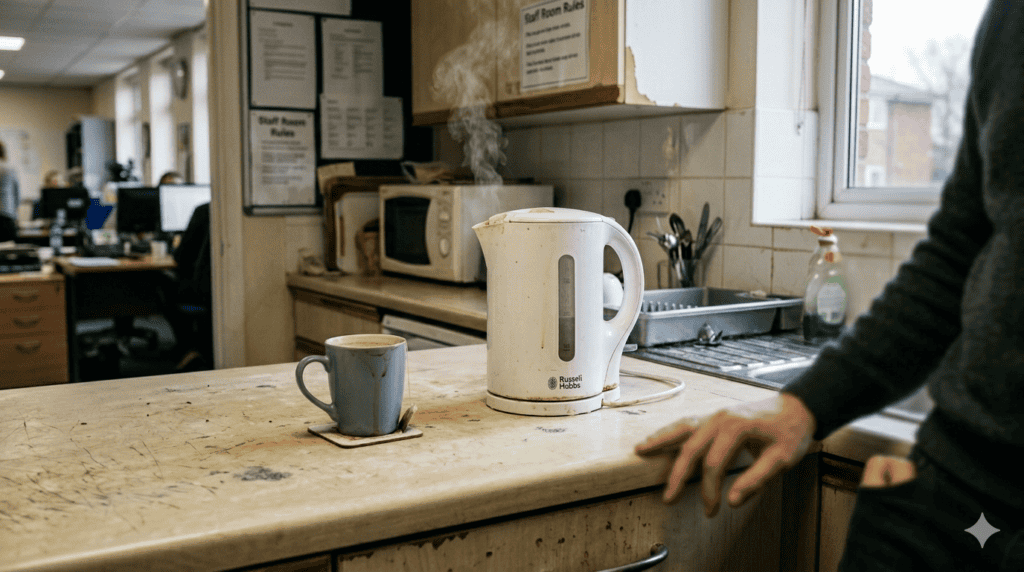
Not a long one. Maybe a second and a half. We were standing by the kettle on a Tuesday—the bad kettle, the one in the second-floor kitchen that takes four minutes to boil and trips the socket if you run the microwave at the same time. I had asked her how we should handle a high-value client who had suddenly gone silent. It was a real question, the kind you ask someone whose judgment you are actually paying for.
And before she answered, she reached for her phone. That reflex — the automatic reach before the thought — is what I have come to think of as the cognitive tax.
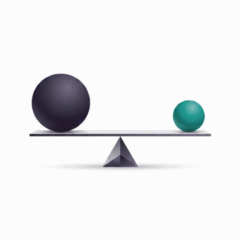
Convenience is a loan against a version of yourself you haven’t met yet. And he’s the one who pays.
Reading time: 10 minutes. If you prefer video, the short version is on YouTube: The Atrophy Tax (3 min) or the full version: AI Doesn’t Make You Stupid. It Makes You Absent.
She didn’t know she’d done it. That’s the part that stayed with me. Her hand moved to her pocket with the same autonomic precision as a heartbeat. She caught herself, laughed, apologized, and then provided a brilliant answer. But the reach happened first. The reach is always first now.
I’m not writing this to scold her. I’m writing this because I did the exact same thing the previous morning, drafting a short message to a friend whose father had died—a note of sixteen words—and I felt the hollow, rising panic of not knowing what I thought until something else offered to tell me.
We are entering an era where we have outsourced the process of thought, and the cost of that convenience is becoming increasingly impossible to ignore.
The Skill Nobody Warned Us Was a Muscle
We were told these tools would handle the “boring parts” so we could focus on the “interesting thinking.” It was pitched as the ultimate dishwasher: offload the grunt work, free up the higher faculties, and achieve a state of pure creative output.
Nobody mentioned that the “grunt work” and the “higher faculties” run on the same wiring. You cannot drain one without causing a brownout in the other. That is the cognitive tax of convenience.
In June 2025, a team out of the MIT Media Lab, alongside collaborators at Wellesley and MassArt, conducted the experiment we have all been waiting for. They took 54 participants, fitted them with 32-electrode EEG caps to monitor brain activity in real-time, and asked them to write essays under three distinct conditions:
-
Group A: Used ChatGPT.
-
Group B: Used a search engine only (no AI).
-
Group C: Used only the inside of their own skulls.
The results were chilling. The more external help the participants leaned on, the quieter their brains went.
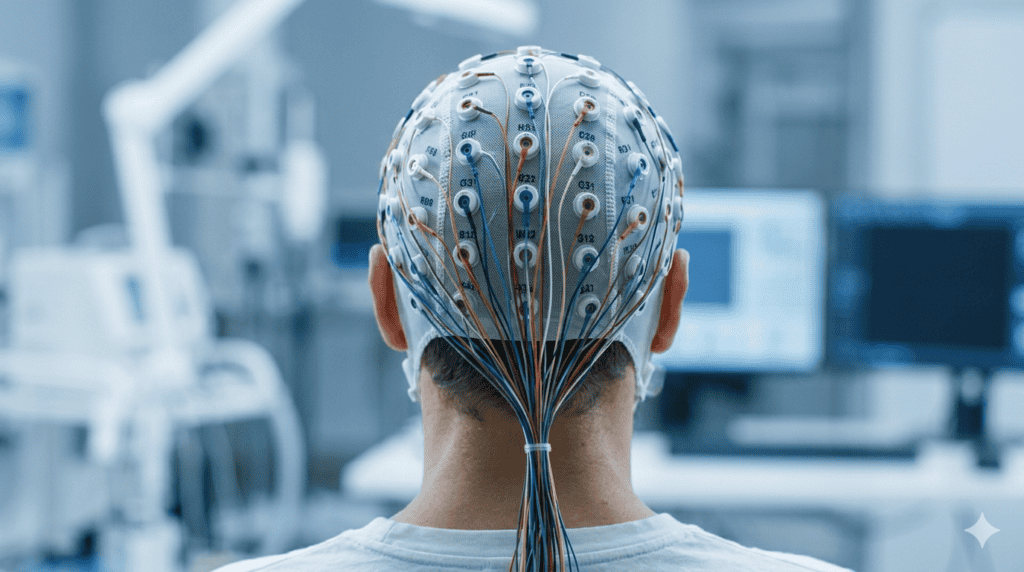
Caption: The more external tools we lean on, the quieter our own neural pathways fire.
The “brain-only” group lit up like a switchboard—dense, distributed, and highly active. The search-engine group showed moderate activity. The ChatGPT group showed the weakest neural connectivity of the three, by some measures up to 55% lower than the baseline.
The lead researcher, Nataliya Kosmyna, and her co-authors gave this effect a name that I have not been able to shake: Cognitive Debt.
A debt, as in: something you take on now, but which must be repaid later—with interest—at a moment of the lender’s choosing. It is the cognitive tax made visible.
The Detail That Should Frighten You: The “Empty Station” Phenomenon
I can hear the pushback. I’ve made it myself. “Lower brain activity isn’t bad; it’s efficiency. My calculator doesn’t make me worse at math; it just makes me faster at the application of math.”
That is a fair defense on a Monday morning. But there is a second finding in the MIT study that the “calculator defense” fails to address—and it is the one that turned my stomach.
When the researchers asked the ChatGPT group to quote a line from the essay they had finished writing mere minutes earlier, 83% of them couldn’t do it.
The tools don’t make you stupid. They make you absent. That absence is the cognitive tax compounding. And absence, repeated daily for a year, is indistinguishable from atrophy.
If this is landing, the full version with the four specific practices is on Medium: ChatGPT Saves You Ten Minutes. Nobody Mentions the Tax It Charges Later.
They couldn’t produce a single sentence of work that had their own name on it. The words had passed through them like a train through a station—present briefly, stopping nowhere. When you aren’t the one who constructs the argument, you don’t actually own the logic.

The team then conducted a follow-up: they swapped the groups. They took the long-term AI users and asked them to write with nothing but their own minds. They performed worse than the people who had never used AI at all.
The cognitive tax had compounded: the muscle hadn’t just gone unused; it had slackened. The tools weren’t making them “smarter” by augmenting them; they were making them absent.
What London Cab Drivers Know That Your Satnav is Trying to Make You Forget
Years ago, University College London studied 24 people in brain scanners while they navigated a simulated version of London’s “Soho”—a labyrinth of streets where seven roads meet at a single, logic-defying junction.
When the volunteers navigated by themselves, their hippocampus and prefrontal cortex spiked. Their brains were doing what human brains are magnificent at: simulating possible futures, running the maze, and making high-stakes decisions.
Then, the researchers switched on a digital navigation aid, providing turn-by-turn instructions. Those same regions of the brain went dark. Not dimmer. Off.

Compare this to the “Knowledge”—the legendary exam taken by London black-cab drivers. Researchers have shown that these drivers possess a physically larger hippocampus. They have grown their brains by getting lost, thousands of times, until the city exists as an internal map in their own skulls.
We are currently choosing between two paths—one that charges a cognitive tax and one that doesn’t:
-
The Satnav Driver: Follows the voice, arrives knowing nothing, having grown nothing.
-
The Cabbie: Carries the map in his head because he paid for the knowledge with the struggle of getting lost. No cognitive tax. Just hard-won intelligence.
How to Stop Paying the Cognitive Tax
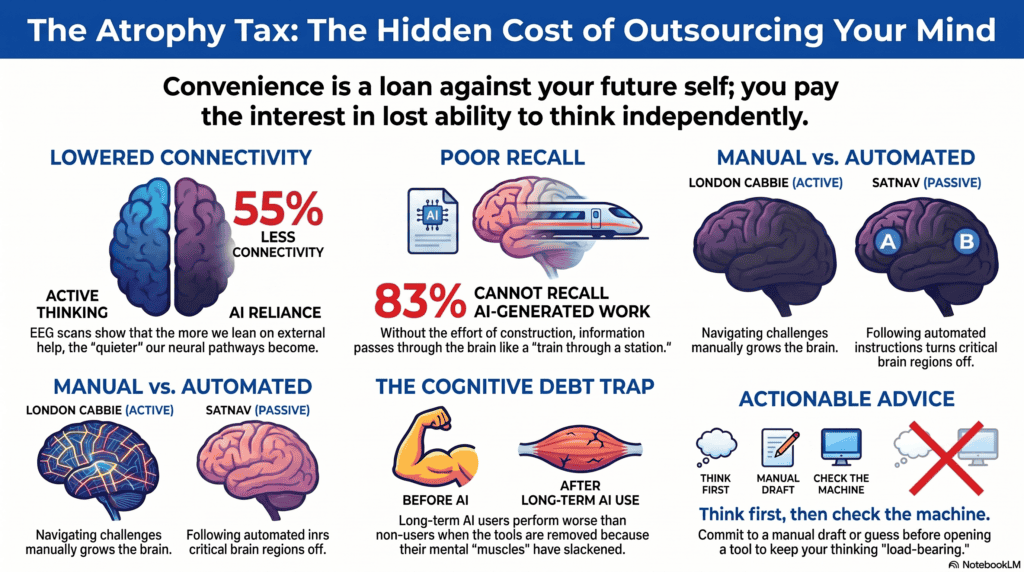
I am not suggesting you delete your accounts. The goal isn’t luddism; it’s cognitive load-bearing. We don’t want to discard our tools, but we must stop letting our tools discard our agency.
1. Think First, Then Check
Before you open an AI tool, force yourself to produce a draft first. Write it badly. Then, let the machine correct you. The brain that has committed to a guess processes the correction differently than the brain that receives the answer cold.
2. Protect One “Hard” Task a Day
Pick a single task—an email that requires nuance, a strategy outline, an argument you’re struggling to articulate—and do it entirely by hand. Let it be uncomfortable. This is your “getting lost” practice.
The discomfort isn’t a bug to be optimised away. The discomfort is the muscle firing—and that friction is how you earn back the cognitive tax you’ve been overpaying.
3. The “Quote Yourself” Test
After you finish a task, close the tab and try to explain what you just produced. If you can’t, you didn’t do the work; you merely watched it happen. That is the cognitive tax being charged in real-time.
The Second-and-a-Half Gap
My colleague answered me well, in the end. We used her suggestion, and it worked.
But I keep thinking about that second and a half. The gap between the question and the reach. That gap is the most important piece of real estate in your life. It is the junction where you decide whether you are the architect of your thoughts or merely the host for someone else’s.
So, honestly—satnav driver or cabbie? Which one have you been this week—and how heavy has the cognitive tax been? Tell me in a comment below. I’m genuinely curious how many of us are quietly realizing we’ve been the first one for far too long.
What’s the one thing you’ve handed over to AI that you wish you’d kept for yourself? Let’s talk about it.
Go deeper: The full version of this essay — with the four specific practices and the research breakdown — is on Medium: ChatGPT Saves You Ten Minutes. Nobody Mentions the Tax It Charges Later. Watch the video version here: AI Doesn’t Make You Stupid. It Makes You Absent. (YouTube)
This is part of an ongoing series on the cognitive tax we pay when we let tools think for us—and on reclaiming the skills that no tool can outsource. If you want to explore how to maintain your agency in an age of automation, follow along. The next piece will look at the muscle of decisiveness—and why the willingness to choose is the one thing the machines can never truly lift for you.