
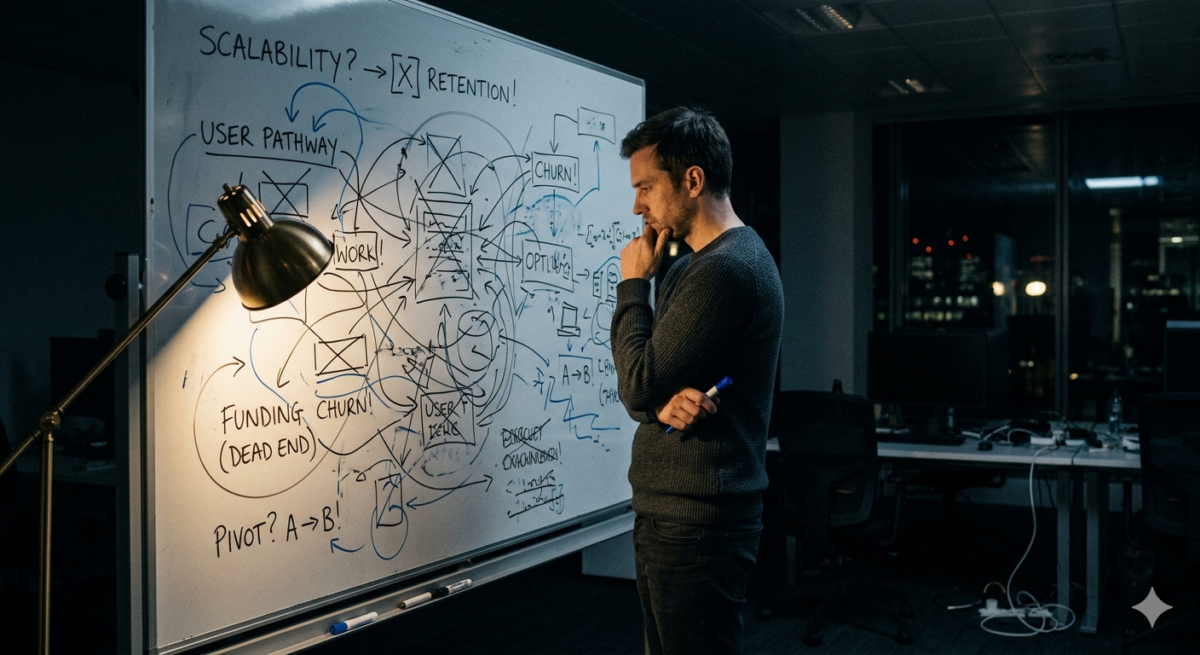
Right now, AI is making every freelancer look replaceable. The consultants surviving it stopped selling hours years ago. This is the exact three-stage path they took — and the 90-day roadmap to follow it. (Read it on Medium | Watch the full video breakdown on YouTube)
This is the story of how I learned to productize your expertise — the quiet, three-stage shift that changed everything: from guessing my way through every project, to a repeatable machine, to a product I could sell on Ko-fi while I slept.
The invoice that broke something open in me was for $1,400.
I’d just run a full competitive teardown for a startup in an afternoon. Positioning, pricing gaps, the soft underbelly of three rivals, done by dinner. The client before that one had paid me for nine days of nearly the same work, back when it actually took me nine days. Same output. Roughly the same deck. The only thing that had changed was me. I’d gotten good, and getting good had quietly cut my pay by eighty percent.
I sat with that invoice for a long time.
Because the real problem wasn’t the number. It was that I had no idea how I’d done it. The good afternoon and the nine bad days came out of the same place: me, winging it, reaching into a decade of experience and hoping the right thing came out. Sometimes it did. Sometimes it didn’t. I couldn’t tell you which it would be before I started.
I wasn’t running a business. I was running a streak.
Most people don’t fail because they’re wrong. They fail because they’re guessing, and guessing feels exactly like working.
That afternoon is where this story starts, and it’s a story with a shape I want to give you upfront, because the whole piece hangs on it. The journey goes from guessing, to building a repeatable machine, to selling that machine on Ko-fi. Three stages. Each one is a different relationship with your own expertise. Most people never leave the first one, and they spend their whole careers wondering why the money never matches the skill.
Let me walk you through all three.
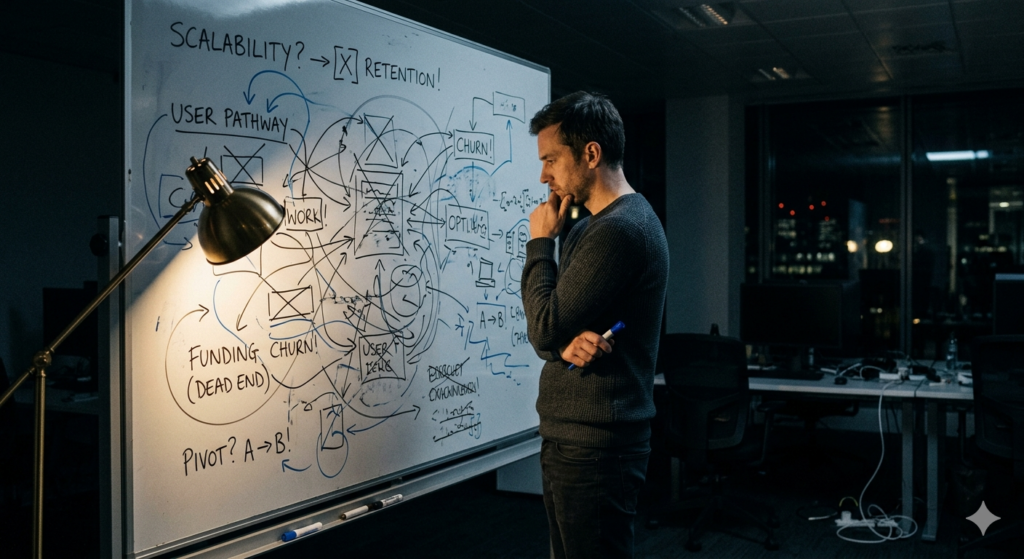
Stage One: You’re Guessing (and You Can’t See It)
Here’s the uncomfortable part. The better you are, the harder guessing is to notice.
When you’re junior, guessing announces itself. You miss deadlines, you fumble the deliverable, the feedback is brutal. But once you’ve got real experience, your guesses are usually decent. You land enough wins that nobody complains, including you. The streak holds. And a holding streak feels identical to a system right up until the day it doesn’t.
I knew I was guessing because of three tells, and you’ll recognise at least one of them in yourself.
-
The first tell: I quoted prices out of a feeling. Someone asked my rate and I read the room, guessed at their budget, and named a number that felt safe. No logic I could defend. Just vibes wearing a suit.
-
The second tell: Every project started from a blank page. I’d done thirty go-to-market plans and I still opened a new doc each time and thought, right, where do I even begin. Thirty times. The thirty-first should have taken twenty minutes of setup. It took the same dread as the first.
-
The third tell (the one that stings): I couldn’t have trained anyone to do what I did. If a clone of me had shown up begging to help, I’d have had nothing to hand them. It was all in my head, undocumented, unrepeatable, and therefore unsellable beyond my own two hands and the hours in my day.
You don’t have a strategy yet. You have a streak. And a streak is just a machine you haven’t noticed you’re running.
That last line is the hinge. Because hidden inside every long-running streak is a pattern. You are doing something repeatable. You just haven’t looked closely enough to name it. The work of Stage One isn’t to get better at the work. You’re already good at the work. It’s to catch yourself in the act and write down what your hands already know.
[Image Placeholder: A close-up of weathered hands holding a single index card with a simple flowchart drawn in pen, warm window light, shallow depth of field, documentary style.]
Caption: The skill was never the problem. The fact that it lived only in your head — that was the problem.
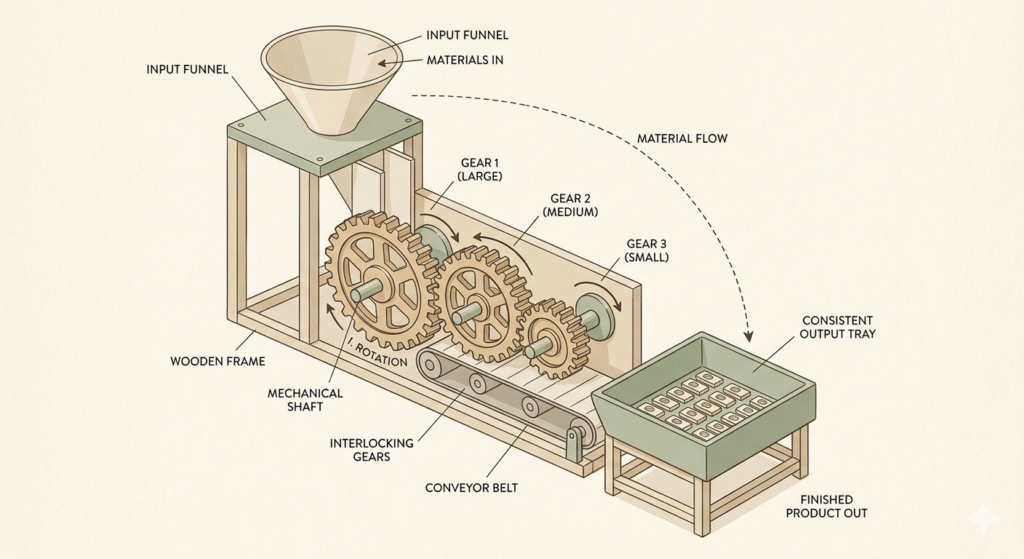
Stage Two: You Build the Machine
So what actually is a machine? Strip away the jargon and it’s almost embarrassingly simple.
A machine is just a promise you can deliver every single time.
Same input, same valuable output, regardless of your mood, your energy, or whether you slept. The duck on a restaurant menu costs forty pounds whether the chef nails it in twelve minutes or ninety, because the kitchen runs a machine, not a streak. You’re paying for the dish, not the chef’s afternoon.
This is the shift that ends the competence tax.
| The Old Way: Selling Hours | The New Way: Selling a Machine |
| Speed punishes skill (faster work = less pay) | Speed becomes pure profit (faster work = next client) |
| Deliverable starts from a blank page | Deliverable starts from a proven template |
| Trust relies on your personal charisma | Trust relies on your documented process |
| Value is locked inside your head | Value exists as an independent asset |
For me, the machine was a 90-day go-to-market system. The same sequence, every client, producing the same result: a company that goes from “we’re guessing about marketing” to “we have a repeatable demand engine and a junior who runs it.”
I took the thing I’d been improvising and turned it into a documented sequence with templates at each step. The first time I ran the documented version instead of winging it, two things happened. It took less than half the time. And the client trusted me more, not less, because watching someone run a clear system is far more reassuring than watching a clever person improvise.
Productising isn’t dumbing your expertise down. It’s refusing to reinvent it every Monday morning.
Here’s what most people get wrong about this stage. They think building the machine means making something fancy. It doesn’t. It means making something handable. The test is brutal and simple: could a competent stranger follow your written process and get 80% of your result? If yes, you have a machine. If the answer is “well, you’d have to know what I know,” you still have a streak with better notes.
A machine you can’t hand to someone else isn’t a machine. It’s a memory.
The beautiful, slightly unsettling consequence of all this: once the value lives in the system and not in your head, the system becomes a thing that can exist apart from you. It can be run by a junior. It can be licensed. And it can be sold.
Which is where the third stage comes in, and where most expertise-rich people leave most of their money on the table.
Stage Three: You Sell the Machine on Ko-fi
The day I realised I could sell the machine itself — not my time running it, but the actual documented thing — I felt slightly dizzy.
Here’s the logic. I’d built a documented 90-day GTM system: a sequence, a set of templates, a few scripts, a roadmap. I was using it to deliver $5,000-a-month retainers. But the system had value to people I’d never have time to consult for. The solo founder who can’t afford me. The junior marketer who wants to operate three levels above their title. The other fractional operator who’d happily pay to skip two years of trial and error.
They didn’t want my hours. They wanted my machine. And a machine, unlike my afternoons, can be sold a thousand times without me being in the room.
So I put it on Ko-fi.
Not LinkedIn, not a bloated course platform with a 50% cut and a launch funnel that takes a month to build. Ko-fi, because the friction is almost zero: a clean storefront, a single productised offer, instant delivery, low fees, no gatekeeping. You can have a digital product live in an afternoon. The platform is built for exactly this moment, when a creator’s knowledge finally has a price tag and just needs somewhere to sit.
The moment your expertise has a price tag and a delivery mechanism, it stops being a hobby and starts being an asset.
What I sold wasn’t a 200-page magnum opus. It was the Minimum Viable Machine: the documented sequence, the templates I actually use, the scripts, and the 90-day roadmap, packaged so a stranger could run it without me. Priced at a fraction of one consulting hour, sold while I sleep, to people I’ll never meet.
The first sale came in at 6:40 in the morning. I was asleep. I’d earned money, for the first time in my career, with my hands completely off the work. That notification did something to my brain that no invoice ever had.
The buyer was a solo founder in Lisbon I’ll never meet. She messaged me a week later: she’d run the audit diagnostic on her own company, found her bleeding neck in an afternoon, and killed two channels she’d been pouring money into out of habit. None of that needed me. It needed the machine. That was the moment the whole thing clicked into something bigger than a side income: I’d built a tool that did the thinking I used to charge by the hour for, and it kept working in rooms I wasn’t standing in.
The same five documents have since gone to a designer in Manila and a fractional ops lead in Leeds, each running the sequence on a business I know nothing about, getting a version of the same result. That’s the tell that you’ve built a real machine and not just a tidy PDF: it travels without you.
Here’s the part I didn’t expect. Before long, the question people asked me stopped being “will you run my marketing” and became “how did you build the machine.” So I packaged the build itself—the mining grid, the promise template, the documenting worksheets, the dated roadmap—into one fill-in kit, and that became its own quiet product sitting beside the first. The machine for building your machine. It’s the thing I wish someone had handed me three years and a few thousand wasted hours ago.
This is the destination. Guessing made me money only when I was personally grinding. The machine made the grinding faster and more reliable. But selling the machine — that’s the only stage where the income finally detached from my calendar entirely.
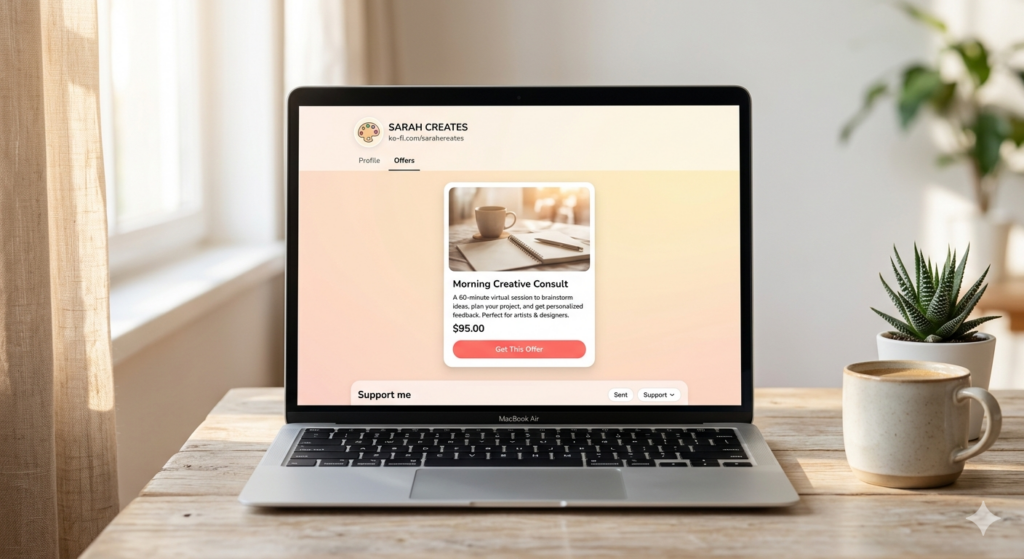
If you’re somewhere in Stage 1 or 2 and want the templates already built — the mining grid, promise template, worksheets, and 90-day roadmap — they’re in The Machine Kit on Ko-fi. Everything you need is in the guide below, though. No pressure.
The Step-by-Step Guide: Building a Machine From What You Already Know
Everything above is the why. What follows is the exact how: a step-by-step guide to building your own machine, then a dated 90-day roadmap that takes you from guessing to a live Ko-fi storefront. Read the guide for the logic. Run the roadmap for the dates.
If you do nothing else, do step one. Most people skip it and wonder why steps two through eight never stick.
Step 1: Mine your last 10 projects for the repeatable win
What to do: List your last ten paid projects. For each, write the one outcome the client was actually happy about. Circle the outcome that repeats.
Why it matters: You’re hunting for the machine you’re already secretly running. It’s hiding in your wins. You can’t build a system from scratch nearly as well as you can extract one from your own track record.
How to do it: Open a spreadsheet. Columns: project, what they paid for, what they actually thanked me for. That third column is gold. The phrase that appears three or more times is your machine’s output.
Real example: Across my ten, the recurring thank-you wasn’t “the campaign” or “the hire.” It was “you finally told us what to ignore.” That became the spine of the whole system: a machine that produces focus, not activity.
Micro-prompt: What have the last three people you helped actually thanked you for, in their words, not yours?
Step 2: Name the machine as a single promise
What to do: Compress the repeatable outcome into one sentence a stranger understands in five seconds.
Why it matters: A machine you can’t name in a sentence is a machine you can’t sell, document, or delegate. The name is the product.
How to do it: Use the format: “I take [specific person] from [painful before] to [valuable after] in [timeframe].” Cut every word that isn’t load-bearing.
Real example: Mine: “I take a seed-stage SaaS founder from guessing about marketing to a repeatable demand engine in 90 days.” Not “I do fractional CMO work.” That’s a category. This is a promise.
Micro-prompt: Fill in the blank out loud: “I take ___ from ___ to ___ in ___.” Did it feel specific or did it feel like a category?
Step 3: Document the sequence until a stranger could follow it
What to do: Write down the actual steps you take, in order, with nothing assumed.
Why it matters: This is the line between a streak and a machine. Undocumented expertise dies in your head and can never be sold or scaled.
How to do it: Run your next project and narrate every decision into a doc as you make it. Then delete everything that required “you” specifically and replace it with an instruction or a template. Aim for seven steps or fewer. If it needs more, you’re describing a textbook, not a machine.
Real example: My 90-day system collapsed into five moves: audit, find the bleeding neck, write the playbook, install the metrics, train the operator. Five. A junior can hold five.
Micro-prompt: Where in your process do you currently think “you’d just have to know”? That sentence is the exact spot that needs a template.
Step 4: Build the templates and scripts
What to do: Create the reusable artifacts that make each step push-button: templates, checklists, fill-in scripts.
Why it matters: Templates are what let the machine run without your full attention. They’re also most of what you’ll eventually sell.
How to do it: For every step, ask “what document would let someone do this without me?” Build that document once. A good template has blanks, not blank pages.
Real example: My audit step became a 12-question diagnostic the client fills in themselves before we meet. It used to take me a week of digging. Now it takes them an hour and me twenty minutes to read.
Micro-prompt: Which single template, if it existed, would save you the most dread at the start of your next project? Build that one first.
Step 5: Run the machine live and time it twice
What to do: Use the documented system on two real projects. Time both. Compare the outputs.
Why it matters: A machine is only real if it produces the same quality twice. Two clean runs is your proof of repeatability, for clients and for buyers.
How to do it: Run it exactly as written, even when your instinct says improvise. Note where you deviated. Those deviation points are bugs in the machine, not proof you’re irreplaceable.
Real example: Run one took 14 hours, run two took 9, and the client on run two was happier. The gap between them was the parts I hadn’t templated yet. I templated them.
Micro-prompt: What did you improvise last time that you could turn into a checklist before next time?
Step 6: Define your Minimum Viable Machine
What to do: Strip the system to the smallest version that still delivers the core promise. That’s what you sell first.
Why it matters: Perfectionism is how machines die undelivered. The MVM gets you to market in weeks instead of never.
How to do it: Ask: “What’s the least I could hand someone that still produces 80% of the outcome?” Usually it’s the sequence, three to five templates, and one script. Not the whole brain. The spine.
Real example: My MVM was the five-step sequence, the audit diagnostic, the playbook template, the metrics tracker, and the operator-handoff script. Five documents. That’s the product.
Micro-prompt: If you had to ship your machine as a product by Friday, what’s the smallest version you wouldn’t be ashamed of?
Step 7: Package it as a Ko-fi product
What to do: Put the MVM on a Ko-fi storefront as a single, clearly-described digital product with a price and instant delivery.
Why it matters: A machine that isn’t for sale earns you nothing while you sleep. The storefront is what converts an asset into income.
How to do it: One offer, not ten. Write the product description as a promise (Step 2’s sentence), list exactly what’s inside, set a price that’s a fraction of one consulting hour, and attach the files for instant download. Keep the literal link off your Medium posts and push it from your newsletter and LinkedIn instead.
Real example: I described mine in three lines: who it’s for, the transformation, and the five documents inside. Priced at less than I bill for forty minutes. It’s sold while I’ve been writing this paragraph, probably.
Micro-prompt: Write your product’s one-line description right now. If it sounds like a category and not a promise, go back to Step 2.
Step 8: Launch to a few, then iterate in public
What to do: Tell a small, warm group first. Collect what confuses them. Fix it. Then widen.
Why it matters: Your first buyers are your QA team. Their confusion is a free product roadmap.
How to do it: Send it to ten people who already trust you with a plain message, not a pitch. Watch where they get stuck. Every stuck point is a missing template. Add it, raise the price slightly, repeat.
Real example: My first ten buyers all asked the same question about the handoff step. I added one script to answer it, and the question vanished. That script is now the most-praised part of the product.
Micro-prompt: Who are the ten people who’d buy this from you on trust alone, before any marketing? Write the names. That’s your launch list.
The Full 90-Day Roadmap (With Dates)
Ninety days is enough time to stop guessing. Most people simply never start the clock.
This plan assumes a Monday, 22 June 2026 start. Shift every date to land on your own real start Monday; the structure is what matters.
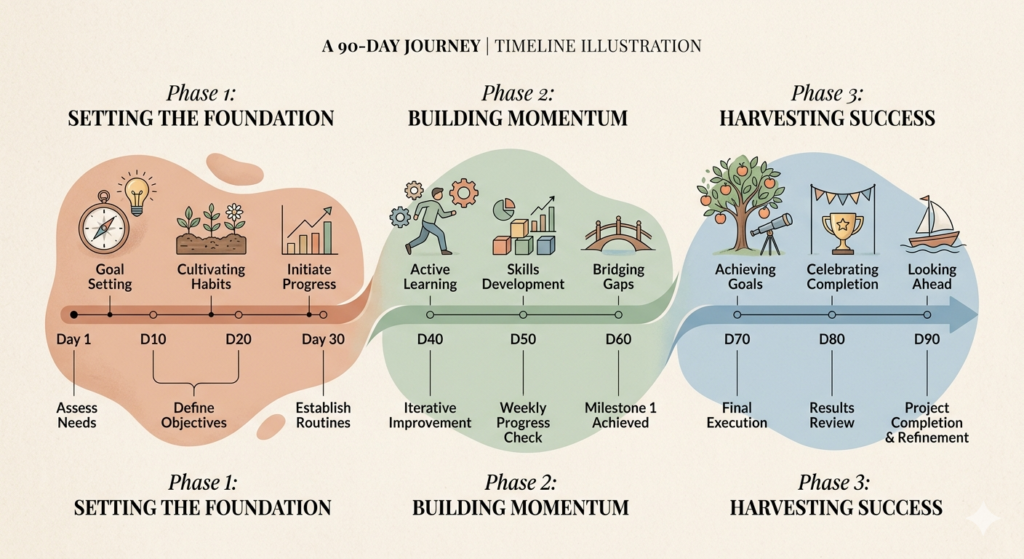
Phase 1: From “We’re Guessing” to Clarity (Weeks 1–4)
-
Week 1 (22–28 Jun) — Excavate the pattern.
Milestone: The ten-project spreadsheet from Step 1, completed.
KPI: 10 projects logged, one repeated thank-you phrase identified.
Template (Project Mining Grid): Project | What they paid for | What they actually thanked me for | Time it took.
-
Week 2 (29 Jun–5 Jul) — Name the machine.
Milestone: Your one-sentence promise (Step 2), tested on three real people.
KPI: 3 out of 3 understood it in under 10 seconds without you explaining.
Script (The 5-Second Test): “I take ___ from ___ to ___ in ___. In your words, what do you think I do?”
-
Week 3 (6–12 Jul) — Map the raw sequence.
Milestone: Every step you take, written down messily, nothing assumed.
KPI: A draft sequence exists end-to-end, however ugly.
Checklist: Did I narrate every decision? Did I mark every “you’d just have to know” moment?
-
Week 4 (13–19 Jul) — Compress to seven steps or fewer.
Milestone: The sequence cut to ≤7 named steps.
KPI: A friend outside your field can read it and explain it back to you. (Phase 1 gate: if they can’t explain it back, do not proceed. Re-cut.)
Phase 2: Build the Machine (Weeks 5–9)
-
Week 5 (20–26 Jul) — Template the heaviest step.
Milestone: The single most dread-inducing step turned into a fill-in template.
KPI: That step’s time cost drops by at least half on next use.
-
Week 6 (27 Jul–2 Aug) — Template the rest.
Milestone: Every step has at least one supporting artifact.
KPI: Each step answerable with “here’s the template” instead of “let me think.”
-
Week 7 (3–9 Aug) — Live run #1.
Milestone: Machine run end-to-end on a real project, exactly as written.
KPI: Run completed; deviations logged.
-
Week 8 (10–16 Aug) — Patch the deviations.
Milestone: Every deviation from run #1 turned into a checklist or template.
KPI: Zero “I improvised here” gaps remaining unaddressed.
-
Week 9 (17–23 Aug) — Live run #2 and define the MVM.
Milestone: Second clean run, plus your Minimum Viable Machine defined.
KPI: Run #2 faster than run #1 with equal-or-better output. MVM = 3–5 documents named. (MVM Definition: The smallest bundle that delivers 80% of your core promise without you in the room).
Phase 3: Package and Sell on Ko-fi (Weeks 10–13)
-
Week 10 (24–30 Aug) — Productise the MVM.
Milestone: The 3–5 documents cleaned, branded, and exported as a deliverable bundle.
KPI: A stranger could open the files and start, with no call required.
Checklist: Consistent formatting; no client names; a one-page “start here” guide on top.
-
Week 11 (31 Aug–6 Sep) — Build the storefront.
Milestone: Ko-fi product page live with one offer, promise-led description, price, instant download.
KPI: Product page passes the “promise not category” test.
Script (Product Description): “For [specific person] who [painful before]. This gives you [valuable after] in [timeframe]. Inside: [list the documents]. Built and used on real [projects], not theory.”
-
Week 12 (7–13 Sep) — Launch to the warm ten.
Milestone: Personal, non-salesy notes sent to your ten-name launch list.
KPI: First sales or first detailed feedback from at least 5 of 10.
Script (Warm Launch Note): “I built the exact system I use for [outcome] into something you can run yourself. Made you think of it. No pressure, but if it’s useful, it’s here: [link].”
-
Week 13 (14–20 Sep) — Iterate and widen.
Milestone: Confusion points from early buyers fixed; one improvement shipped; price nudged up.
KPI: Target ≥3 sales or ≥10 waitlist emails; one testimonial captured.
Day 90 ≈ 20 September: Storefront live, machine documented, first income earned hands-off.
The “Ready to Sell on Ko-fi” Checklist
Run this before you publish the storefront. Every box should be ticked.
-
[ ] The product delivers one clear promise, statable in a sentence
-
[ ] A stranger could use it with zero call from you
-
[ ] 3–5 clean documents, consistently formatted, no client data
-
[ ] A one-page “start here” guide sits on top of the bundle
-
[ ] The price is a fraction of one hour of your consulting rate
-
[ ] Instant download is attached and tested from a second account
-
[ ] The description is a promise, not a category
-
[ ] You’ve run the underlying machine successfully at least twice
-
[ ] The literal Ko-fi link lives in your newsletter and LinkedIn, not your Medium body
-
[ ] You have a list of ten warm people to tell first
Before You Scroll Past This
I want to tell you the truth about that 6:40am sale. It wasn’t life-changing money. It was small. But it changed how I saw every hour I’d ever sold, because for the first time the income wasn’t tethered to me being awake and grinding.
That’s the whole journey in one image. Guessing pays you only while your hands are moving. The machine makes your hands faster and more reliable. Selling the machine is the only stage where you finally step out of the frame and the thing keeps earning without you.
You already have a streak. Somewhere in your last ten projects is a machine you haven’t named yet. The work is just to catch it, document it, and give it a storefront.
The goal was never to work less. It was to stop my income from being chained to my calendar.
So here’s what I’d love from you, and I mean this personally, not as a growth tactic.
Highlight the one line in here that landed hardest. I read every highlight, and they tell me which parts are actually true for people and which parts only sounded good in my head.
In the comments, tell me your machine’s one-sentence promise. Use the format from Step 2: “I take ___ from ___ to ___ in ___.” Even a rough draft. I’ll reply to as many as I can and help you sharpen it, because that single sentence is 80% of the work and watching people find theirs is the best part of writing this.
And if you’re somewhere on this road already — still guessing, mid-build, or staring at an empty storefront — say which stage you’re stuck in. Half the value of these comment threads is people realising they’re not the only one parked at stage one.
If the three stages gave you a clearer map than you had this morning, follow along. I’m documenting the whole build in public, machine by machine, and I’d rather you walk it with me than alone.
Now go find your streak and turn it into something you can hand to someone else.
(And if you’d rather not rebuild every grid and script from scratch, the fill-in kit that pairs with this piece is in my bio. The whole method is already in the words above, though, so truly, no pressure either way.)

Continue the journey: The full written version of this piece — with comparison table, checklists, and formatted roadmap — is right here on this page. The video walkthrough is on YouTube. The Medium version (with Member responses) is here. And the fill-in kit — the mining grid, promise template, worksheets, and dated roadmap, all pre-built — is on Ko-fi.