

Quick read: Most mid-career professionals plateau at the same spot — somewhere between senior individual contributor and director. They produce great analysis, structure problems beautifully, and write competent memos. But they never quite cross into leadership. This piece is about what’s actually going on, why it’s getting worse in the AI era, and the three habits that close the Conviction Gap. It’s the second part of a series; the first part is here.
Prefer the narrative version? Read the full story on Medium — same argument, written as one continuous piece. Or watch the 10-minute video.
TL;DR
(For readers who want the takeaways without the story — though the story is where most of the value lives.)
- There are two career skills, not one. The first is structuring ambiguity (the Five Whys, the 3×3 grid, the one-page memo). It gets you to mid-management. The second is closing the Conviction Gap — the skill of taking a position and owning the consequences.
- Most professionals get stuck at the first skill because school, university, MBA programmes, and corporate culture all reward analysis and punish wrong calls.
- AI is now extremely good at structuring problems for free, in seconds. If structuring is the ceiling of your value, you are already being replaced.
- The three habits that close the Conviction Gap: (1) Replace “it depends” with a stake in the ground; (2) use the “Even If” clause to project conviction with 70% information; (3) build a Pre-Mortem into every recommendation, claiming the risk upfront.
- Doing this for 90 days will change how your organisation reads you. Not because you became smarter. Because you started signalling responsibility.
📌 Reader’s note.
This is a follow-up to my earlier piece, The Human Premium — the mid-career audit that pairs with the Conviction Gap. If you haven’t read that one, the 30-second version is in the callout below. If you have read it, skip the callout and dive in.
📎 NEW HERE? Quick context.
In a previous piece I described getting fired from three jobs before learning to think strategically. A mentor named Sarah taught me three tools: The Five Whys — ask “why” five times before doing any actual work, because the surface request is almost never the real problem.
The 3×3 Grid — when given a vague goal, break it into three strategic approaches × three key metrics. “Grow the business” becomes acquisition vs retention vs monetisation, scored on revenue, time, and resource cost.
The One-Page Memo — recommendation, three reasons, two risks, what would change your mind. Stop sending decks. Together, these tools close what I called the Ambiguity Gap. They get you from analyst to director. This piece is about what happens next.
Table of Contents
- Why this matters now (more than it did five years ago)
- The meeting that broke me
- The coffee that changed everything
- What is the Conviction Gap?
- Why everything in your life trained you to hedge
- The AI acceleration: why this is no longer optional
- The three reps that close the Conviction Gap
- The 90-day implementation plan
- Industry-specific applications
- Common objections (and what I’d say to them)
- The final uncomfortable truth
- Related reading
- Frequently Asked Questions
Why this matters now (more than it did five years ago)
In 2018, the standard career advice was learn to think strategically. In 2026, that advice is necessary but no longer sufficient. Here’s why. Five years ago, the people who could structure an ambiguous problem and produce a clean recommendation were rare. They could charge a premium because they were the bridge between executives drowning in information and the operational layer that needed clear direction. Today, large language models can structure problems competently in under thirty seconds. They produce decent 3×3 grids. They identify reasonable tradeoffs. They write clean one-page memos. The structuring skill has been commoditised. What hasn’t been commoditised — what cannot be commoditised, for reasons I’ll get into later — is the willingness to take a position, defend it under pressure, and own the consequences of being wrong. This is the skill I’m calling the Conviction Gap. And closing it is now the highest-leverage move in a white-collar career.
The meeting that broke me
Before I had a name for the Conviction Gap, I had a moment that taught me it existed. The room was small. Eight executives. The CEO. The CFO. A board member named Marcus — who, as it turned out, had been Sarah’s mentor a decade earlier. I was presenting a recommendation about whether to expand into a new vertical. I had done the work. Five Whys done. 3×3 grid done. One-page memo with three structured options, clear tradeoffs, a recommended path. I walked through it for ten minutes. When I finished, the room went quiet. Marcus looked at me. He had a coffee in front of him that he hadn’t touched. He said, very politely: “That was a beautiful analysis. What do you think we should do?” I said, “Well, given the tradeoffs, Option B has the strongest case if our growth thesis holds — ” “No,” he said. “I read your memo. I see the options. I’m asking what you think we should do.” I started to say something about the considerations. He cut me off. “Robert. Are you going to make a call, or do I have to do it for you?” It was a small moment. Nobody in the room reacted visibly. The CEO moved us on to the next agenda item. The meeting ended on time. I walked out feeling like I’d been hit in the chest. For about eighteen months before that meeting, I had been killing it. I’d been promoted twice. I’d been poached by a Series C startup. I had a salary that would have seemed impossible to my fired-three-times self at 26. I thought I had it figured out. Turns out, I had figured out exactly half of the job.
The coffee that changed everything
The Conviction Gap is something you usually only see clearly in hindsight. For me, it took a fifteen-minute coffee with a chairman who had stopped tolerating it. Two days after the meeting, Marcus emailed me. He asked if I wanted to grab a coffee. I said yes immediately, because I knew what was coming, and I wanted to hear it directly. We met near his office. He didn’t bring a deck. He didn’t bring notes. He ordered a black coffee and waited until I sat down. Then he said: “You’re a senior analyst with a director title. You’re not going to make it to VP unless something changes.” Here’s what he told me over the next forty minutes. I’m summarising — the specifics involved my career and his patience. There are two skills, he said. Not one. The first — the skill Sarah taught me — is the skill of making chaos legible. Turning vague mandates into structured options. Naming the real problem. That skill gets you to mid-management. He’d watched a hundred analysts use it to ascend from individual contributor to director.
“But that skill has a ceiling. And you’re sitting on it.”
Because the higher you go, the less your job is to structure decisions. Your job becomes making them. Executives don’t want a 3×3 grid. They want your call. They want to know what you’d do with the company’s money if it were yours — and they want you to defend it under pressure, in real time, while three people in the room disagree with you. This, he said, is the skill that separates middle managers from leaders. He called it conviction. I’d later come to call it something more useful.
What is the Conviction Gap?
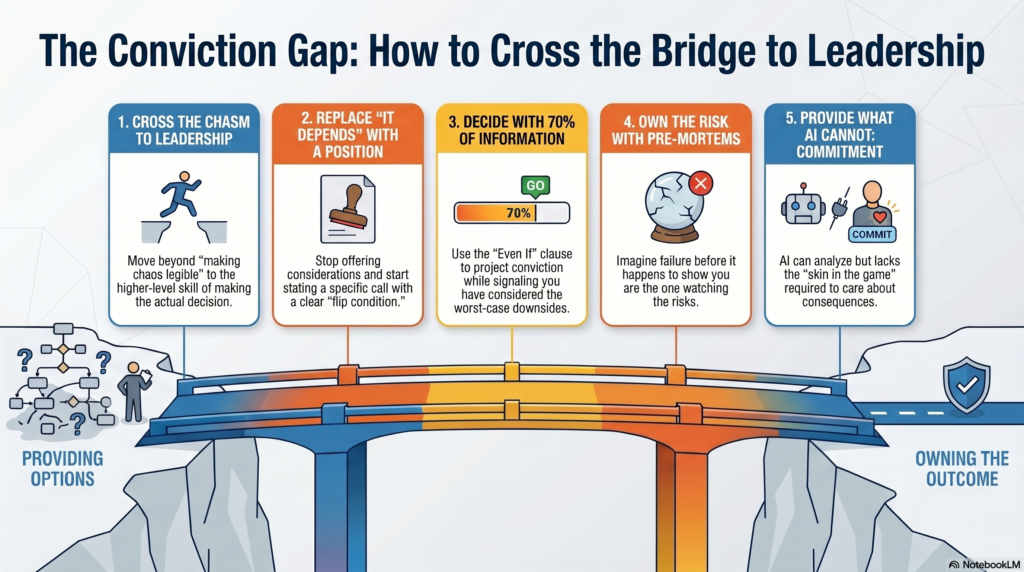
The Conviction Gap is the chasm between the professional who can structure a problem and the professional who can decide one. Most professionals — and I mean almost all of them, including the people you currently think are doing well — get stuck in the same trap. They learn how to analyse decisions, and then they hide behind the analysis. They produce options. They lay out tradeoffs. They write memos that cover every consideration. They feel competent, because they did the work. But when the moment comes to say “I think we should do X, and here’s why I’d bet my career on it,” they reach for the structure. They retreat into “well, it depends.” They serve the decision back to the executive on a platter — because committing to a position feels dangerous.
This is the Conviction Gap.
It’s the chasm between people who structure problems and people who decide them. Once you start looking, you see it everywhere.
- It’s the analyst who’s been a senior analyst for nine years.
- It’s the PM who runs great meetings but never tells you what to ship.
- It’s the consultant who delivers a brilliant deck and asks the client what they want to do.
- It’s the engineering manager who escalates every architecture decision two levels up.
- It’s the head of marketing who runs nine campaigns instead of choosing two.
The Conviction Gap is the reason the smartest people I know have plateaued. It’s also the reason the most influential people I know rarely seem like the smartest in the room. They seem confident, decisive, and a little simplifying. They are paid for those qualities, not for nuance.
Conviction isn’t bravado
Here’s the part most people get wrong when they first try to close the Conviction Gap. Conviction is not loudness. It is not stubbornness, and closing the Conviction Gap is not about volume. The Conviction Gap is fundamentally about willingness. It is not having the most confident voice in the room. Some of the most decisive executives I have ever worked with speak so quietly you have to lean in. They almost never raise their voice. They are not performing certainty. They are acting on a decision and signalling that they will own it.
Conviction is the willingness to commit before all the information is in.
To name a path and own the consequences. To say “we should do X, and I’d still say X even if you told me half my assumptions were wrong.” This is not the same as being right. It is the willingness to be measured — to put your judgment on record where it can be checked against reality later. People who refuse to do this can stay clever forever. They never get to be trusted.
A short note on where this concept comes from
I want to be honest about something. The framing I’m using here didn’t come fully from Marcus or from my own experience. It draws on research I went deep into after that coffee conversation. The pre-mortem habit I’ll describe in Rep 3 comes directly from a cognitive psychologist named Gary Klein, who spent decades studying how expert decision-makers (firefighters, military commanders, ICU nurses) actually make calls under uncertainty. His finding, simplified: experts decide faster than novices, with less information, and they explicitly imagine failure scenarios before committing. Daniel Kahneman wrote about a related distinction between fast and slow thinking, and about how senior professionals get good at intuiting when more analysis will help versus when it’s just procrastination. The “70% rule” — make the call when you have 70% of the information you’d want — is associated with Colin Powell and is now widely repeated in military and corporate decision-making contexts. None of this is new. What’s new is that we’re now in an environment where the analytical layer has been almost completely commoditised by AI, and the conviction layer is finally getting the price premium it always deserved.
Why everything in your life trained you to hedge
Most mid-career professionals do not have a Conviction Gap because they are flawed. They have one because almost everything in their life and career has rewarded the opposite behaviour. I want to spend a moment on this, because it’s worth understanding the structural forces working against you. Not to give you an excuse — to give you a diagnosis. Every educational system most readers of this piece have been through teaches the opposite of conviction. School rewards you for showing your work, not for being right. The student who guesses correctly without a method gets a worse grade than the student who reasons carefully to the wrong answer. This is sensible pedagogically. It is catastrophic professionally, because work doesn’t grade you on your reasoning. It grades you on your outcomes. University rewards you for citing sources, not for staking out positions. The graduate student who writes “Smith (2019) argues X while Jones (2021) argues Y, suggesting the question remains contested” gets praised. The graduate student who writes “Smith is right and Jones is wrong, here’s why” gets called reckless — even if they’re correct. MBA programmes reward you for elegant frameworks, not for the courage to bet on one. Think about how case studies are taught. You’re rewarded for considering all stakeholders, mapping out all scenarios, presenting a balanced view. The student who walks into class on day one and says “This company should fire its CEO” gets called arrogant. They’re often also right. Corporate culture, in most companies, punishes wrong calls more than it punishes no calls. If you stay quiet and the project fails, the blame diffuses. If you spoke up and the project fails, you become the story. The math is asymmetric and obvious. Quiet pays. So we learn to hide. We learn to say “it depends” and “the data suggests” and “one perspective would be.” We learn to lay out three options and let our manager pick. We learn to be useful without being responsible. This is the trap. And the trap is closing fast, because the entire layer of “useful but not responsible” work is being absorbed by software.
The AI acceleration: why this is no longer optional
The Conviction Gap used to be a quiet career ceiling. AI has turned it into a hard one. In the last piece I wrote, I covered how AI is commoditising technical skills — engineering, writing, design at the entry level. That’s still true. What I didn’t fully explain then is how AI is now eating into the strategic skills that used to be a moat for mid-career professionals. Let me be specific about what AI can now do without a human in the loop: A modern large language model can:
- Read a fifty-page document and produce a clean executive summary in seconds
- Take a vague business problem and structure it into a 3×3 grid of strategic approaches
- Run a Five Whys analysis with reasonable depth
- Draft a one-page memo with recommendation, supporting evidence, and risks
- Identify second-order consequences of a decision that a junior analyst would miss
- Synthesise dozens of conflicting data points into a balanced position
If your day-to-day value is doing those things — and I’d guess for most readers of this piece, it is — then you are competing with a tool that produces a credible version of your work for free, at any hour, with no PTO, no benefits, and no ego. The middle of the analyst bell curve is gone. The top decile of analytical work still has value, because the top decile catches subtleties machines miss. But the median is over.
What AI cannot do (and probably never will)
Here’s the part that matters, and the part most career commentary gets wrong. AI cannot commit. Not in the way that matters professionally. It can output a recommendation. It can use confident language. It can simulate conviction. But it cannot have skin in the game. It cannot be embarrassed by being wrong. It cannot lose status. It cannot be fired. It cannot watch the consequences of its judgment unfold over months and be the person held to account. Why does this matter? Because conviction, in the professional sense, is not a cognitive output. It is a social signal that someone has put themselves on the hook. When a senior leader says “I’m betting on this,” they are not just making a forecast. They are voluntarily exposing themselves to consequences. They are saying “if this is wrong, I will pay the cost — in reputation, in career, in the trust of the people who report to me.” That signal is what makes other people willing to follow. An AI cannot send that signal. Because it has no self to expose. No career to lose. No relationships to damage. No reputation to defend. This isn’t a limitation we can engineer away. It’s structural. Conviction requires that something be at stake for the person making the call. AI has nothing at stake. This is why I keep telling clients: the Conviction Gap is the most defensible career skill in the modern economy. Not because AI lacks the cognitive horsepower to mimic it, but because conviction is existential, not cognitive. It requires that you, the human, be willing to absorb consequences a machine cannot. That is the entire game from here.
The three reps that close the Conviction Gap
The Conviction Gap closes the way every other professional skill closes — through deliberate repetition. So how do you actually close the Conviction Gap? Nobody wakes up one morning and decides to suddenly have opinions. The shift is gradual, and it requires deliberate practice. Here are the three habits that worked for me, that I now teach to mentees, and that I’ve watched genuinely change careers over six-to-twelve-month windows. None of them are clever. All of them are uncomfortable at first.
Rep 1: The stake in the ground (the first habit for closing the Conviction Gap)
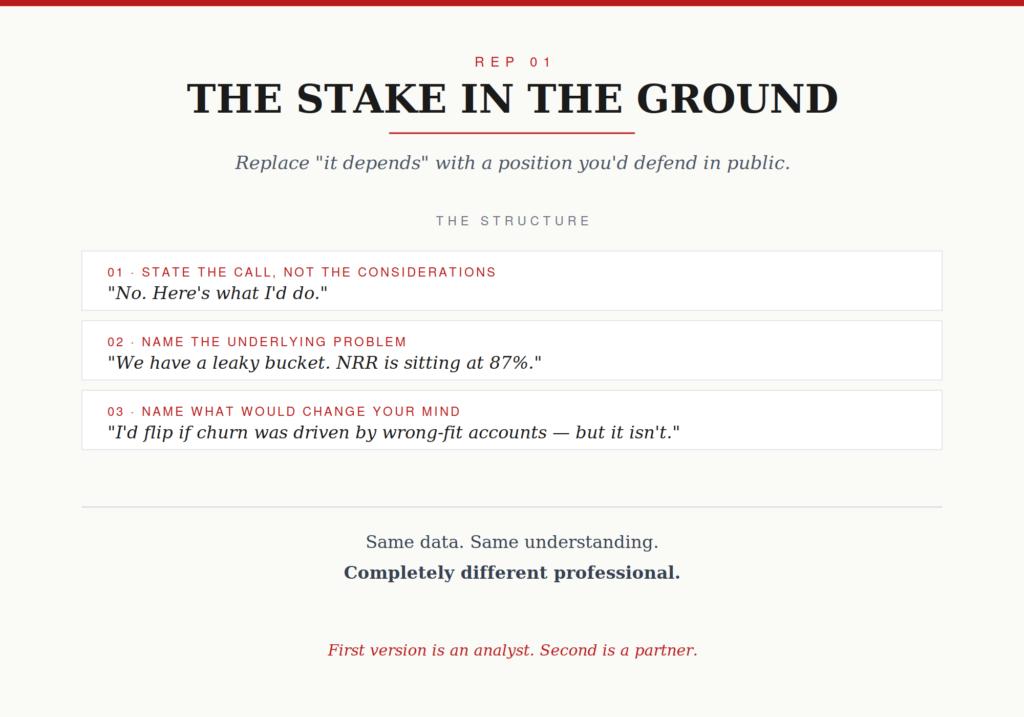
The first rep is the simplest, and it is the one most people skip. When asked a question that requires judgment, stop offering considerations and start offering a position. The trigger phrase to retire from your vocabulary is “it depends.” Or its cousins: “there are pros and cons,” “a few things to consider,” “the data suggests.” These are not answers. They are pre-answers — verbal warm-ups that produce structure without commitment. The replacement template is:
- State the call. Not the considerations.
- Name the underlying problem the call addresses.
- Name what would change your mind.
That’s it. Three moves.
Worked example, sales operations.
Question: “Should we double our outbound sales spend to hit the Q4 number?” Bad response: “It depends on a few things. We’d want to look at CAC across channels, current pipeline conversion, and whether the sales team has the bandwidth. I can put together a comparison of outbound versus paid acquisition versus partnerships. When do you need it?” Good response: “No. We have a leaky bucket. Net revenue retention is sitting at 87%, which means anything we pour in at the top is leaking out the side. I’d put the budget into retention this quarter and circle back to outbound in Q1. I’d change my mind if you told me churn is driven by wrong-fit accounts that the sales motion is already filtering out — but the cohort data doesn’t suggest that.”
The first answer is an analyst. The second is a partner.
Worked example, engineering.
Question: “Should we refactor the auth service or push the new feature?” Bad response: “There’s a tradeoff. Refactoring buys us long-term velocity but costs us six weeks of feature work. The new feature is what the sales team is asking for, but the auth code is getting fragile. I can scope both and we can decide.” Good response: “Refactor. The auth service has cost us three sev-1s in six months — at this rate, we’ll have a customer-impacting outage during the year-end push and that’s a worse business outcome than missing one feature ship. I’d flip if you can show me a customer specifically at churn risk over this feature, in which case the political math changes.”
Worked example, content marketing.
Question: “Should we publish weekly or biweekly?” Bad response: “It depends on bandwidth and our quality bar. We could test both. I’d suggest we model out the SEO impact and audience attrition under each cadence and decide based on the projections.” Good response: “Biweekly. We’re getting 4× more engagement per piece when we let editing take its full course, and our search rankings have stayed flat under the weekly cadence — volume isn’t the bottleneck. I’d reconsider if competitor velocity starts pulling top-of-funnel away, but we haven’t seen that yet.”
Notice the pattern. The conviction version always:
- Opens with a position (often a single word: yes, no, kill it, ship it)
- Names a specific, observable reason
- Provides an explicit condition under which the speaker would change their mind
That last element — naming what would change your mind — is crucial. It signals you’ve considered disconfirming evidence. It distinguishes conviction from stubbornness. It also makes you nearly impossible to ambush, because you’ve pre-named the conditions under which you’d update.
Common failure mode: People try Rep 1 and immediately collapse the moment someone pushes back. They take a position, get a sharp question, and fold. The point is to stay in the position while acknowledging the question is real. “That’s a fair challenge. Here’s how I think about it…” You’ll be wrong sometimes. That’s the point. The professional standard isn’t being right every time. It’s being measurable.
Rep 2: The “Even If” Clause (a defensive layer for the Conviction Gap)
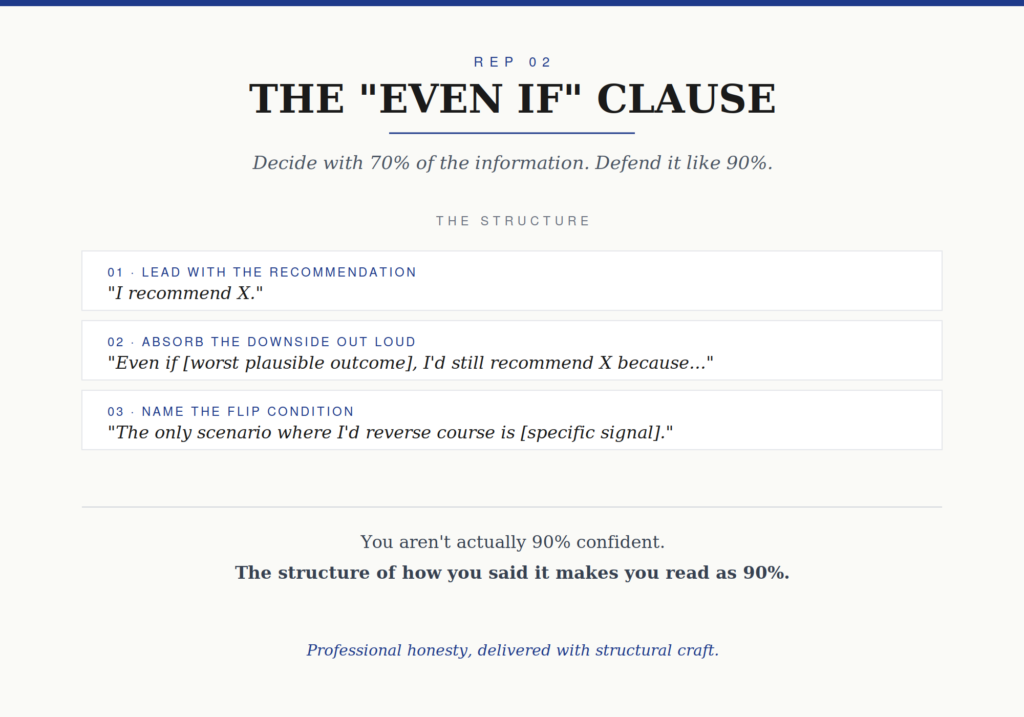
This is the rep that took me longest to learn, and the one that changes how senior leaders read you fastest. Here’s a number worth internalising: by the time you have 95% of the information you’d ideally want, the decision window has closed. The world has moved on. Your competitor has shipped. The candidate has accepted another offer. The market has shifted. Your team has lost momentum.
Leaders decide with about 70% of the information.
That last 25% is asymptotic. It costs ten times the effort for half the additional clarity. And most of the time, it doesn’t even arrive — you just convince yourself you’re “gathering more data” while you’re actually avoiding the decision. But here’s the trap. If you walk into an executive’s office with a 70%-confidence recommendation and you sound 70% confident, they will not act on it. They will ask for more analysis. They will push it to next quarter. They will quietly stop including you in the meeting. You have to project conviction while signalling that you’ve already considered the downside. The verbal device for this is the “Even If” Clause.
The structure is:
- “I recommend X.”
- “Even if [worst plausible downside], I’d still recommend X because [reason].”
- “The only scenario where I’d flip is [specific disconfirming condition].”
What you’re doing is publicly stress-testing your own recommendation. You’re saying: I’ve thought about how this could go wrong. Here is exactly how wrong it could go. I am still willing to move forward.
This is the verbal signature of someone who has crossed the Conviction Gap.
Worked example, product.
Question: “Should we launch the new pricing tier in Q2 or wait until we have more usage data?” Bad response: “I think Q2 looks good, assuming we get good signal from the customer interviews and engineering confirms feasibility and the marketing team has bandwidth to support.” Good response: “Launch in Q2. Even if customer interviews come back lukewarm, the strategic positioning still justifies it because it locks us in before [competitor] makes a similar move. Even if engineering hits ceiling complexity, we can ship a v1 that solves the top use case. The only scenario where I’d push back is if our two largest enterprise accounts tell us they’re walking — that would mean we’ve misread demand entirely.”
The bad response distributes blame in advance. If anything goes wrong, the speaker has plausible deniability across four conditions. Senior people read this instantly and discount the speaker accordingly. The good response absorbs risk explicitly. It names two failure scenarios, owns them, and explains why the recommendation survives both. Only then does it name the actual flip condition.
Worked example, hiring.
Bad response: “I’d lean towards hiring her, depending on how the team likes her and whether we can close on comp.” Good response: “Hire her. Even if the team has some friction with her communication style in the first month, the underlying judgment is exactly what we’re missing. Even if we have to stretch on comp by 10%, the payoff window is twelve months. The flip condition is if her references reveal a pattern of process issues we missed — that would suggest the judgment I saw in interviews isn’t representative.”
Worked example, marketing strategy.
Bad response: “I think we should focus on LinkedIn this quarter, but it depends on whether our content calendar can sustain it and whether the buyers we’re targeting are actually active there.” Good response: “Focus on LinkedIn. Even if our content cadence slips by a third, the platform still produces our best-quality leads per hour invested. Even if our ICP is less active there than we modelled, the demonstrated CPL is well below paid alternatives. The flip condition is if our test campaign shows below 1% engagement on three consecutive posts — that would tell us the audience isn’t there.”
The point of the “Even If” clause isn’t to be brave. It’s to make your reasoning legible to a senior decision-maker. You’re showing them that you’ve already done the stress test in your head, which means they don’t have to.
Common failure mode: Naming downsides that aren’t actually downsides. The “Even If” clause has to feature a real worst-plausible-case scenario. If you say “Even if conversion is slightly below target, I’d still recommend X,” you’ve just signalled you haven’t actually thought hard about how this could fail. The downside you name should be the one that genuinely keeps you up at night.
Rep 3: The Pre-Mortem — the final move in closing the Conviction Gap
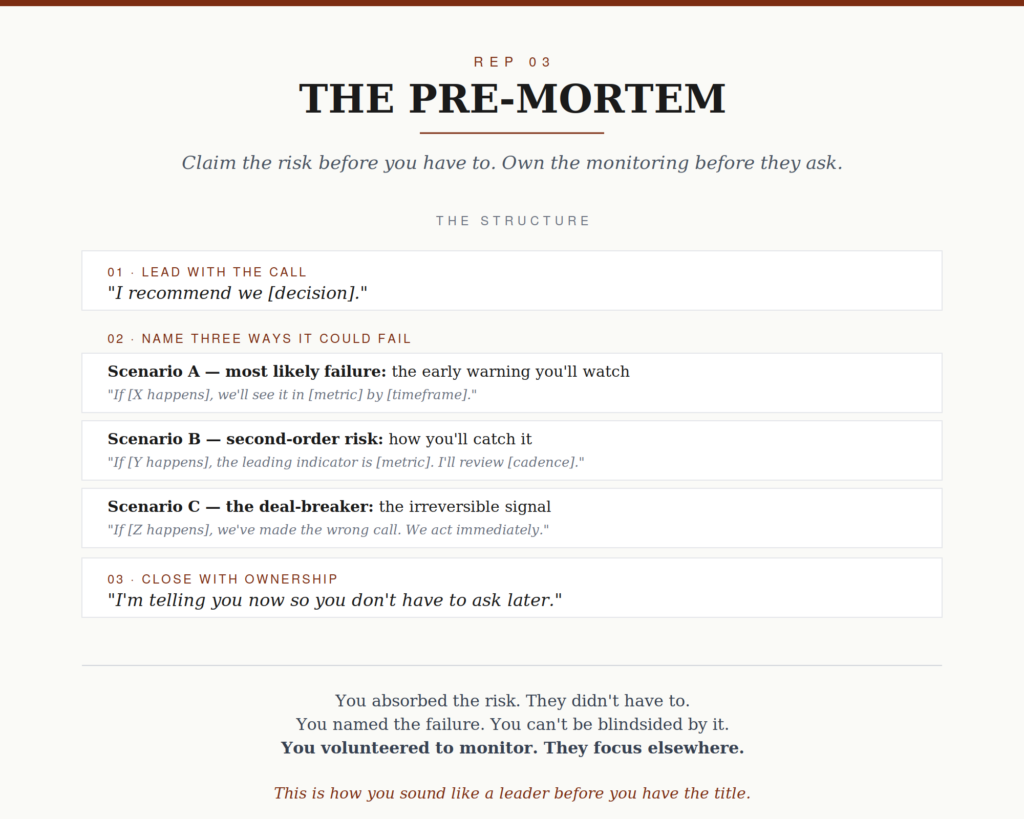
This is the rep that closes the Conviction Gap for good. The concept comes from the cognitive psychologist Gary Klein. His research found that high-performing decision-makers do something most professionals never do: before they commit to a decision, they explicitly imagine that it has already failed. They run a mental simulation. They ask: if this blows up in six months, what’s the most likely reason? Then they decide anyway. Junior people skip this step because it feels pessimistic. Senior people do it because they understand the alternative is post-mortem ownership — looking at the failure backwards, after the damage is done, with nowhere to hide.
“When something goes wrong and you didn’t predict it, you look reckless. When something goes wrong and you did predict it, you look prescient.”
The move is to claim the risk upfront, in writing, before you have to. End every major recommendation with a Pre-Mortem section. Tell your boss exactly how this could fail. Tell them how you’ll see it coming. Tell them what you’ll do. This sounds counterintuitive. You’d think naming failure modes would make leadership less likely to approve your recommendation. The opposite is true. When you name the failure modes yourself, you signal three things at once:
- You’ve thought harder about this than anyone else in the room.
- You’re not asking leadership to absorb risk you haven’t already absorbed.
- You’re going to be the one watching this. They don’t have to.
That third one is the entire game.
Worked example: a hiring decision (the script that got me promoted).
“I recommend we hire Sarah for the VP Sales role. Here’s the pre-mortem. Scenario A — Cultural fit failure: If she struggles with our founder-led sales motion in the first 60 days, we’ll see it in her deal involvement and her rep onboarding velocity. I’m tracking both biweekly. If we’re not seeing real engagement by month three, we have a fit problem and I’ll bring it to you immediately. Scenario B — Velocity drag: If her process discipline doesn’t translate to our deal velocity, our average sales cycle will lengthen by more than 15%. I’m tracking this monthly. If we see drift by month four, I’ll escalate. Scenario C — Trust failure: The deal-breaker is if she can’t close a single deal personally in her first 90 days. That tells us the buyer doesn’t trust her, which means we hired wrong and we need to act fast. I think she’s a strong yes. But these are the three things I’m watching, and I’m telling you now so you don’t have to ask later.”
Read that aloud. That is not the voice of an analyst. That is the voice of someone whose job is to absorb risk on behalf of the organisation. The first time I wrote a memo like this, Marcus circled the entire pre-mortem section in red ink and wrote in the margin: “Now you’re playing the right game.” Six weeks later, I was promoted to VP.
Worked example: a product roadmap decision.
“Recommend we ship the integrations push in Q3 over the AI features push. Pre-mortem: Scenario A — Demand misread: If integration usage stays flat after launch, our hypothesis about retention impact is wrong. I’ll know within six weeks based on activation cohorts. If we don’t see lift, I’ll come to you with a redirect plan. Scenario B — Competitive shift: If [competitor] ships their AI feature first and it lands well, our positioning erodes. I’m monitoring their release notes weekly. We have a contingency plan ready to fast-follow if needed. Scenario C — Engineering capacity collapse: If the integrations work creates more tech debt than we modelled, we’ll see it in deploy frequency. I’m watching this with engineering leadership. If deploys drop more than 30%, we pause and reassess. Strong recommend integrations. But these are the three watchpoints.”
Common failure mode: Pre-mortems that name only soft risks (“we might encounter friction with stakeholders”). A real pre-mortem names the specific, measurable, observable signal that would tell you the recommendation was wrong. “We’ll know it’s broken when X is below Y by Z.” If your pre-mortem doesn’t contain a number and a timeframe, it’s not a pre-mortem. It’s an excuse list.
The 90-day implementation plan
Closing the Conviction Gap is a habit, not an epiphany. Here is the 90-day cadence I use with the people I coach. The reps above don’t work as concepts. They work as habits. Here’s the actual practice schedule I give to people I mentor. Ninety days, with weekly milestones. If you do this, your professional life will be unrecognisable.
Days 1–30: Awareness
The first month is about catching yourself. You aren’t trying to change yet. You’re trying to notice.
- Week 1: Keep a running list of every time you said “it depends” or its variants in a meeting or email. Don’t try to stop. Just count.
- Week 2: For each entry on the list, write down what the position would have been. Don’t share it. Just practice forming it in your head.
- Week 3: Notice who in your organisation closes the Conviction Gap fluently. Watch their language. Copy nothing yet — just observe.
- Week 4: Pick one low-stakes meeting (a recurring stand-up, a team sync) where you will deliberately replace one hedge with a position. Notice what happens.
By the end of Month 1, you should be aware of the pattern in real time, not after the fact.
Days 31–60: Low-stakes practice
Month 2 is about deliberate practice in environments where being wrong won’t cost you.
- Week 5: Use Rep 1 in every team meeting. Not in every answer — just once per meeting, on something where you have a clear opinion.
- Week 6: Use the “Even If” clause in one written recommendation (Slack message, email, or internal doc). Force yourself to name a real downside.
- Week 7: Add a one-paragraph pre-mortem to one project plan. Even if you’re not asked to. Even if no one will read it.
- Week 8: Ask a peer you trust to give you feedback on whether your communication has shifted. Don’t argue with their feedback. Just listen.
By the end of Month 2, you should have a small body of work where you took positions in writing.
Days 61–90: Public conviction
Month 3 is where the actual career change happens.
- Week 9: Use Rep 1 in a meeting where your boss is present, on a question with real consequences. State the call. Hold the position when pushed.
- Week 10: Use the “Even If” clause in a recommendation that goes to leadership. Make the downside genuinely scary.
- Week 11: Send a recommendation memo with an explicit pre-mortem section. Watch how people respond.
- Week 12: Volunteer for one ambiguous, high-stakes assignment. Use all three reps in your response.
By the end of Month 3, your manager will read you differently. Your peers will read you differently. You will read yourself differently. Most of my mentees report that by week 8 or 9, they get pulled into a strategic conversation they would not have been included in before. By week 12, several of them have had a promotion conversation initiated by their boss without prompting. This is not a coincidence. The signals you are sending have changed.
Industry-specific applications
The Conviction Gap looks slightly different depending on the world you work in. Here is how it shows up across five common environments. The reps work across functions, but they look slightly different depending on the work.
For engineers and engineering managers: The most common Conviction Gap moment is a technical architecture decision. The instinct is to surface tradeoffs and let leadership choose. The conviction move is to recommend, in writing, the path you would take, with a pre-mortem covering the two specific scenarios that would force a refactor.
For product managers: The Conviction Gap shows up in roadmap reviews. PMs who can’t cross it produce roadmaps that are everything-for-everyone. PMs who can cross it produce a single ordered list with a recommendation for what to cut, not just what to add. The pre-mortem for a PM is usually a specific user-behaviour signal that would invalidate the roadmap thesis.
For marketers: The Conviction Gap shows up in budget allocation. The conviction move is to recommend a concentrated bet (60% on one channel) with the “Even If” clause naming the worst-case ROI scenario. Most marketers diversify their way into mediocrity to avoid this conversation.
For consultants: Your entire job is now closing the Conviction Gap on behalf of clients who can’t close it themselves. If your deliverables look like balanced option-papers, you are doing the same work an AI does for free. Charge premium rates for the part nobody else will do — telling the client what you would do.
For founders: The Conviction Gap is your default operating mode, whether you like it or not. The question is whether you’re closing it explicitly (with named bets and pre-mortems shared with the team) or implicitly (with vague decisions nobody can challenge). Explicit conviction makes your team stronger. Implicit conviction makes them dependent on guessing what you want.
Common objections (and what I’d say to them)
Every time I teach the Conviction Gap framework, the same objections surface. Here are the four most common — and the responses that move people past them. “Won’t this make me look arrogant?” Only if you do it badly. Conviction without humility reads as arrogance. Conviction with explicit flip conditions and pre-mortems reads as judgment. The structure of the reps is what protects you from coming across as a bulldozer. If you say “I think we should do X — even if A happens I’d still do X — I’d flip if B,” you have demonstrated more humility than the person who hedged. Because you actually considered the downside out loud. “What if I’m wrong?” You will be. Sometimes badly. The professional standard isn’t being right every time. It’s being measurable. Senior leaders accumulate a record of wrong calls — and a separate record of how they responded to those calls. The second record matters more than the first. If you’re wrong, own it quickly, explain what you missed, and adjust. The career-killer isn’t being wrong. It’s being wrong without admitting it and without learning. “What about junior people? Can they do this without being smacked down?” Yes, but the calibration is different. Junior people should close the Conviction Gap in writing more than in meetings, and they should explicitly tag their recommendations as “my read, happy to be corrected” until they’ve built trust. The structure of the reps is the same. The framing softens slightly. Within six months of working this way, most junior people I’ve coached have either been promoted or asked to take on stretch responsibilities. The signal travels fast. “Won’t I get fired for being too direct?” If your company actively punishes people for taking positions, you are at the wrong company and you should be looking. But in my experience, this is almost never the actual situation. The actual situation is that you are uncomfortable taking positions and projecting that discomfort onto the culture. Test it. Take one position this week, in a low-stakes situation. Watch what happens. Almost certainly: nothing bad. Often: something good. “Isn’t this just being a contrarian?” No. Contrarians take positions for the social benefit of taking positions. People who close the Conviction Gap take positions because the situation requires one and someone has to. The motive is different. The signal is different. The career outcome is different. Contrarians eventually get tired. People who close the Conviction Gap get promoted.
The final uncomfortable truth
If you have read this far, you already understand the Conviction Gap intellectually. The uncomfortable part is what happens next. Here’s the part nobody tells you about closing the Conviction Gap. It’s terrifying. Not in the abstract. In the specific, bodily, can’t-sleep-on-Sunday-night sense of the word. The moment you stop hiding behind analysis, you put a target on your back. Every call becomes a record. Every recommendation becomes a thing you can be measured against. People will disagree with you publicly. Some of them will be more senior than you. Some of them will be right. You will be wrong sometimes. You will be wrong in writing. You will be wrong in meetings. You will be wrong in rooms where other people are taking notes.
This is not a bug. This is the toll.
You cannot be promoted to the top without accumulating scars. There is no path that bypasses this. No clever framework that exempts you. No amount of preparation that lets you make calls without ever being wrong. Every senior leader I know — without exception — has a list of decisions they got badly wrong. Most of them can recite the list from memory. Some keep the list on paper. The list is the credential. The scars are the certification. If you came to this piece looking for a clever trick that gets you promoted without exposing you to risk, I don’t have one. There isn’t one. That’s the entire point of the Conviction Gap. The only people who cross it are the ones who decide, at some point, that being replaceable is more frightening than being wrong. Everyone else stays where they are. AI will do all the analysing from here. It is doing it now. It will do more next year, and more the year after that. The analysis premium is gone — and that is exactly why the Conviction Gap matters.
The only premium left in white-collar work is the human courage to absorb risk that a machine cannot.
To say “I recommend X. Here’s how it could fail. I’ll watch it. I’ll own the outcome.” That is the entire game. If you do that, you become irreplaceable. If you don’t, no degree, no certification, no framework, and no employer is going to protect you. I am not being dramatic. I am telling you what I have watched happen to dozens of careers, including my own. You have a choice to make this week. You can be the smartest person in the room. Or you can be the one who decides. The job market only pays for one of those.
Related reading
If this piece resonated, here are the adjacent reads from this site:
- The Human Premium — the mid-career audit that pairs with the Conviction Gap — the prequel to this piece. The first skill: closing the Ambiguity Gap.
- AI-Resistant Career Capital: the 7 skills that outlasted 312 layoffs — coming soon. The third piece in this series, covering the verbal patterns that move you from “competent” to “ready for the next level.”
- The 3-Question Pause That Saves Careers — a counterpoint to the framework-obsession of modern corporate culture.
Frequently Asked Questions
This video summarises the main points from this article in 2 minutes:
What is the Conviction Gap? The Conviction Gap is the chasm between professionals who structure problems and professionals who decide them. Most mid-career people learn to analyse decisions but never learn to take positions, defend them under pressure, and own the consequences. Closing this Conviction Gap is the difference between staying in middle management and advancing to senior leadership.
Why does the Conviction Gap matter more now than five years ago? Because AI has commoditised the analytical layer of white-collar work. Tools like large language models can now structure problems, identify tradeoffs, and write competent memos in seconds. If your professional value is doing those things, you are competing with software. The only premium left is the human capacity to take positions and absorb risk — something AI cannot do. Closing the Conviction Gap is therefore the single most defensible skill a mid-career professional can build.
Can AI close the Conviction Gap for me? No. AI can produce confident-sounding output, but it cannot have skin in the game. It cannot be embarrassed, lose status, or be fired. In the context of the Conviction Gap, conviction is not a cognitive output — it is a social signal that a person has put themselves on the hook for an outcome. That is why the Conviction Gap matters more every year AI gets better. No AI can send that signal because no AI has anything at stake.
How long does it take to close the Conviction Gap? Most mentees see meaningful change within 60 to 90 days of deliberate practice with the three reps described in this piece. Within six months, the career signals usually shift visibly — more strategic conversations, more high-stakes assignments, often a promotion conversation initiated by leadership without prompting.
What if my company culture punishes people for taking positions? In rare cases, this is true, and the right response is to look for a different company. In most cases, however, the perceived punishment is projection — you are uncomfortable taking positions and assuming the culture will react badly. Test the assumption in low-stakes situations. Almost always, nothing bad happens, and often something good does.
What are the three reps for closing the Conviction Gap? (1) The Stake in the Ground: replace “it depends” with a position you’d defend, including an explicit flip condition. (2) The “Even If” Clause: project conviction with 70% information by absorbing the worst-case downside out loud. (3) The Pre-Mortem: end every major recommendation with three specific failure scenarios, the early warning signals you’ll watch, and a closing line that owns the monitoring.
Final word: the Conviction Gap is the one career skill AI cannot close for you. Closing it is on you.
About this series, and how to support the writing
This piece on the Conviction Gap is the second in a short series on the under-taught skills that quietly decide mid-career trajectories.
The first piece, on closing the Ambiguity Gap (the precursor to the Conviction Gap), is here. The third — on the meeting habits that change how senior leaders read you — is in progress and will be published shortly.
If this piece was useful, the most generous thing you can do is share it with one person on your team who hides behind analysis. The framework I’ve outlined here has changed careers I’ve coached. It can change theirs. If you’d like to support more writing like this directly — without an algorithm sitting between us — you can do so at ko-fi.com/AFulcrum. Every contribution funds another long-form piece.
Keep going
- The story behind this argument (Medium): I Almost Got Fired Again
- 10-minute video version: The Conviction Gap (YouTube)
- 60-second version: YouTube Short
- 90-day printable assessment: Conviction Gap workbook
Robert Thompson advises founders and executives on strategic decision-making in ambiguous environments — and on closing the Conviction Gap that keeps capable professionals stuck in middle management.