

This is a story about stoic self-mastery — and how an ancient Roman slave philosopher named Epictetus saved me from the most expensive email I never sent.
Prefer the tighter version? This essay first ran on Medium: I Almost Sent the £11,000 Email. There is also a short film of the idea if you would rather watch.
It was 7:52 on a Tuesday morning. The air in my home office was still cold, the radiator ticking as it struggled against a British February. My thumb was already hovering over the blue “Reply” button on my phone.
The reply I had written was objectively correct. It was legally watertight, grammatically flawless, and deeply satisfying. It would have won the argument. It would have also permanently ended the contract, vaporized a multi-year professional relationship, and left a massive hole in my business.
Marcus Aurelius wrote the most famous Stoic book in human history and never meant for a single soul to read it. That is precisely why it works. But that morning, I wasn’t thinking about Roman emperors or stoic self-mastery. I was thinking about survival.
The Anatomy of a 7:52 AM Ambush
The email was exactly one word long.
No “Hi,” no “Hope you’re well,” no sign-off. Just a single, cold word sitting in bold at the top of my inbox, sent from a client whose monthly retainer covered roughly a third of my overhead for the entire year:
“Disappointing.”
My morning coffee hadn’t even touched the desk yet. The steam was still rising from the mug, and yet the counter-attack was already fully formed. It hadn’t been typed out; it had written itself automatically in the dark, primal corners of my brain, every comma perfectly placed like a scalpel. It was a surgical response. The kind of email that leaves the recipient with nothing to say, because you have successfully burned the bridge while they were still standing on it.
I could feel my thumb drifting toward the glass screen. It was a purely physical compulsion—the exact same way your hand drifts toward a hot iron or a falling knife before your conscious brain registers the danger.
[The Inbound Stimulus] ---> (The Reflexive Impulse) ---> [The Disaster]
                                   ^
                           The 0.5-Second Gap
I knew the exact financial metrics of what sending that email would cost. It was roughly £11,000 in immediate contractual revenue if he walked away. And in my experience, corporate executives who fire off one-word emails at 7:52 AM do not stick around to talk through their feelings. They walk.
What stopped my thumb wasn’t a sudden burst of professional maturity. It wasn’t financial terror, either. It was a faded, bright yellow Post-it note stuck to the plastic bezel at the bottom of my monitor. It had gone slightly furry at the edges from months of dust, and it bore four words written in my own terrible, hurried handwriting:
The knock isn’t the door.
To understand that Post-it note, you have to understand that almost everything good in my life right now—my business, my marriage, my mental health, my capacity to sleep through the night—lives entirely within the tiny, half-second window I almost skipped that Tuesday morning.
I have come to call this space the flinch gap. It is the single most valuable psychological tool I ever stole from a group of dead Mediterranean philosophers who wore tunics and slept on dirt floors. Nobody charged me for it, which is the part that still slightly annoys me.
The First Jolt is Not an Emotion

Here is where the modern wellness industry, the mindfulness apps with their soft ambient rain sounds, and the £200-an-hour corporate coaches get human psychology completely wrong.
They tell you that if you are truly mindful, disciplined, or enlightened, you will stop feeling the anger. They imply that a successful professional retains perfect serenity when insulted.
This is a lie.
When an aggressive email lands, or when a colleague takes credit for your work in a meeting, something deep inside your nervous system fires instantly. Your chest tightens. Your blood pressure spikes. A localized heat rises up the back of your neck. A small, electric, chemical voice screams: How dare they?
+--------------------------------------------------------+
|             THE TWO-STAGE REACTION MODEL               |
+--------------------------------------------------------+
| 1. THE FIRST MOVEMENT (Involuntary Nervous Response)    |
|    - Heart rate spike, flush of heat, defensive panic. |
+--------------------------------------------------------+
| 2. THE SECOND MOVEMENT (The Rational Ascent)           |
|    - Signing the narrative, choosing the execution.    |
+--------------------------------------------------------+
This sequence occurs before you have made a single conscious decision. You do not choose this reaction any more than you choose to blink when a pebble hits your windshield. You are not weak for flinching; you are simply a mammal with a nervous system.
Lucius Annaeus Seneca, writing about this exact phenomenon two millennia ago in his masterpiece De Ira (On Anger), called these sensations the first movements.
The First Movements vs. Rational Consent
Seneca was incredibly explicit: these initial physical reactions are not actually “anger.” They are pre-anger. They are merely the body’s internal weather.
True anger—the destructive force that actually types the words, hits the send button, or slams the door—only arrives at the second step. True anger occurs when the rational mind looks at the physical flinch, agrees with its narrative, and signs its name to the bottom of the page.
-
The Flinch: Involuntary. A biological reflex.
-
The Signature: Voluntary. A cognitive choice.
The entire game of self-mastery relies on separating these two events. There is the knock at the gate. And there is you, standing on the other side, deciding whether or not to draw the bolt.
You cannot stop the knock. You can only train the door. That is stoic self-mastery in its purest form — not the elimination of the flinch, but the mastery of your response to it.
A Slave Wrote the Ultimate Guide to Freedom

The philosopher who hammered this truth about stoic self-mastery into my life was a man who spent the first half of his existence owning absolutely nothing he could not carry in his hands.
His name was Epictetus. He was born a slave in Hierapolis (modern-day Turkey) during the first century AD. The historical anecdotes about his life, though worn smooth by centuries of retelling, paint a terrifying picture of psychological defiance.
The story goes that his brutal master, Epaphroditus, began twisting Epictetus’s leg for pure amusement. Epictetus didn’t scream or beg. He simply looked at the man and said calmly, “If you keep going, you will break it.” The master kept twisting until the bone snapped. Epictetus merely looked down and remarked, “Did I not tell you that you would break it?”
He walked with a severe limp for the rest of his life. When he was finally freed, he chose to live in a small, rented room containing only three things: a rough wool cloak, a clay oil lamp, and a straw reed mat to sleep on.
Yet, this crippled ex-slave wrote a short handbook—the Enchiridion—that has out-sold, out-quoted, and out-lived every modern corporate coach, venture capitalist, and self-help guru who ever filmed a morning-routine video from a marble kitchen island.
The Dichotomy of Control
Epictetus’s entire philosophical architecture rests upon a single, brutally binary premise found on the very first page of his manual:
| Up to Us (Internal) | Not Up to Us (External) |
| Your opinions and judgments | Your reputation and social status |
| Your desires and aversions | Your clients’ moods and emails |
| Your deliberate actions | The economy, weather, and traffic |
The moment you confuse these two columns—the moment you tie your internal peace to an external column event (like a client’s 7:52 AM email)—you have handed the keys of your life to a total stranger. Epictetus couldn’t choose his physical quarters, his master, or his broken leg. But he chose his judgments.
Epictetus could not choose where he slept. He chose everything that mattered.
The Rise of “Broicism” and the Monetization of Stoic Self-Mastery

We must be deeply careful here, because ancient Stoicism has recently been kidnapped.
There is a modern iteration of this philosophy currently circulating on social media that I like to call Broicism. It is a hyper-masculine caricature characterized by 4:00 AM alarms, agonizing cold plunges, aesthetic black-and-white photos of stone statues, and men with sharp jawlines explaining that emotions are a form of personal failure.
It is Stoicism with the deep ethical philosophy violently scraped out, replaced entirely by a superficial discipline cosplay.
The ancient Stoics would have found this modern optimization movement incredibly funny. Marcus Aurelius, the Emperor of the Western world, wrote his Meditations under a military tent on the frozen Danube frontier while fighting a brutal campaign. He didn’t write it to build a personal brand or sell a productivity journal. He wrote it at three in the morning to talk himself down from his own arrogance.
His journal is full of self-admonitions: Stop being petty. Forgive the idiots you have to deal with at court today. Remember that you will be dead soon, and so will everyone who irritated you.
It wasn’t a digital flex; it was a desperate, daily wrestling match between a flawed human being and his worst impulses.
The modern influencer circuit wants to sell you a £40 leather-bound journal and a high-end plunge pool. Epictetus gave the real version away for free to anyone who would sit on the dirt floor of his classroom. We are paying a massive premium to be taught a commoditized, worse version of a problem that a penniless man solved twenty centuries ago.
Breaking the Chain: The Stoic Self-Mastery Method of Naming the Knock
Let’s go back to that Tuesday morning and the Post-it note.
I had written “the knock isn’t the door” a few weeks prior, after a completely different communication disaster. On that occasion, I had received a critical text message, ridden the wave of my own immediate chemical flinch, and fired back an instant, defensive response. I spent the rest of that Thursday dealing with the fallout.
After that mistake, I realized the core tactical secret of the Stoic method: You must label the stimulus before you act on it.
[Inbound Email] ---> "That is the knock." ---> [Pause / 4 Minutes] ---> [Stoic Self-Mastery in Action: Calculated Response]
When the biological jolt hits your system, you must voice it. You tell yourself: That is the knock. The door is still mine. Naming the sensation creates an immediate, highly functional cognitive distance. It opens a microscopic hairline fracture of space between the heat in your chest and the movement of your hand.
The flinch gap isn’t an innate personality trait. I am not a naturally serene individual; I am an anxious, reactive entrepreneur by default. But the gap is a dynamic muscle. You widen it through deliberate, boring repetitions.
If the trigger that gets you arrives faster than you can think, that is exactly why I wrote these four reps down as a daily practice. The 21-day Flinch Gap field journal turns the method below into two honest minutes a morning.
The Four Daily “Reps” of Mental Architecture
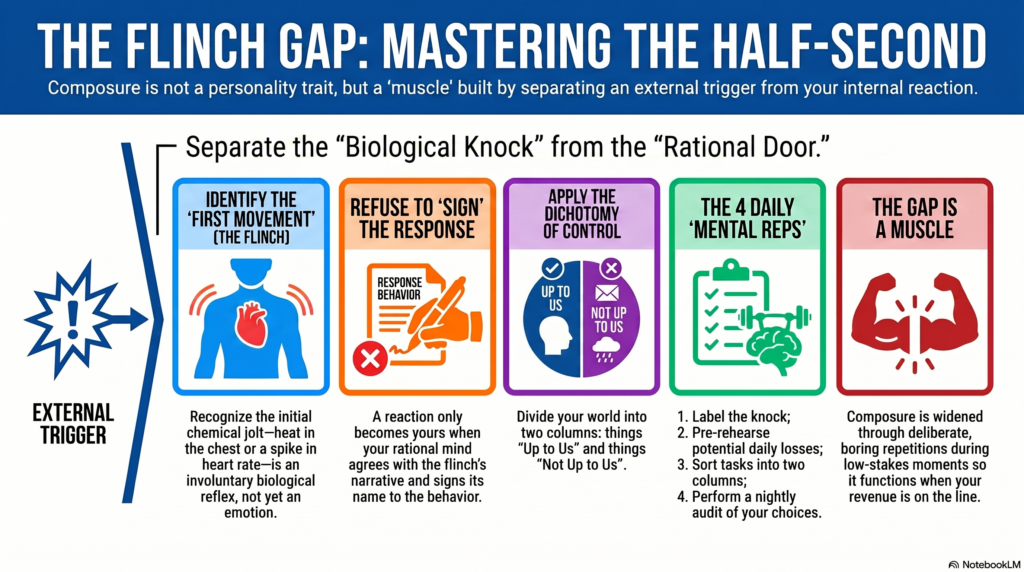
If you want to build this stoic self-mastery capacity so it works when your business or revenue is on the line, you have to practice when the stakes are low. Here are the four daily stoic self-mastery exercises that actually move the needle:
1. Label the Inbound Stimulus
The second you feel your heart rate spike—whether it’s a bad slack message, a driver cutting you off, or a passive-aggressive comment from a colleague—name it immediately. Say it out loud if you are alone, or silently if you are not: “That is the knock.” You aren’t suppressing the emotion; you are simply refusing to give it your signature.
2. Premeditatio Malorum (The Morning Loss Run)
Before you open your laptop, spend exactly two minutes running a simulation of what will likely go wrong today.
-
The difficult client will be cold.
-
The train will be delayed.
-
The crucial software update will fail.
This isn’t pessimism; it’s psychological inoculation. A disaster that you have already shaken hands with at 7:00 AM cannot ambush you at 2:00 PM. You strip away its primary weapon: surprise.
3. The Two-Column Cleanse
This stoic self-mastery exercise requires only a pen and paper: draw a line down a scrap piece of paper every morning. On the left side, list everything within your direct control today (your work output, your diet, your language). On the right side, list everything that isn’t (other people’s moods, the market, the algorithms). Look closely at the right column, acknowledge it, and consciously leave it on the page.
4. The Nightly Audit
Before you sleep, sit in the dark and mentally review your day. Do not use this as an excuse to beat yourself up. Approach it like a dispassionate scientist reviewing lab data. Ask three simple questions:
-
Where did I open a door I should have kept closed?
-
Where did the first movement trick me into an action?
-
What did I trade my peace of mind for today, and was it worth the price?
7:52 AM: The Sequel
I did not send that email.
I stared at the furry Post-it note, took a deep breath, and set my phone face-down on the wooden desk. I stood up, walked to the kitchen, and finally made the cup of coffee I had forgotten about. Then I walked down to the end of my street and back in the cold morning air. The whole process took four minutes, but it required an agonizing amount of restraint.
When I returned to my desk, the chemical flush had cleared. The “first movement” had passed.
I deleted the surgical, bridges-burning masterpiece and wrote a completely boring, three-sentence response. I asked for clarification on what specific parts of the project had missed the mark, stated that I wanted to correct it immediately, and offered a calendar link for a brief call.
He booked a slot an hour later. The phone call lasted exactly ninety seconds. It turned out his “Disappointing” comment was directed at an external supplier’s delivery deadline, not my work—a nuance completely lost in a one-word, early-morning transmission.
We cleared it up instantly. The contract remained intact. The £11,000 stayed exactly where it belonged.
I don’t share this story because I have unlocked perfect serenity. I haven’t. The flinch still finds me almost every single day, right on schedule. The world will never stop knocking violently on your door.
But the door belongs to you.
That tiny, uncomfortable half-second you are tempted to skip—the space between an external event and your internal reaction? That isn’t an empty gap in your workday.
That is the only part of your life you actually own. That gap is stoic self-mastery, distilled to its simplest form.
Go deeper:
- Read the original on Medium: I Almost Sent the £11,000 Email
- Watch the short film: The Flinch Gap on YouTube
- Run the reps: The 21-Day Flinch Gap Field Journal