
The short essay that started all of this is on Medium. The 3-minute version is on YouTube.
In 2026, the detail you’d cut is the detail that earns. Here’s why.
Why the smallest details in personal writing are doing the most work — and why most writers, including me until recently, have been ignoring them.
Three years ago I read a 700-word blog post by a stranger about her father’s bad knee. I was on the 9:47 from Manchester to Euston, somewhere around Stoke. I cried so quietly that the man across from me didn’t look up from his Sudoku.
She’d written about the specific way her father stood up from his armchair. Both hands on the armrests. A small exhale before the lift. A smaller one after. That was the whole piece. No conclusion. No takeaway. No call to action. Just the chair, the exhale, the lift, the exhale again.
I emailed it to my sister, who hadn’t spoken to our father in two years. She replied within an hour. She wanted to know how to write something like that.
I didn’t know how to answer. I’d been writing — and reading writing — for fifteen years, and I knew the chair piece had done something almost nothing I’d written had done. I just couldn’t say what.
It took me three years to be able to.
What I now call ordinary proof
What that woman had, and what most writers (including me at the time) didn’t, is what I now call ordinary proof.
Ordinary proof is the small, low-shimmer, slightly embarrassing detail that proves a writer was actually there. Both hands on the armrests. The small exhale. The chair. Not “watching my father age.” Not “the painful experience of seeing a parent decline.” Not “what dementia taught me about love.”
Those are concepts. The chair is evidence.
When a reader encounters concepts, they have a choice about whether to believe them. When they encounter evidence, they don’t. The evidence does its own work. The reader’s nervous system recognises the chair before their conscious mind catches up.
This is the engine. The piece doesn’t move you because it’s beautiful. It moves you because, for a moment, it’s the only piece of writing in the world that was definitely written by a person who was definitely there.
The frozen peas, briefly
I learned the same thing from the other end.
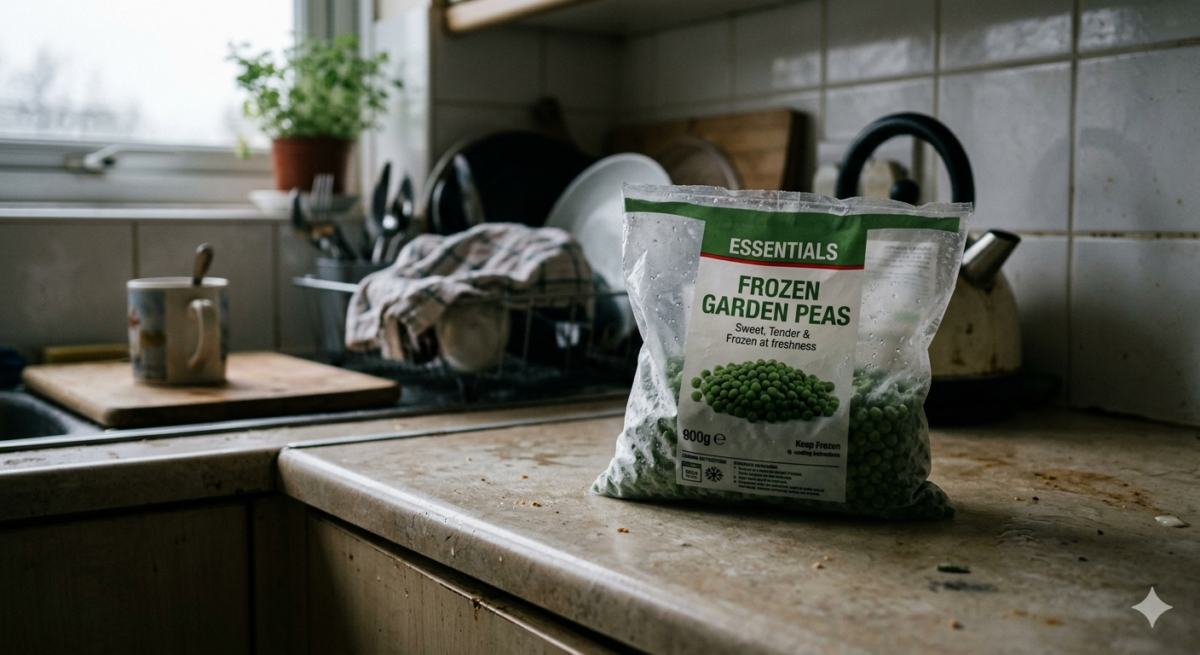
A while back I cried in the freezer aisle of a Co-op on a Tuesday in February, holding a bag of own-brand garden peas. I wrote 600 words about it, didn’t think it was much, published it almost as an afterthought between two essays I was considerably prouder of.
The peas piece earned roughly forty times what the serious essays earned, combined. People emailed me about it for months. They told me about their own freezer-aisle moments — a Waitrose, a Carrefour, a Whole Foods on a particularly awful Saturday. None of them mentioned the serious essays. Several of them quoted the bit about the man pretending to read the pizza label.
I eventually wrote a piece about that. It’s on Medium. The Medium piece is a single anecdote and a single argument; what I want to do here is bigger.
The question is: why.
Why does the chair work. Why do the peas work. Why does the most carefully constructed sentence about grief get scrolled past while a single line about how your grandmother used to fold tinfoil to reuse it generates four hundred comments.
The answer matters now in a way it didn’t even three years ago.
Why this is suddenly a 2026 problem
The case for writing about ordinary things used to be aesthetic. It’s nice. It feels real. The good essays are the small ones. That was enough. You were a slightly more literary writer than the people writing 5 Lessons I Learned from Failing Quietly. You felt smug. Sometimes you got an essay into a journal that paid in copies.
That changed in the last eighteen months.
What changed is that the world now contains, for the first time, an enormous quantity of competent writing not produced by a person. Some of it is bad. Most of it is mid. A small amount of it is genuinely good in the surface ways we used to use to judge writing — well-paced, well-structured, well-thought-out, well-edited.
Readers can tell. Or rather: readers can almost-tell, which is worse than telling. They have a constant background process running that asks, of every piece of writing they encounter, was this written by a person? — and that process is now louder than the appreciation process. The aesthetic experience of reading is contaminated by a constant low-grade authentication problem.
In this environment, ordinary proof stops being aesthetic and starts being structural.
What AI cannot do — what it genuinely, mechanically cannot do — is invent the chair. It can invent a chair. It can describe a chair in moving prose. What it cannot give you is the specific chair this writer’s specific father stood up from on a specific Sunday in 2019 in a specific Premier Inn off the A1, after a specific argument about whether the bacon was overdone. The combination of small, embarrassing, mundane specificities is the one thing it can’t fake. Faking them just produces a different, generic-feeling list of specificities. They have to be true, in the boring sense. AI doesn’t have a life.
Writers who can produce ordinary proof reliably are now in possession of the only currency that hasn’t been counterfeited.
The writers who survive the next five years are not going to be the most lyrical, the most intellectual, or the most prolific. They are going to be the ones whose work cannot be confused with something a model produced.
That’s it. That’s the whole game.
What ordinary proof is actually made of
So how do you produce it.
Ordinary proof has four components, in my reading. None is decorative. All four need to be present for the piece to land.
1. Specificity that costs the writer something
The chair is specific. But the more important thing is that the chair could have been omitted. The woman who wrote about her father’s knee could easily have written “I watched my dad get older” and moved on. The choice to include the hands on the armrests costs the writer something — it admits she was watching, and watching closely, and watching with a particular tenderness she might not want to claim out loud. The cost is what makes it credible.
A specificity that costs nothing is description. A specificity that costs something is testimony.
When you read your own draft, ask: which details did I almost cut? Those are the ones doing the work.
2. A timestamp
Last week is dead. Last Thursday at half four is alive. On the 9:47 from Manchester to Euston, somewhere around Stoke is more alive still.
A timestamp is a kind of oath. It says: I am committing to a verifiable point in time. I am foreclosing on the possibility that I made this up. I am, in a small way, swearing.
Readers can feel oaths even when they don’t notice them. A piece without a timestamp floats. A piece with one is located. Located prose is harder to dismiss.
3. A sensory channel that isn’t sight
Visual writing is cheap now. Anyone can do it. AI can do it.
The other senses are harder. The smell of the freezer aisle. The hum of the fridge against the slightly different hum of the strip lights. The taste of crying into a tuna baguette. The way a bus seat feels through summer trousers. The fact that the trolleys at that specific Co-op all pull slightly to the left.
If a paragraph is doing its emotional work through only the visual channel, it’s underweight. Add at least one other sense — preferably touch, smell, or sound — and the paragraph stops being a description and starts being a room the reader is standing in.
4. A small, specific embarrassment
This is the one most writers resist. It’s also the most important.
A piece without embarrassment reads like brochure copy. A piece with even one moment of small, specific, slightly shameful detail — the fact that you bought a microwave lasagne, the fact that you cried at the line about the dog, the fact that you went back to check your text three times before realising it had sent — is a piece written by a person.
You can spot a writer who has internalised this. They write about themselves the way a friend would describe them. Not the way they’d describe themselves to a stranger at a networking event.
Embarrassment is the difference between writing “I read for an hour before bed” and writing “I read four pages of the same novel for an hour before bed, mouth slightly open, re-reading the same paragraph three times because I kept thinking about the email.”
The second one was you. The first one was your CV.
The trophy and the fossil
Here is the metaphor I keep coming back to.
Most writing on the internet is trophies. Achievements polished and angled toward the light. The promotion announcement. The launch post. The “I left my corporate job and now I run a six-figure business” arc. The lesson learned. The transformation.
Trophies are suspicious now. We’ve seen too many of them. The trophy says look what I did. The reader, exhausted, scrolls past. Worse: the reader assumes the trophy is partially fake, or fake in some hard-to-articulate way. Trophies are in the same epistemic neighbourhood as influencer ads.
Fossils are different.
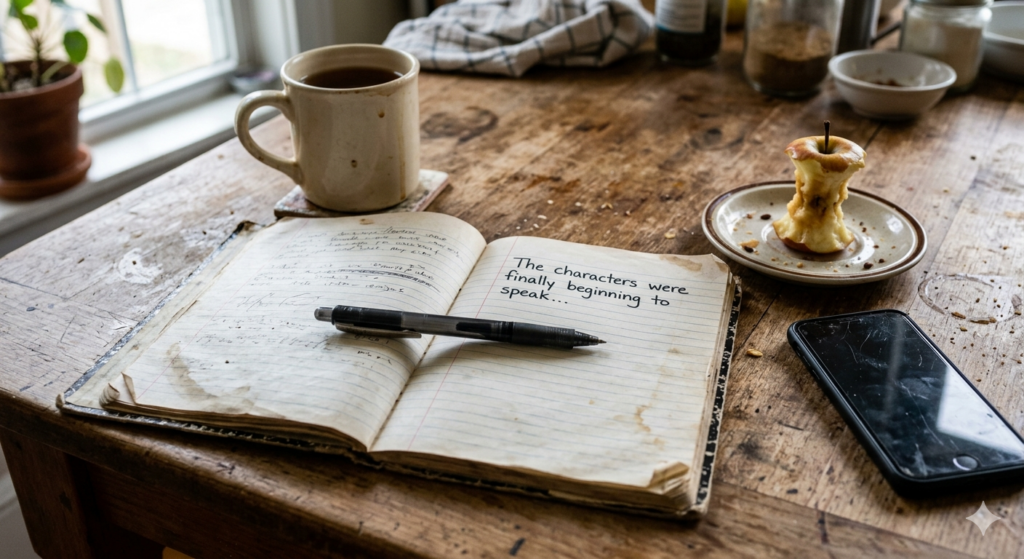
A fossil is what happens when something ordinary gets pressed into the rock by accident. A leaf in mud. A footprint in clay. A bag of peas on a Tuesday. Nobody sat down to make a fossil. It got there by being real and then being preserved.
When you read someone else’s fossil, you don’t feel sold to. You feel found. You feel like a stranger has reached across time and recognised something in you that you’d thought was just yours.
The economics matter here. The market for trophies is saturated and approaching zero. Every platform is drowning in them. The market for fossils is wide open — partly because they’re harder to make, partly because most writers haven’t realised the rules have changed — something I explored in more depth in Why Your Best Ideas Keep Dying in the Feed.
Stop curating trophies. Start preserving fossils.
The three mistakes that destroy it
Three things writers do that destroy ordinary proof. I have done all of them, repeatedly, and still catch myself doing them.
Generalising the moment to make it “more relatable.”
“I think we’ve all had that experience where…”
No.
The reader hasn’t. The reader has had a specific experience that resembles yours, and the resemblance only registers if you stay inside your specific one. Generalising is an act of cowardice that pretends to be an act of generosity. It is the writer asking permission to be there. The reader doesn’t want a writer who needs permission.
Concluding for the reader
This is the most common failure mode in personal essays.
You set up a vivid scene. Then, terrified the reader won’t get it, you spend three paragraphs explaining what the scene meant.
Don’t.
The reader will draw the lesson; that’s their job. When you do it for them, you take away their seat at the table, and they will resent you for it whether they know it or not. The chair piece worked because there was no paragraph after the chair. There was just the chair.
Smoothing
The instinct to make every sentence rhyme with every other sentence, every paragraph the same length, every transition graceful.
This is the thing AI does best and the thing that now reads most as AI.
Asymmetry is now a credential. Leave the rough edge. Leave the abrupt pivot. Leave the sentence that runs on for too long and then cuts to a fragment.
Like this.
Eight practices, if you want to try this
None of these is a productivity hack. All of them are small choices about what to keep and what to cut.
- Keep a small notebook for the wrong thoughts.
The thoughts you’d never tweet, never tell a friend, never use in conversation. The petty observations. The mean ones. The embarrassed ones. - Write the moment, not the conclusion.
Show me the peas. Don’t tell me what the peas meant. - Use the exact time.
Half four on a Thursday. 8:14 in February. The 9:47 from Manchester. - Name a specific shop.
Co-op. Tesco Express. The Waitrose with the loose-fitting door. - Include a sensory channel that isn’t sight.
Smell, sound, touch, taste. - Keep one detail that embarrasses you.
The cheap thing you bought. The petty thing you thought. The minor humiliation you’d cut if you were performing for an audience. - Write the first draft fast and the second draft slow.
The first draft captures the moment. The second draft removes the performance. - Read your draft aloud.
The overly smooth bits are usually the false bits.
When this doesn’t work
Ordinary proof isn’t a universal solvent.
It doesn’t work for instructional writing, where the reader needs clarity over presence.
It doesn’t work for pure argument, where the writer needs to disappear into the logic.
It doesn’t work for satire, where the form has its own demands.
It doesn’t always work for fiction, where the proof has to be invented and the invention is the point.
What it does work for is the form most people now mean when they say writing: the personal essay, the memoir fragment, the Substack post, the long social-media thread.
If you’re writing one of those, ordinary proof is no longer optional. It’s the only thing standing between your writing and the ocean of competent, plausible, frictionless prose the rest of the internet is now drowning in.
A slightly heretical position
I think the next five years of writing advice are going to be wrong in a particular way.
There will be endless content about how to use AI to make your writing more efficient, more polished, more consistent.
Most of it will be written by people who haven’t noticed what’s happening to the value of polished writing.
Polished writing is the thing AI does best.
By definition, optimising for it is optimising for the thing the reader has already started filtering out.
The advice I would give a writer starting now is the opposite.
Get rougher. Get more specific. Get more embarrassing. Stop trying to sound like a writer. Start sounding like a person who happens to be writing.
The economic incentives have flipped.
The aesthetic incentives are about to follow. If you want to understand where you stand, the AI-Resistance Self-Assessment is a useful diagnostic.

The chair, still
I never replied to my sister.
I meant to. I drafted three different responses to her email, all too long and too explainy. One was 1,800 words and ended with “so I think what she did was just trust the chair.” I deleted it.
What I should have said, and what I’m only now able to articulate, is this:
The woman didn’t do anything.
She didn’t have a technique.
She had a chair, and a father, and a Sunday, and she had enough confidence in the chair to leave it on the page without polishing it.
That was the whole craft.
My sister called our father the following spring. I don’t know what role the blog post played in that, if any. Probably none. But I know that for two and a half years she’d been waiting for a version of the situation to feel true enough to act on, and that the woman who wrote about the chair gave her that, and that the woman who wrote about the chair will almost certainly never know.
That is what ordinary proof does.
It reaches strangers and lets them act on their own lives.
It does this quietly, slightly accidentally, without ever announcing itself.
If you’re writing — and especially if you’re writing about your own life — that is the thing worth optimising for.
Not the trophy.
The fossil.
Enjoyed this essay?
Pushed for time? This video summaries the main points:
I write about writing, reading, attention, memory, and ordinary things most weeks.
Read the companion Medium piece here, which tells the story of the freezer-aisle peas in more detail.
More from A Fulcrum:
- The peas essay (Medium) — the short piece that sparked this one
- Full video breakdown on YouTube — 12 minutes on why AI can’t fake the chair
- 3-minute short — the core argument, fast
- Ko-Fi shop — if this kind of thinking is useful