Read time: ~12 min. Also available as a shorter essay on Medium and a 7-minute video on YouTube. The companion journal — The Door Audit — is available if this lands.
The Danish philosopher who saw your panic attack coming before electricity did.
Why this matters now: Anxiety diagnoses in adults under 35 have climbed for fifteen consecutive years — and most of what we’re selling as treatment is repackaged 19th-century philosophy. The original is sharper, cheaper, and still unanswered.
Kierkegaard anxiety — the idea that dread is built into human freedom itself — is not a metaphor. Anxiety isn’t a chemical imbalance.
Or rather — sometimes it is, but mostly it’s a philosophical condition we’ve been mistaking for a medical one for the better part of a century.
I’m not saying that to be provocative. I’m saying it because a slightly hunchbacked Danish theologian with a fragile voice and a broken engagement wrote a short book in 1844 that has, in retrospect, described the inner life of a thirty-two-year-old in 2026 better than most of what’s been published in pop psychology this decade.
His name was Søren Kierkegaard. He died at forty-two, having spent most of his adult life walking the streets of Copenhagen, watching well-dressed people pass him on the way to dinner parties, and being quietly horrified by what he saw. The book was The Concept of Anxiety. In it, he made a claim that has aged the way good prophecy ages — not less accurate over time, but more.
He said anxiety is the dizziness of freedom.
That sentence does not look like much sitting on the page. Sit with it for a moment.
The Architecture of Too Much
You have, statistically speaking, more options than any human in history.
You can choose what city you live in, what work you do, who you sleep with, what god you pray to or don’t, what gender you present as, what your face looks like next Tuesday with a few thousand dollars and a steady hand. You can begin and end relationships from your couch. You can quit your job in an email and find another by morning. You can refuse to ever speak to your family again and your social fabric will absorb the gesture without comment.
None of your ancestors had any of this.
Your great-great-grandmother had her village, her god, her trade, her husband (likely assigned, possibly cruel), her death (likely in childbirth, likely young). The vocabulary of options did not apply to her life. The vocabulary of anxiety — in the modern, free-floating, why-do-I-feel-like-this sense — barely did either. Her inner life had problems. They were specific. They had names. They could be addressed by prayer, drink, or a sharp word to her sister-in-law.
We have inverted her position completely. And we are, by every available metric — clinical, pharmaceutical, sociological — coming apart. Anxiety diagnoses among young adults have risen sharply in the last fifteen years. We’re prescribing SSRIs to teenagers in numbers that would have alarmed psychiatrists in 1995. The most-Googled questions about life all begin with the word why.
You’d think more freedom would mean more peace.
Kierkegaard would say: you are reasoning backwards. Of course it doesn’t. It couldn’t. Freedom is what produces the condition you’re trying to escape.
The Dizziness of Freedom: Kierkegaard’s Anxiety Explained
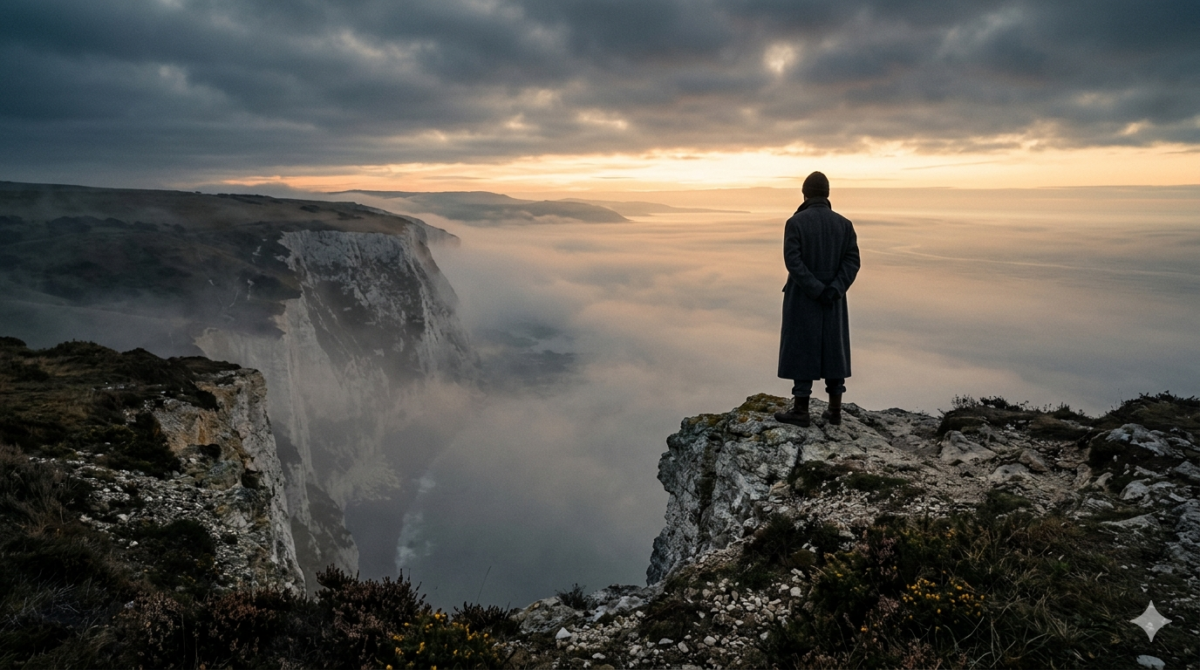
Picture yourself, Kierkegaard said, standing at the edge of a cliff.
You look down. Your stomach drops. You feel sick. Most people would tell you this is fear — fear of falling, fear of the rocks. But Kierkegaard noticed something stranger about the feeling.
You’re not afraid of falling.
You’re afraid of the fact that you could jump.
Nothing in the laws of physics, your morality, your biology, prevents you from taking one step forward and ceasing to exist. The vertigo at the cliff edge is not the vertigo of danger. It is the vertigo of possibility. The danger is outside you. The possibility is inside you. And the possibility is the part that makes you ill.
This is what he called anxiety — the sickly, weightless feeling of contemplating your own infinity of options. Fear, in Kierkegaard’s distinction, has an object. Anxiety doesn’t. Fear says: that bear is going to eat me. Anxiety says: I could become anyone and I don’t know how to stop noticing this.
Now extend the metaphor.
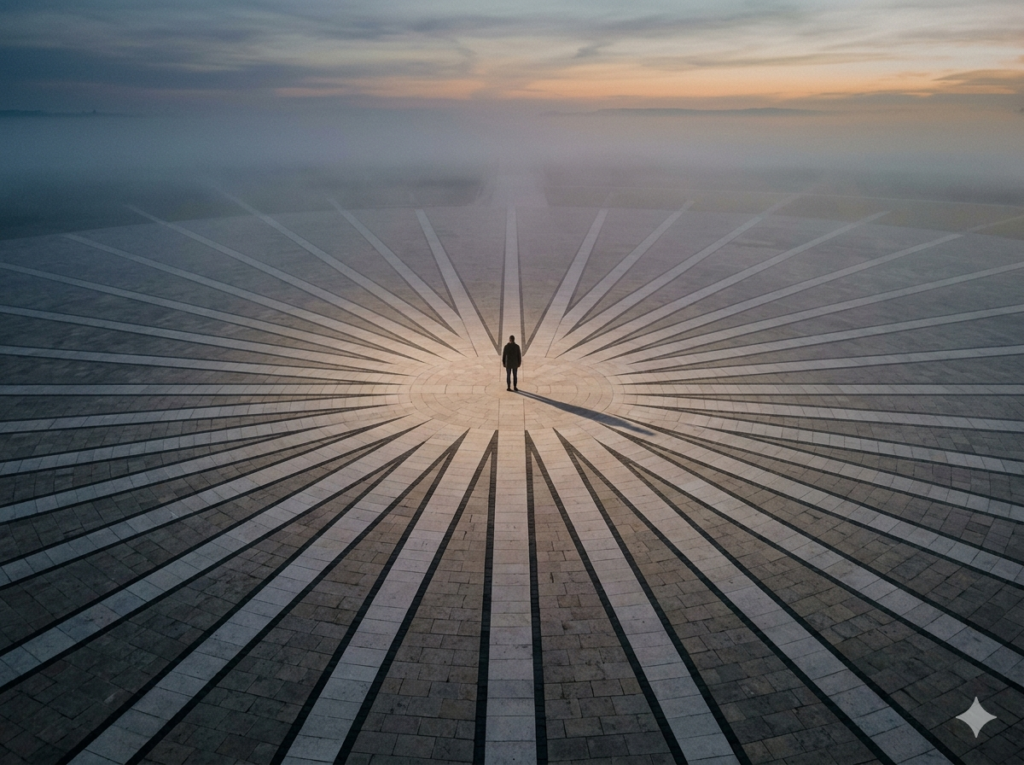
You no longer live in a small village with a small set of paths. You live on a cliff that is also a buffet. Every direction is a possibility. Every relationship is a tab you’ve left open. Every career is a draft you haven’t saved. Every aesthetic, every politics, every body, every god is an option you have not yet ruled out, which means it remains a thing you might, in some other version of your life, become.
The cliff you live on is enormous.
The wind is constant.
You are not broken. You are dizzy.

The Aesthete’s Trap
Kierkegaard wrote about a particular kind of person, whom he called the Aesthete.
The Aesthete is not, despite the name, an art critic. He’s a way of being. He’s the person who organizes his life around the avoidance of boredom. He chases moods, novelty, sensation. He becomes briefly enchanted with things and then briefly disenchanted with them and moves on. He keeps a kind of inner ledger of how interesting he is currently being. He is committed to nothing, because commitment is the slow death of all the other selves he might still become.
In Either/Or, Kierkegaard puts a long essay in the Aesthete’s mouth on what he calls the rotation method. The argument is that the only sane response to a world full of possibility is to keep rotating — never staying long enough with anything to let it become tedious. Don’t read a book twice. Don’t see the same friend too often. When a romance threatens to become a relationship, end it.
Read that paragraph again and tell me, honestly, whether you’ve met him.
He is the man you went on three dates with who would never commit but was always almost committing. He is your friend who has been about to leave his job for five years. He is the version of you that appears at eleven at night with three apps open, none of them holding your attention, all of them slightly soothing the feeling that you might be missing something elsewhere.
He is — and this is the part Kierkegaard saw with terrifying clarity — the model citizen of the internet.
The phone in your pocket is not just a device. It is the aesthetic life rendered as infrastructure. It is the rotation method, mechanized, served to you by algorithm, scaled to four billion people, with a glowing rectangle for compliance.
The Aesthete, Kierkegaard noticed, is never actually happy. He is only ever almost happy, and then bored, and then chasing the next almost. This is not a flaw in his strategy. It is the strategy working perfectly. The strategy was never to find joy. The strategy was to never have to choose.
The Tax on Possibility
Here is the line I want to give you, because it’s the one that, when I first thought it clearly, changed something in me.
A possibility is free. An actuality costs you everything else.
As long as something is possible — the novel you might write, the city you might move to, the person you might marry, the version of yourself you might one day be — it is free. It costs you nothing, because nothing is the price of imagination. You can hold a thousand possibilities in your head and they will not invoice you.
Until you choose one.
The moment you choose, that possibility becomes an actuality, and the bill comes due in the most painful currency there is: all the other possibilities, which you must now murder. To marry one person is to refuse every other person you have ever found beautiful, and every one you have not met yet. To commit to one career is to euthanize all the other lives you could have led. To write one book is to admit, by silent omission, that you will not write the other twelve floating in your head.
We avoid this transaction.
We avoid it so completely that we have developed an entire culture around what looks like sophistication but is actually evasion. Keeping your options open. Not labeling things. Seeing where this goes. Staying flexible. Not boxing yourself in. These are not different strategies. They are the same strategy in different clothes. The strategy is: never pay the tax. Hold the possibilities. Be all of them, theoretically, forever.
The trouble is that holding possibilities, despite being free of cash cost, charges interest in another currency.
It charges you presence.
You cannot be fully here with the person you are with if you are also still entertaining the ghost of everyone you didn’t choose. You cannot be fully in the job you have if every Sunday you mentally re-open the spreadsheet of the careers you didn’t take. You cannot be fully writing the book you are writing if you are perpetually negotiating with the other six.
The Aesthete’s secret is not that he refuses to grieve. It’s that he refuses to know he’s grieving. Underneath every kept-open option is a small, unburied corpse — the version of you that would have lived that life if you had let it. The corpses pile up. The pile is what we call anxiety.
The Either/Or
Kierkegaard’s prescription has a brutal simplicity. He called it Either/Or.
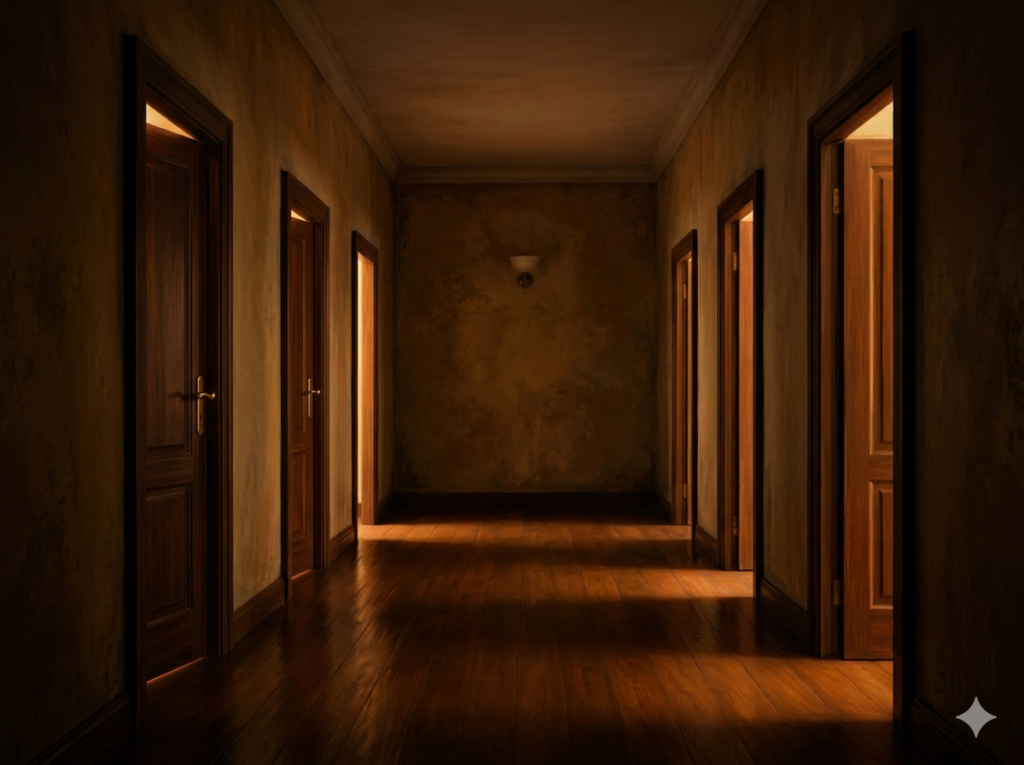
Either you choose, or you don’t. There is no third option. The illusion that you are deciding when to decide is itself a choice — the choice to remain the Aesthete, to remain in possibility, to remain dizzy. Non-choice is choice. The man who cannot pick a partner is picking. The woman who cannot leave the job is leaving every day, by staying.
What he wants you to understand is that choosing is what creates a self.
You are not a fixed person who selects from options. You are an unformed cloud of possibility that becomes a self by the act of cutting away everything you are not. The shape of who you are is determined by what you refuse. The sculptor doesn’t add — he removes. Marble plus chisel minus stone equals David.
Possibility minus refusal equals you.
This is why the people who strike us as most themselves are almost always people who have closed doors decisively. Somewhere in their lives they have said: this and not those. They have married this person, not the others. They have made this thing, not the things they could have. They have stopped negotiating with their alternate lives.
This is also, incidentally, why they seem less anxious than the rest of us. Not because they have escaped the human condition. Because they have stopped fighting it.
If you’re carrying a kept-open right now: The Door Audit is a 7-day workbook for identifying which doors you’ve been keeping open and closing one — clearly, without the vertigo. Built around the same ideas in this essay.
The Leap
Kierkegaard called the move from possibility into actuality the leap.
Modern readers tend to assume the leap is religious — the leap of faith. Sometimes it is, in his work. But the deeper, more useful sense is simpler: the leap is the move from could to is. From entertaining a future to inhabiting one. From the limbo of options to the dirty, finite, irreversible commitment of having chosen.
The leap is not pretty.
You cannot rationally justify it, because rational justification requires comparing this option to all the others, and you cannot finish comparing — there are too many, the future is not legible, and you are not omniscient. At some point you must close the spreadsheet, walk out of the building, and choose. Not because the math worked. Because waiting longer would not improve the math, and you have a life to live, and a life is something you can only live by committing to a particular shape of one.
The leap is, finally, a kind of trust. Not necessarily in God. In the actual. In the proposition that one chosen life — one real, lived, scarred, embodied life — is worth more than a thousand pristine theoretical ones. That the actual outranks the possible. That a small chosen thing beats a vast unchosen one.
When I left a career I’d spent a decade preparing for, in my early thirties, with no plan and a great deal of vertigo, this is the thing nobody told me and the thing that would have helped: it doesn’t matter, in the end, whether you make the “right” leap. The leap itself is the point. The leap is the move from inhabiting your mind to inhabiting your life. You can correct course after a leap. You cannot correct course at the edge of the cliff, because at the edge of the cliff you are not moving. You are only dizzy.
The Constraint That Frees
I’ll close with the inversion Kierkegaard wants you to see, because if you see it, the rest will follow.
We have been taught that freedom is the menu — that more options means more liberty, that to be unfree is to be limited, and to be free is to have access to everything. This is the picture sold to us, very loudly, by everything that wants our attention and our money. The picture is wrong. It produces what we are watching it produce: a generation of intelligent, optionful, exhausted people who cannot tell the difference between being unable to choose and being unwilling to.
Real freedom is not the menu. Real freedom is the meal.
It is the peace of having ordered. It is the relief of putting the laminated card back into the holder and turning, finally, to the person across from you. It is the lightness — and this is the joke Kierkegaard saw a hundred and eighty years ago — of being not less constrained but more.
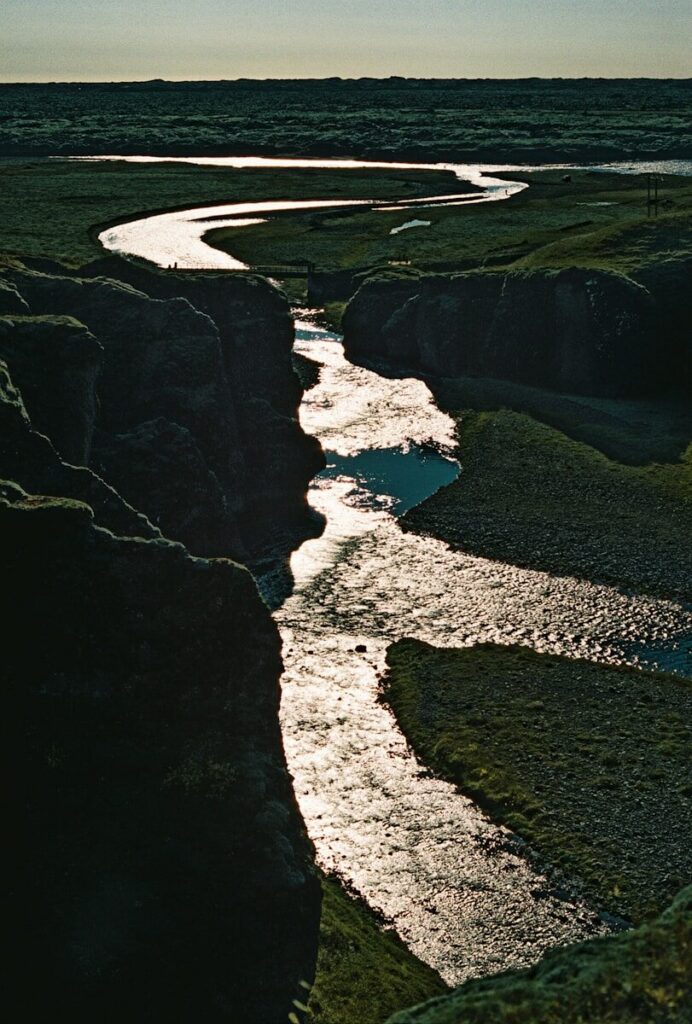
A river is not freer when it floods. It is most itself when it has banks.
So if you are anxious — really, persistently, ambiently anxious in the way most people you know are anxious — try the experiment Kierkegaard offers, before you reach for anything else. (Reach for anything else too, if you need to. I’m not your doctor.) Identify the thing in your life you have been keeping open. The relationship you have been figuring out. The career you have been exploring. The version of yourself you have been considering. Find the door you have refused to either walk through or close.
Then close it. Or walk through it.
Either is acceptable. The third option — the one you’ve been running — is the one that will keep killing you slowly.
This is what he meant.
He didn’t mean that life is small. He meant that you are — not yet, not quite, not all the way — until you choose a shape and pay for it. The shape is what philosophers since have called a self. The payment is what we, here, in the strange new century he never saw but somehow described, have been calling anxiety.
Pay it.
You’ll be lighter in the morning.
🪞 The five lines worth saving from this essay
If you take nothing else, take these. Most of what’s wrong with the modern interior compresses into them.
- Anxiety is the dizziness of freedom — not a malfunction, but the natural response of a finite creature to infinite possibility.
- A possibility is free. An actuality costs you everything else. That is why you don’t choose.
- Non-choice is itself a choice — the choice to remain dizzy.
- A self is not chosen from a menu. It is sculpted by what you refuse.
- Real freedom is not the menu. It is the meal.
A question I’d genuinely like answered in the comments
What is the door, in your life right now, that you have refused to either walk through or close?
You don’t have to name it. Just notice it. That noticing is the first thing on the other side of the leap.
About the man behind the diagnosis
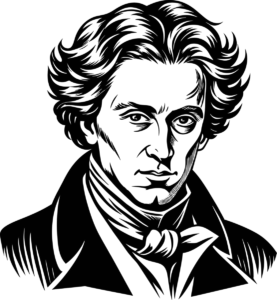
Søren Aabye Kierkegaard (1813–1855) lived almost his entire short life in Copenhagen, walking the city for hours every day in a heavy coat and writing at a standing desk in a fourth-floor apartment. He broke his engagement to a woman named Regine Olsen in 1841 and never recovered from the choice; she is mentioned, in coded ways, in nearly everything he wrote afterward. He published most of his major books under pseudonyms — Johannes Climacus, Anti-Climacus, Victor Eremita — because he believed the truths he was after could not be delivered by a single, settled “Kierkegaard” but had to be staged, like a play, between conflicting voices in the reader’s own head. The strategy worked. Two centuries later we are still listening to the voices arguing.
If you want to read him directly, start with Either/Or (the long essay called The Rotation of Crops in Volume I is the one that will make you put the book down and stare at the wall). Then The Concept of Anxiety. Then Sickness Unto Death, which is the bleakest and the kindest of the three.
Explore the full ecosystem
- Shorter read (Medium): Søren Kierkegaard Named Your Anxiety in 1844
- Video breakdown (7 min): Watch on YouTube
- 2-min short: The Dizziness of Freedom (YouTube Short)
- Companion workbook: The Door Audit — £5 on Ko-Fi
If something here landed, I write one essay like this each week — on philosophy, psychology, and the practical work of being a person in a century neither of us asked for. You can find more pieces under my profile, or A Fulcrum on Medium to get new ones in your inbox.