

My 90-Day ChatGPT Experiment ended in disappointment. The dashboard didn’t just report a loss; it reported a failure of soul.
$12.43.
That was the total payout for seven days of “peak productivity.” Seven articles, 12,000 words, zero typos, and enough SEO keywords to choke a search engine. I had spent three months building a “content machine” that was technically perfect and fundamentally unreadable.
I sat there in the amber glow of my desk lamp, the tea on my desk having reached that skin-forming coldness that signals a wasted afternoon. The laptop fan was the only sound in the room. I felt a mix of relief and profound embarrassment. I had “automated” my way into irrelevance.
Three months earlier, I was the one preaching. I told my colleagues I had “removed myself as the bottleneck.” I had custom instructions, multi-step chains, and a “voice” prompt that I thought made the machine sound like me. I was producing 5x the volume with 10% of the effort.
Then I watched the Read Ratio—the only metric that actually matters—crater. It fell from a healthy 45% to a flatline of 12%. People were clicking. The headlines worked. But the moment they hit the first paragraph, they smelled the “synthetic” and bailed.
Here is why that happened, and the exact framework I use now to ensure my writing never feels like a brochure again.
I also wrote the original version of this on Medium, and talked through it on camera here.
The “Polish Trap”: Why Perfect is the New Boring
We’ve been conditioned to think that good writing is “clean” writing. We want smooth transitions, logical flow, and zero grammatical friction.
The problem? AI is better at “clean” than you will ever be.
When you compete on being polished, you are entering a race against a machine that works for free and never sleeps. You are competing on a commodity level. If your writing is just a summary of facts delivered with professional poise, you are a Wikipedia entry with a worse UI.
The realization: Readers don’t come for information anymore. They can get information from a LLM in four seconds. They come for the Friction.
They come for the specific, slightly humiliating texture of a human being who has actually tried the thing. AI writes from a mountaintop it never climbed. It gives you the “view from nowhere.”
I call this “Polish Rot.” It’s the phenomenon where the more you buff a piece of writing to make it “professional,” the more you sand off the very things—the scars, the weird metaphors, the jagged opinions—that make a reader trust you.
The “Scar Tissue” Framework
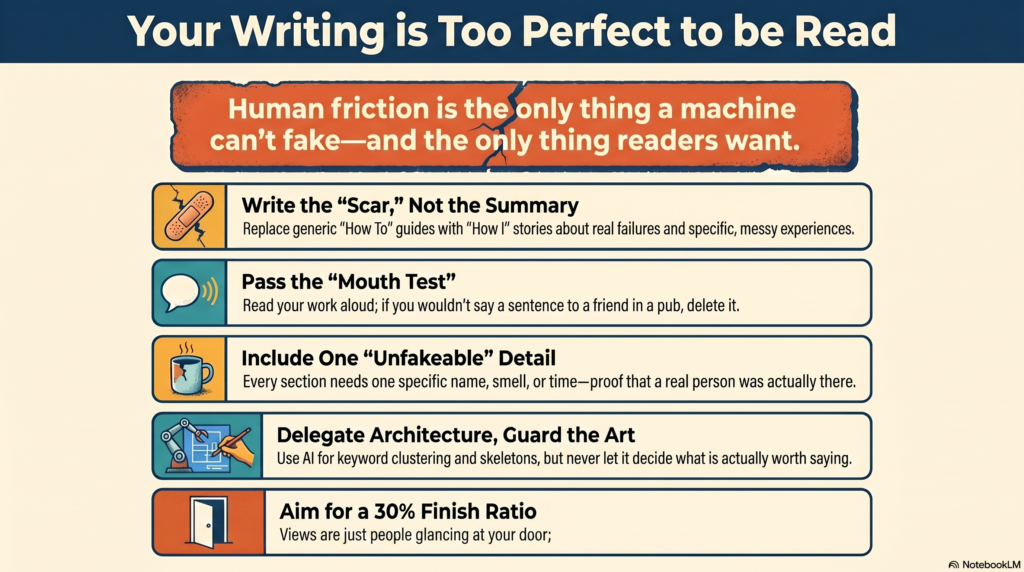 Real expertise is mostly scar tissue. A language model has none. To survive the AI era, you have to write the Scar, not the Summary.
1. Stop Writing “How To.” Start Writing “How I.”
“Five ways to improve your productivity” is a commodity. It’s a prompt away from existing.
“The Tuesday I realized my productivity system was just a fancy way to procrastinate” is a story.
One is a lecture; the other is a confession. Humans follow confessions. They skim lectures.
2. The “Mouth Test” (The AI Killer)
AI produces “Standard Written English.” Humans produce “Speech-Patterned English.”
The Test: Read your draft out loud. Not in your head. Out loud. Every sentence your mouth refuses to say naturally—the ones that sound like a corporate press release or a “delve into the landscape” intro—must be deleted.
AI passes grammar. It fails the mouth. If you wouldn’t say it to a friend in a pub, don’t publish it.
3. Kill the “Throat-Clearing” Paragraph
AI loves a preamble. “In today’s fast-paced digital world, it is increasingly important to…”
Delete it.
Start at the moment of crisis. Start at the $12.43. Start with the cold tea. Readers don’t want the warm-up; they want the dropped mug.
Caption: Scar tissue is the one thing a machine can’t fake—and the one thing readers actually came for.
Leave the Seams Showing
 I noticed a shift in my own reading habits. I no longer read top-to-bottom. I skim, looking for a “snag.”
AI writes in “Beautiful Grey Bricks.” Perfectly even paragraphs. Identical lengths. No handholds. It’s a wall built by something that has never had to hold a stranger’s attention for a living.
Now, I deliberately break my formatting to mirror the way a human thinks:
-
A short, punchy line.
-
Followed by a long, wandering sentence that doubles back on itself and maybe uses a word like “clunky” or “absurd” because that’s how I actually feel.
-
A fragment.
This lesson from my ChatGPT Experiment isn’t a “growth hack.” It’s a signal. It’s the sound of a human brain deciding what matters in real-time. A machine spaces everything evenly because nothing costs it anything. You space things unevenly because some of it cost you.
The “One Specific Detail” Rule
Every section of your article needs one detail only you could have written.
-
Not: “I worked in a busy office.”
-
But: “I worked in an office that smelled like burnt popcorn and stale Xerox toner.”
If a stranger could have written your sentence, it isn’t yours yet.
The “Architecture vs. Art” Split
I didn’t quit AI. That would be like a carpenter quitting the power saw. I just stopped letting the saw design the house.
I now follow a strict 80/20 Split:
| Hand Over to the Machine (Architecture) | Guard With Your Life (Art) |
| Keyword clustering and SEO mapping | The specific “Take” or “Angle” |
| Turning a 10-minute voice note into a bulleted list | The rhythm and cadence of the sentences |
| Playing “Devil’s Advocate” to find holes in my logic | The personal anecdotes and “Scars” |
| Summarizing long research papers | Deciding what is actually worth saying |
The mistake wasn’t using the tool. The mistake was letting the tool decide what was important. Those are not the same sin, and pretending they are is just a different flavor of lazy.
If you would rather watch this part: I broke down the “scar, not summary” idea in this short video.
The Metric That Saved My Business: The Finish Ratio
I stopped looking at “Views.” A view is a stranger glancing at your front door. It’s vanity.
I started obsessing over the Finish Ratio.
If a reader gets to the end, they trust you. If they trust you, they subscribe. If they subscribe, they buy.
I treat any read ratio under 30% as a code red. It usually means I’ve committed one of two sins:
-
The Click-Gap: My headline promised a burger and my body text delivered a salad.
-
The AI-Drone: I let the “Polish Rot” set in and the reader’s brain switched off.
The Fix: Write the headline last. Write it after the piece is finished, once you know exactly what you’ve actually delivered. Most writers write the headline first as a promise they haven’t earned yet.
Your 10-Minute “Humanity” Audit
If you want to go viral in 2026, you don’t need a better prompt. You need more of yourself. Do these three things before you hit “Publish” on your next piece:
-
Find the “AI-ism”: Scan for words like delve, unleash, testament, landscape, or transformative. If the word sounds like it belongs in a LinkedIn “Thought Leader” post, kill it.
-
Add a “Because”: Don’t just give a tip. Tell us why you learned it. “I use a paper planner because the blue light of my phone makes me feel like my brain is being microwaved.”
-
The Ugly Sentence: Leave one sentence in that is slightly “unprofessional” but deeply true.
The $12.43 Lesson From My ChatGPT Experiment
After my ChatGPT Experiment, the dashboard looks different now.
I’m still sitting at the same desk. The tea is still getting cold. But the numbers are moving in the right direction because there is finally someone on the other side of the screen. A real reader, finishing a real thing, instead of a thousand people sensing the “hollow” and slipping away.
$12.43 was a cheap price to pay for the realization that you cannot prompt your way to being worth reading.
Let’s do a quick audit. Go to your last published piece. Find the flattest, most “could-be-anyone” sentence in it—the one that smells like a machine wrote it. Paste it in the comments below.
I’ll start with my most mortifying one from the “dark period.” Let’s catch each other’s polish rot before it kills our income.
One more thing, if it is useful. After all this, I spent a year interviewing 312 people whose jobs had been handed to AI. 28% landed on their feet. 72% did not. I turned what separated them into a 30-question audit you can run on your own role: The AI-Resistance Self-Assessment. No prompt pack. Just the questions I wish I had asked before the dashboard read $12.43.