

A reply six days late, a heart emoji, and the two-month experiment that cured me of being everyone’s low-maintenance friend.
Last Thursday, I finally answered a text that had been sitting in my inbox for six days.
It was from Jess. A decade ago, I’d have called her my closest friend without needing to think about it. My reply was the standard apology template, the one we all keep pre-loaded:
I had, without noticing, spent a decade perfecting the role of the low-maintenance friend — the one who never asks, never needs, never inconveniences anyone. It’s the same reflex I once wrote about at work, where eating the loss quietly became a kind of professional virtue. Turns out I’d imported it straight into my friendships.
“So sorry! Work has been absolute chaos. Miss you, let’s catch up soon ❤️”
She replied within a minute. “No worries at all! We’re both so busy. Love that we can go months without talking and pick up right where we left off.”
I gave her message a heart reaction and put the phone face down on the sofa. The modern friendship script, executed flawlessly by both parties in under ninety seconds.
Well handled, I remember thinking. Very healthy. Very secure.
Then I sat in my quiet flat with a feeling I couldn’t immediately name. Somewhere between guilt and grief, but blurrier than either. Because “pick up right where we left off” only sounds warm until you look at where we actually left off. We left off at a heart emoji. That was the location. That was the whole address.
Two months later, because of that exchange, I sent Jess a very different kind of text. What came back is the reason I’m writing this. But to explain why, we need to talk about the lie we’ve all been sold about adult relationships.
Why this matters now: the U.S. Surgeon General flagged chronic loneliness as a mortality risk on par with smoking a pack a day, and most of us are still managing our closest friendships with three emojis and a “so busy!!”
Quick preview of what’s ahead:
- The 1950 stairwell study that predicts your friendships better than any personality test.
- Why the word “whenever” quietly kills more friendships than any argument does.
- The exact text I sent instead of my usual apology template, and the reply that came back an hour later.
- What “low-maintenance” actually costs you in trust, in plain terms.
If you want it in a different format: read the Medium cut, or watch the 60-second version if you just want the headline.
The Friendship That Asks for Nothing

Somewhere in the last ten years, being the “low-maintenance” friend became the highest compliment you can pay an adult friendship.
We brag about it. There are entire TikTok genres celebrating the friend who “doesn’t get mad when you don’t reply for three weeks.” Needing nothing gets framed as maturity. Asking for something gets framed as a red flag.
I want to be precise about what most of these friendships actually are, because “low-maintenance” is doing a lot of dishonest work in that sentence. It looks like:
-
Story reactions instead of phone calls.
-
A meme at 11:00 PM instead of a weekend plan.
-
“We should get coffee soon!” typed with the full, calm knowledge that no coffee will ever occur.
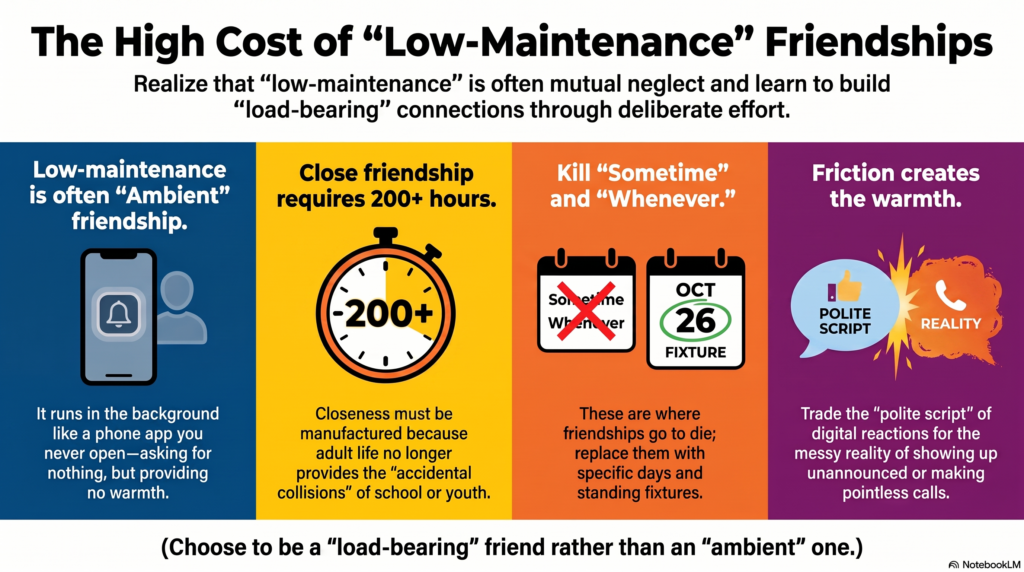
There’s a better name for this: an ambient friendship.
It runs quietly in the background of your life like an app you never open but can’t quite bring yourself to delete. It sends the occasional notification. It uses almost no battery. It asks nothing of you at all.
That last part is the entire selling point. It’s also the disease.
Mutual Neglect in a Boundary Costume
We tell ourselves the ambient arrangement is evidence of security. We’re not clingy. We respect each other’s time. We’ve read the attachment books.
Be honest, though. A lot of what we call low-maintenance friendship is mutual neglect wearing a boundary costume. We optimized our social lives for convenience and called the result peace.
There’s a healthy version of pulling back — psychologists sometimes call it strategic detachment, the professional skill of not absorbing everyone else’s stress. But what we do to our friends usually isn’t that. It’s neglect, wearing detachment’s clothes.
Here’s the part I didn’t want to write: I wasn’t a victim of this arrangement with Jess. I was a co-author of it.
A friend who demands nothing of you is also a friend who can’t catch you hiding, and I had been hiding for months. That six-day silence wasn’t busyness. I opened her message twice, felt the guilt spike in my chest, and closed the app. Twice. “Low-maintenance” was my cover story, and she was gracious enough to countersign it.
Now, some seasons of life genuinely are survival mode. New babies. Grief. The year a job eats you alive. Nobody owes anyone performance through those, and a friend who understands that is worth keeping forever.
The problem is never the season. The problem is the season quietly becoming the system.
And once it’s the system, the physics turn against you. We engineered the friction out of our friendships, then stood around wondering where the warmth went. Friction was the warmth. That is what friction does.
What Three Psychologists Learned from a Stairwell
In 1950, Leon Festinger and two colleagues at MIT studied how friendships formed in a married-student housing complex called Westgate West. They assumed the answer would be the obvious one: shared values, shared interests, compatible personalities.
That is not what they found. The strongest predictor of who became close friends was the physical distance between front doors. Next-door neighbors became friends far more often than people living four doors away. Residents whose flats happened to sit near stairwells and postboxes had noticeably richer social lives, for no reason other than accidental, repeated collision.
Festinger called it propinquity. Nearness, in routine and in space. Not chemistry. Collision frequency.
This explains something most of us have felt but never said out loud: childhood and university handed us propinquity for free. Corridors, lectures, lockers, the same bus home. Adult life strips out every bit of that scaffolding, then lets us believe the friendships failed on their own merits.
It’s a strange kind of via negativa in reverse. Normally, removing the wrong thing improves a system. Here, we quietly removed the friction — the calls, the check-ins, the small inconveniences — and mistook the resulting silence for progress.
The time required to rebuild it is brutal. In 2018, Jeffrey Hall at the University of Kansas put actual numbers on friendship formation:
-
Roughly 50 hours together to turn an acquaintance into a casual friend.
-
About 90 hours to make a real friend.
-
Over 200 hours to forge a close friendship.
Nobody has 200 spare hours. That was never the plan. The hours were supposed to accumulate ambiently, the way they did when we were twenty and proximity did the work for us.
So adult closeness has to be manufactured. And manufacturing propinquity is, by definition, maintenance. It means locking in dates. Leaving the house tired. Surviving the guilt of canceling and the sting of being canceled on.
To dodge all that friction, we invented a magic word: “Whenever.” As in, “Whenever things calm down, we’ll do dinner.”
“Whenever” is not a day of the week. Adult life does not calm down. By demanding nothing from the people we love, we eventually, politely, receive nothing. Most friendships don’t end. They just get archived.
Two Months of Being High-Maintenance on Purpose
So, I ran the experiment I’d been avoiding for a year. For two months, I stopped praising people for needing nothing and started making demands.
-
I texted one friend: “I’m coming over Tuesday night. Don’t clean the flat. We’re eating takeaway on the floor.” Not “would you maybe be up for”. A day, a plan, a demand.
-
I rang another on the drive home and opened with: “Nothing important. I just wanted to hear your voice.”
-
I double-texted people without apologizing for it.
It felt awful at first, I won’t pretend otherwise. I felt clingy. I felt like I was breaching the great unspoken contract of adulthood: thou shalt not inconvenience thy neighbor.
Then the walls started coming down, and they came down fast.
The friend on the kitchen floor, halfway through a chow mein, admitted she’d been crying most of that afternoon about her job. This behind three straight weeks of “all good!! 😊” texts. The friend on the phone talked for forty minutes about something she’d been carrying alone since March, and when she finished she said, quietly, “I haven’t told anyone that.”
Two months of small demands, and here is the finding: Every breezy “no worries, we’re both so busy!” I had received that year had a whole struggling person standing behind it.
Nobody was actually fine. People are almost never actually fine behind that script. The script exists so that neither of you has to check.
Every friendship you have is drifting toward one of two states: ambient noise, or load-bearing structure. Drift decides which one, unless you decide first.
The Maintenance, In Practice
If you want the warmth back, it costs friction. Here is where I’d start, because it’s where I started.
-
Kill “sometime” inside the sentence it arrives in. The moment you type or hear “we should catch up soon,” answer it with a day. “Tuesday or Thursday?” is a complete sentence. “Sometime” is where friendships go to die politely.
-
Make the pointless call. Once a week, ring someone with nothing to report. No news, no agenda, no reason. The lack of a reason is the message: you didn’t need one to want to hear their voice.
-
Build one standing fixture. First Sunday of the month, same café, same two people, no fresh logistics required. A standing fixture is manufactured propinquity. You are building Festinger’s stairwell into an adult life that demolished all the original ones.
None of this is sophisticated. That’s rather the point. The ambient friendship survives on sophistication—on perfectly worded check-ins scheduled around perfectly defended calendars. The real one survives on chow mein on the floor.
If you’re the one who’s been quietly cast as low-maintenance and you’re tired of it: the shop has a small toolkit built for exactly this kind of rebuild.
What I Sent Jess
Last week, I finally sent Jess the text this whole experiment had been building towards. Not the apology template. This:
“Thursday. Yours. I’ll bring dinner. You don’t have to tidy and you don’t have to be interesting.”
Her reply didn’t come within a minute this time. It took an hour, and when it landed, it wasn’t the script either.
“I actually really needed this. It’s been a strange month. Please come.”
Six days of silence, answered, finally, by a plan.
I don’t believe anyone genuinely wants to be the low-maintenance friend. We want to be worth the maintenance. We want someone to care enough to double-text. We want someone to walk straight past the fortress of our “mad busy” and demand our presence anyway.
So look at your calendar this week, not your inbox. Stop auditioning for the role of the friend who needs nothing.
Be the inconvenience someone actually needs.
Somebody specific came to mind while you were reading this. Tell me who in the comments. Or do the braver thing: send them this piece instead of the apology text. It says more.
If this landed, these are its siblings:
- The Case for Ordinary Proof — why the smallest, most specific detail is what actually earns someone’s trust.
- Kierkegaard Named Your Anxiety in 1844 — on how much of modern wellness advice is just old philosophy with a subscription fee.
- Or read the Medium cut of the stress essay, if that’s where you keep your reading list.
- Watch the video walkthrough, or the 60-second cut if reading isn’t your format today.
And if you want the tools, not just the argument: the shop has the toolkit built for this.