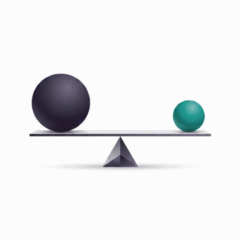

The most meaningful lives I’ve watched up close weren’t the happiest. They were the load-bearing ones, the ones holding weight.
A while ago, I took a fortnight off work. Properly off. Phone in a drawer, out-of-office autoreply locked in, the lot. I spent those two weeks walking, reading, and occasionally wincing at the thought of what I was returning to. I came back braced for the avalanche. The backlog. The smouldering fires. The hundred small ways the place must have needed me while I was gone.
There was no avalanche.
The inbox was tidy. A colleague had quietly handled the one major project I’d been losing sleep over—and, if I’m honest, handled it rather better than I would have. The whole operation had hummed along in my absence, perfectly content and unbroken.
I should have felt free. By all modern metrics of productivity and work-life balance, this was a victory.
Instead, I felt something I couldn’t name at the time. I have since decided to call it a kind of grief. I had spent the better part of two decades making myself useful to that place. Pouring my energy into the machinery of it. And it turned out the place could comfortably take me or leave me.
I was, quite simply, optional.
Now, a place that runs fine without you for two weeks is a well-managed place, not a tragedy. I knew that. I had spent years deliberately building teams that wouldn’t topple the moment one person stepped out for a coffee or a holiday, and I had been quietly proud of that resilience. That part wasn’t the source of the grief.
The grief was realising I’d never made myself load-bearing, and had done the exact same thing to the whole of my life. I had engineered the entire structure of my existence to need me as little as possible, and I had proudly called it “competence.”
That quiet, frictionless fortnight taught me something I had backwards for most of my adult life. And looking at the world around us, I suspect you might have it backwards, too.
We Were Sold the Wrong Destination
Somewhere along the way, happiness got installed as the default, unquestioned goal of a human life. It became the ultimate metric—the thing that every other thing is supposedly for.
Work hard so you can be happy. Buy the house so you can be happy. Secure the relationship, book the holiday, sculpt the body, hit the arbitrary number in the savings account. All of it is done in service of arriving, finally, at the station called “Happy.” And staying there.
Here is the trouble with that premise. The fine print nobody mentions in the lifestyle adverts.
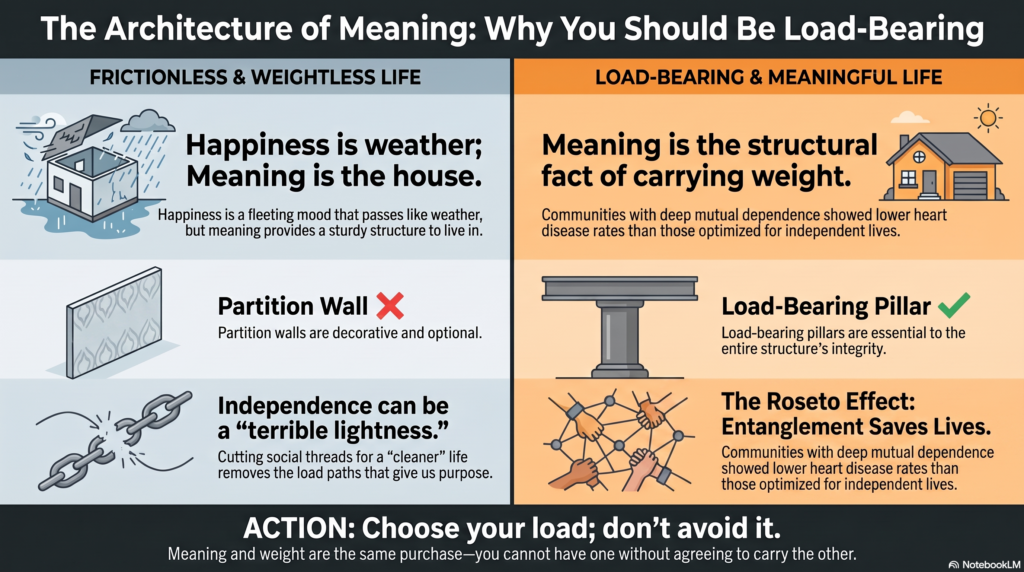
Happiness is weather.
It moves through you. A good morning, a clear run, a meal with people you love, the particular gold of late-afternoon light in autumn. These moments are real, they matter, and you should chase every one of them.
But you cannot live in good weather.
It passes. It always passes. When the mood fades, that isn’t a flaw in your happiness, nor is it a personal failure. It’s the nature of the thing. Weather isn’t a geography; it isn’t somewhere you can move to and establish a permanent residence.
A life built entirely on feeling good is built on a foundation that won’t hold still long enough to stand on. You lay the bricks, pour the concrete, and wake up the next morning to find the ground itself has drifted.
So you chase the next front. And the next. And somewhere in your forties or fifties, you lie awake staring at the ceiling and think: I did the things. I bought the items. I chased the freedom. Why does it feel like nothing is holding?
The honest answer is simple: You optimised for the weather, and you forgot to build the house.
The Architecture of a Meaningful Life
 There is a term from structural engineering and building work that I’ve come to think is the most useful concept for living a life that actually counts.
Load-bearing.
In a building, a load-bearing wall holds weight. It has a structural purpose. Take it out, and something above it comes down. It is inextricably tied to the integrity of the whole.
Its opposite is a partition wall. It looks identical from the hallway. It can be freshly painted, beautifully decorated, and perfectly nice to look at. But it holds absolutely nothing. You can take a sledgehammer and knock it through on a whim to create an open-plan kitchen, and the building won’t so much as flinch.
Most of us, if we are unflinchingly honest, have spent years meticulously turning ourselves into partition walls.
Decorative. Independent. Optimised to need no one and to be needed by no one. Because being needed is inconvenient, and we were taught that the ultimate goal of adulthood was total freedom.
Then we stand in the middle of our beautifully renovated, perfectly frictionless lives and wonder why we feel so weightless. Why a fortnight’s absence changes nothing. Why we could vanish into thin air and the structure around us would simply settle and carry on.
The meaningful life isn’t the happy one. It is the load-bearing one. Load-bearing is not a mood; it is a structural fact.
The Structural Difference in Living
| Feature | The Partition Wall Life | The Load-Bearing Life |
| Core Goal | Maximising personal convenience and freedom. | Holding weight and providing stability for others. |
| Relationships | Transactional; easily detached if they become difficult. | Entangled; deeply rooted in mutual reliance. |
| Absence | Unnoticed; the system simply automates around it. | Felt deeply; something structural shifts or requires rebuilding. |
| Primary Feeling | A weightlessness that eventually feels hollow. | A heaviness that eventually feels grounding. |
Meaning isn’t a mood you achieve through meditation or a perfectly curated morning routine. It is the undeniable, structural fact of carrying weight.
I didn’t understand my grief during that fortnight off until I understood this distinction. I wasn’t sad that the work got done without a single load-bearing part of me involved. I was sad because I had discovered I was a partition wall dressed up as a supporting one. And that was a mirror I simply didn’t want to look into.
We Have Engineered Ourselves Out of Mattering
Here is the cruel twist of modern life.
Almost everything around us is explicitly designed to reduce the weight we carry. And we cheer it on, paying premiums for it every step of the way.
Convenience means fewer people depend on you. Independence means you owe nobody, and nobody owes you. The entire machinery of modern life—the delivery apps, the subscription services, the remote work, the frictionless everything—is built to make you maximally self-sufficient and minimally entangled.
That sounds a lot like liberation. Right up until you notice that entanglement was the entire point of being alive.
The threads that tie you to other people, the ones you keep trying to snip for a cleaner, freer life, were the load paths. They were how the weight of the world reached you. Cut enough of them, and you achieve a perfect, terrible lightness.
The Roseto Effect: Proof That We Need the Weight
There is a town that proves this point beautifully and oddly.
Roseto, Pennsylvania. In the 1960s, researchers noticed the people living there had remarkably little heart disease. The rate was far lower than in the towns immediately next door, and it made absolutely no sense on paper.
They smoked. They ate badly. They worked brutal jobs in the slate quarries. By every risk factor on the charts, they should have been dropping dead left and right. And they weren’t.
The thing protecting their hearts wasn’t a Mediterranean diet or morning jogging. It was each other.
Roseto was densely, almost suffocatingly close. Three generations lived under one roof. Neighbours were constantly in each other’s kitchens and deeply in each other’s business. Nobody carried anything alone; the weight of daily life was distributed across a vast, interconnected web of load-bearing people.
The researchers gave this phenomenon a name—The Roseto Effect—and then they watched it tragically fade. Over the following decades, the younger generation did exactly what we have all been taught to do. They moved out. They spread out into the suburbs. They built cleaner, freer, more independent lives.
And as the entanglement thinned, the heart attacks arrived, roughly on schedule, until the town looked exactly like everywhere else.
They cut the load paths for the sake of freedom. It cost them years of their lives.
We do the micro-version of this every day, with the very best of intentions. We mistook being unburdened for being free. But a life with no weight on it isn’t free. It is just untethered.
Ask anyone who has retired into a silence they didn’t expect. Or moved to a beautiful remote cottage where nobody knows their name. Or finally achieved the utterly empty calendar they had spent years dreaming of.
The lightness they were promised finally arrives. And it turns out to weigh a tonne.
What It Costs to Be a Wall
So, how do you actually become load-bearing?
Not, I’m afraid, by feeling more grateful, reciting affirmations, or journalling harder. You become load-bearing the only way a physical, load-bearing wall ever does.
By becoming load-bearing. By letting things rest on you. By taking on weight you are under no contractual obligation to take.
There is a distinct failure mode here, and it is worth naming before you get the wrong idea and run yourself into the ground. A load-bearing wall has a structural limit. If you pile on more weight than it was designed for, the masonry cracks, the whole thing comes down, and then you have helped absolutely no one.
Saying “yes” to every single request until you crack isn’t being load-bearing. It’s just rubble with good intentions.
This was never about carrying the most weight. It’s about carrying the right weight, on purpose, instead of arranging your life to carry none.
-
The doormat lets everyone wipe their feet on them without boundary or purpose.
-
The pillar actively supports the roof above it.
They look similar from a distance. The difference is that the pillar chose its load.
This is harder than it sounds. Being depended upon is a genuine burden, and we are not wrong to feel the friction of it. When you let someone rely on you, you open yourself up to the possibility of letting them down. When you decide to become the person who shows up, you have to keep showing up—on the grey, exhausted days as well as the good ones, long after the warm, fuzzy feeling that started it all has worn off.
A partition wall never has to worry about any of this. That is its whole appeal. But it also never holds anything up.
The Low Ground of Responsibility
I think often of a neighbour of mine. He is long retired. Yet, somehow, he has become the person three entire streets of people phone when something has gone wrong. A sudden death in the family, a terrifying medical diagnosis, a teenager in trouble.
Nobody elected him to this position. He simply kept answering the door. Kept turning up with a kettle and a quiet presence. Kept being reliably there, year after year, until the weight of the neighbourhood found him the way water naturally finds the low ground.
He is not, by any obvious measure, having a “happy” time. He carries other people’s worst days, and if you look closely, it shows on him.
But I have never met a human being who is less weightless. I have never met anyone more obviously needed. I have never met anyone whose eventual absence would tear a bigger hole in the fabric of a place.
If a human life can be said to matter, his does. Structurally. In a way no amount of pleasant weather could ever provide.
That is the trade nobody advertises: Meaning and a load-bearing life are the exact same purchase. You do not get to keep the one without agreeing to carry the other.
The Catch at the Centre of It All
Here is the reversal it took me far too long to finally see.
A life that doesn’t need you is a life you can disappear from without consequence. And some part of us knows that a thing you can vanish from without consequence was never quite real to begin with.
The people who seem the most anchored, the most vividly here, are almost never the ones who arranged their lives for maximum lightness and optimisation. They are the ones who allowed themselves to get loaded up.
With people. With tedious duties. With the kind of messy, unpredictable obligations a sensible optimiser would have automated away years ago.
They are tired in a way the weightless never are. They are also, unmistakably, holding something up.
You will not feel happy all the time doing this. That was never the offer. What you will feel is load. The grounding, undeniable heaviness of being someone that other things rest on. And one day, lying awake in the dark, you will notice that the ground beneath you has finally stopped drifting.
The Avalanche I Actually Want
I think about that fortnight off differently now.
I don’t want to be the wall you can knock through without the building noticing. I’ve had a taste of the frictionless life, the one built to need no one. And I have felt exactly how much that terrible lightness weighs at three in the morning.
I would rather be load-bearing.
I would rather be the one whose fortnight away leaves a noticeable hole. Not because I am indispensable in some flattering, ego-driven way. But because that hole is the exact shape of a load-bearing life that actually held something up.
Chase the good weather. Catch every single scrap of it you can. It is real, it is a gift, and it will never come back quite the same way twice.
But build the house out of something sturdier.
Let things rest on you. Actively take on the weight you could so easily avoid. Become the wall somebody leans on when they are tired.
And one day, when you finally step away for good, let there be an avalanche. Because that avalanche is the truest evidence you will ever get that you were here. And that it counted.
One Thing to Try This Week:
Find a single thread you’ve been meaning to cut for the sake of a cleaner, more convenient life—an obligation, a recurring favour, a messy relationship—and don’t. Let it hold. See what it holds up.
If this landed, I write about meaning, weight, and the human things that don’t automate, every week. The Borrowed Brain and The Case for Ordinary Proof go deeper on the same fault line. You can also get these straight to your inbox, where I send the longer cuts first.
This essay has a longer home on Medium, where I go deeper on the load-bearing life. And if you want to actually do the work instead of just nodding along, The Door Audit is a seven-day practice for closing one door you’ve been holding open—the small, deliberate way you start carrying weight on purpose.