

The running shoes are by the door. Then a small voice asks one question, and your shot at consistent habits takes another knock.
The alarm goes at 6:00. Shoes where you left them. Last night, brushing your teeth, the plan felt settled.
Then, feet still under the duvet, the voice pipes up:
Do I really feel like doing this today?
Most mornings the honest answer is no.
I’d bet that question has ended more running plans, diets and half-written reports than any shortage of willpower. When people give up on a goal around week three, they usually blame their discipline and decide they’re just not one of those consistent people. I think they’re asking the wrong question.
So you go looking for fixes. The two-minute rule. Reward charts. Picturing your future self in a nicer shirt. I’ve tried most of them, and a couple worked for about a week before the novelty wore off and I was back where I started, slightly more annoyed with myself for failing at something sold as easy.
Why Consistent Habits Fail: The Question Is the Problem
I call that morning voice the mood check. Before you start anything hard, you take your emotional temperature. Calm and rested, you go. Groggy, or a bit overwhelmed, you stay put.
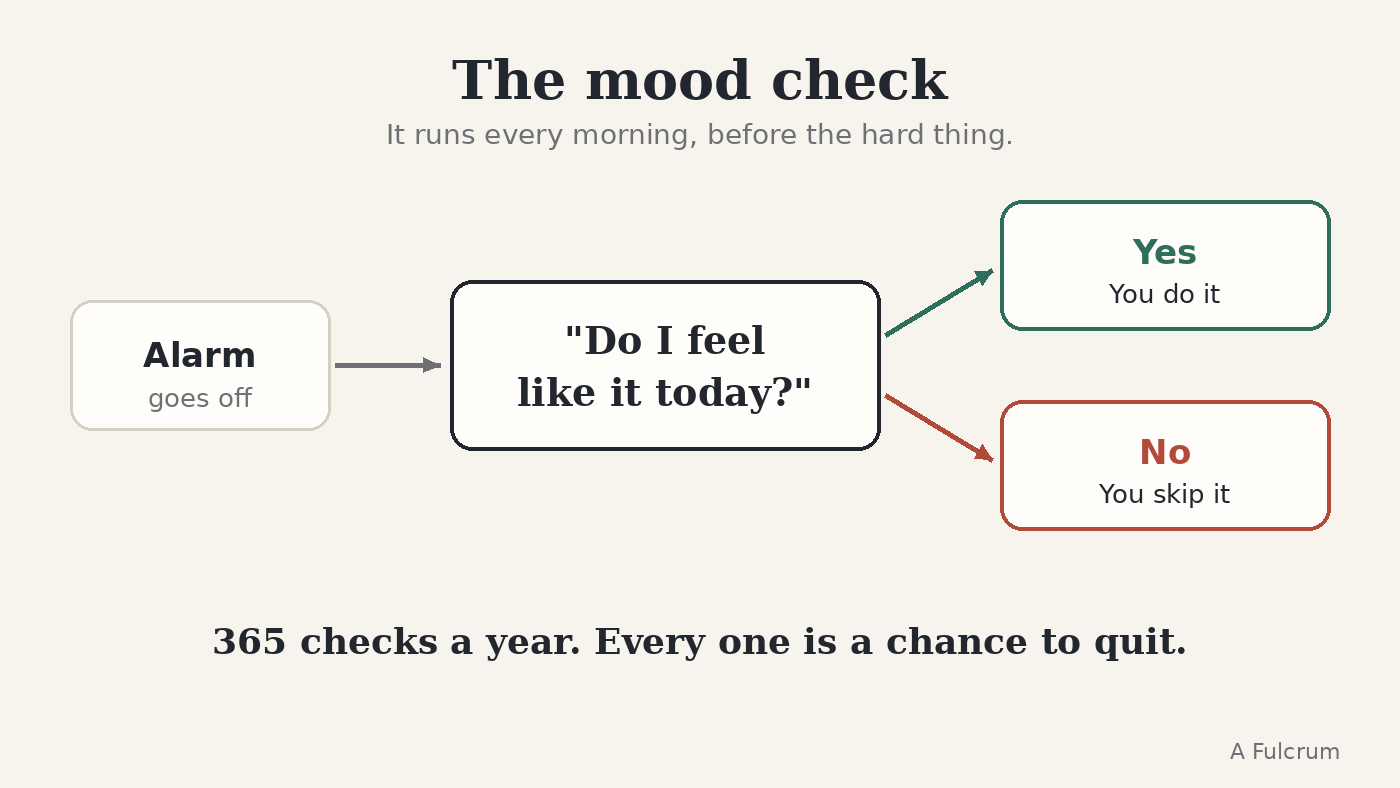
The trouble is how often it runs. Once a day for a year gives your brain 365 chances to opt out. Some of those mornings you’ll be shattered, some you’ll be fretting about a 9 o’clock meeting, and on a few you simply won’t care. Those are the days the shoes stay by the door.
We assume consistent people win this argument more often than the rest of us. From what I’ve seen, most of them rarely have it. Their mornings are arranged so the question doesn’t come up.
The Bench vs. The Worker: Lessons from the Factory Floor
I’ve spent most of my working life in quality, much of it on factory floors, and I watched this same pattern play out among people who knew exactly what they were doing.
On one fast line, an operator kept fitting a component backwards. They knew the procedure cold and had been retrained twice. The defect still turned up in random checks.
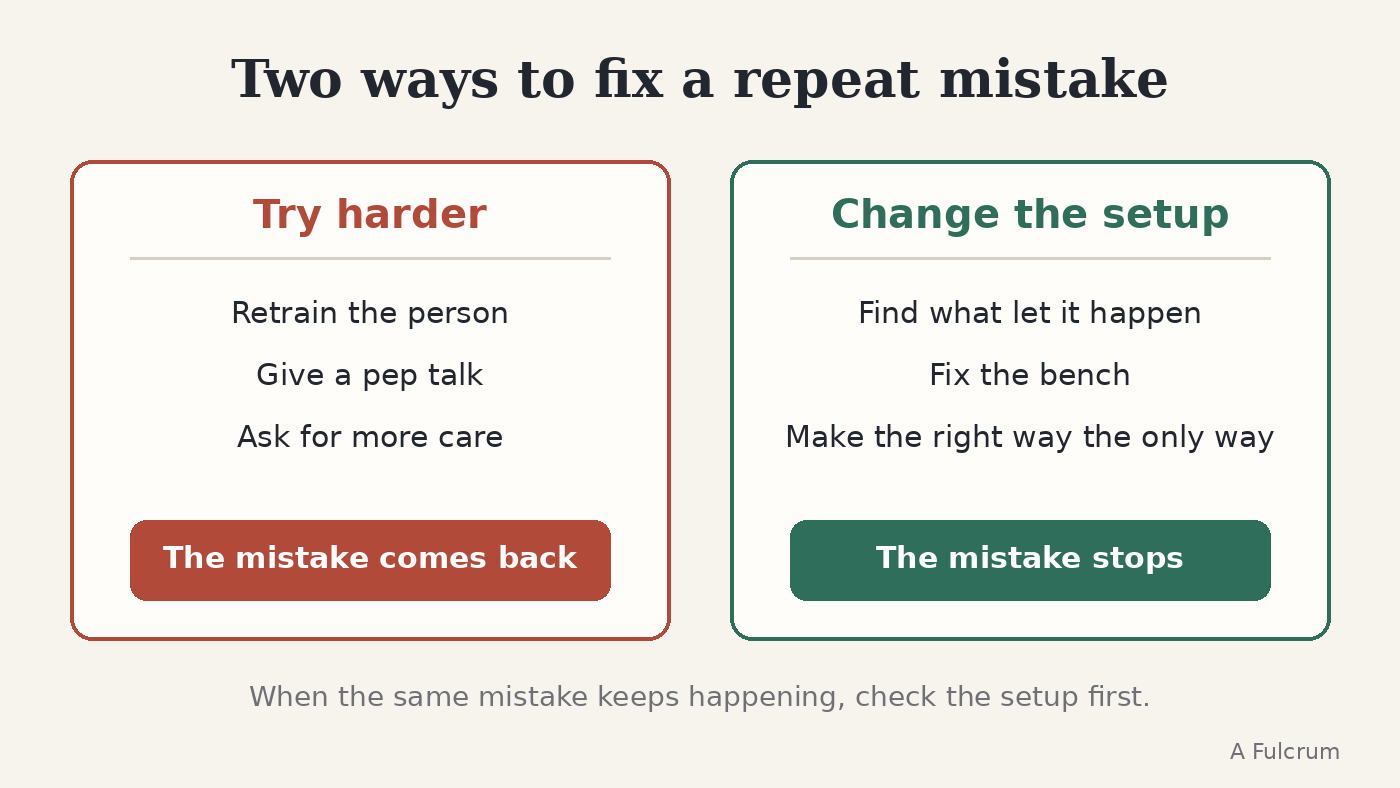
Management wanted another talk about focus. An industrial engineer bolted a small metal guide to the bench instead, so the part would only seat one way round. The defect stopped, and it stayed stopped. Engineers call this poka-yoke, or mistake-proofing.
(Thirty-odd years in quality, and it still took a bent bit of steel to make that one stick for me.)
Quality engineers have a working rule for this: when a mistake keeps repeating, audit the system before you blame the person. “Try harder” and constant vigilance buy you a few good weeks at most. A changed setup tends to last.
If you’re negotiating with yourself most mornings, stop trying to win. Rearrange things so the negotiation doesn’t start.
The 5-Step Setup for Consistent Habits Without the Mood Check
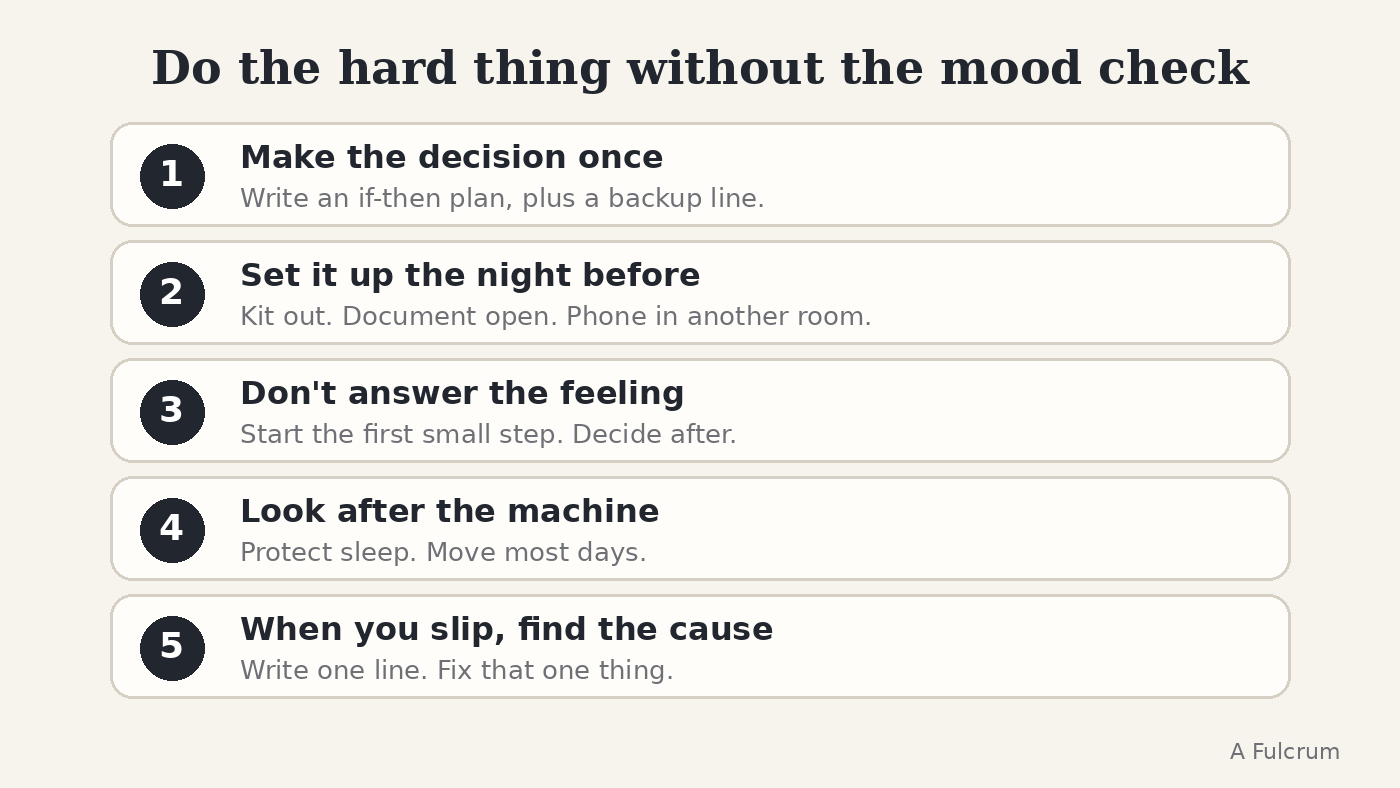
1. Make the Decision Once
The usual advice is to find a stronger why. A clear reason helps you pick a direction, but even a good one gets worn down by fifty grey mornings in a row.
Deciding in advance holds up better. Psychologists call this an implementation intention, or an if-then plan.
In a 2006 meta-analysis in Advances in Experimental Social Psychology, Peter Gollwitzer and Paschal Sheeran pooled 94 studies with more than 8,000 participants. People who wrote their goals as if-then plans reached them noticeably more often than people who simply intended hard. The effect size was d = 0.65, which researchers class as medium to large.
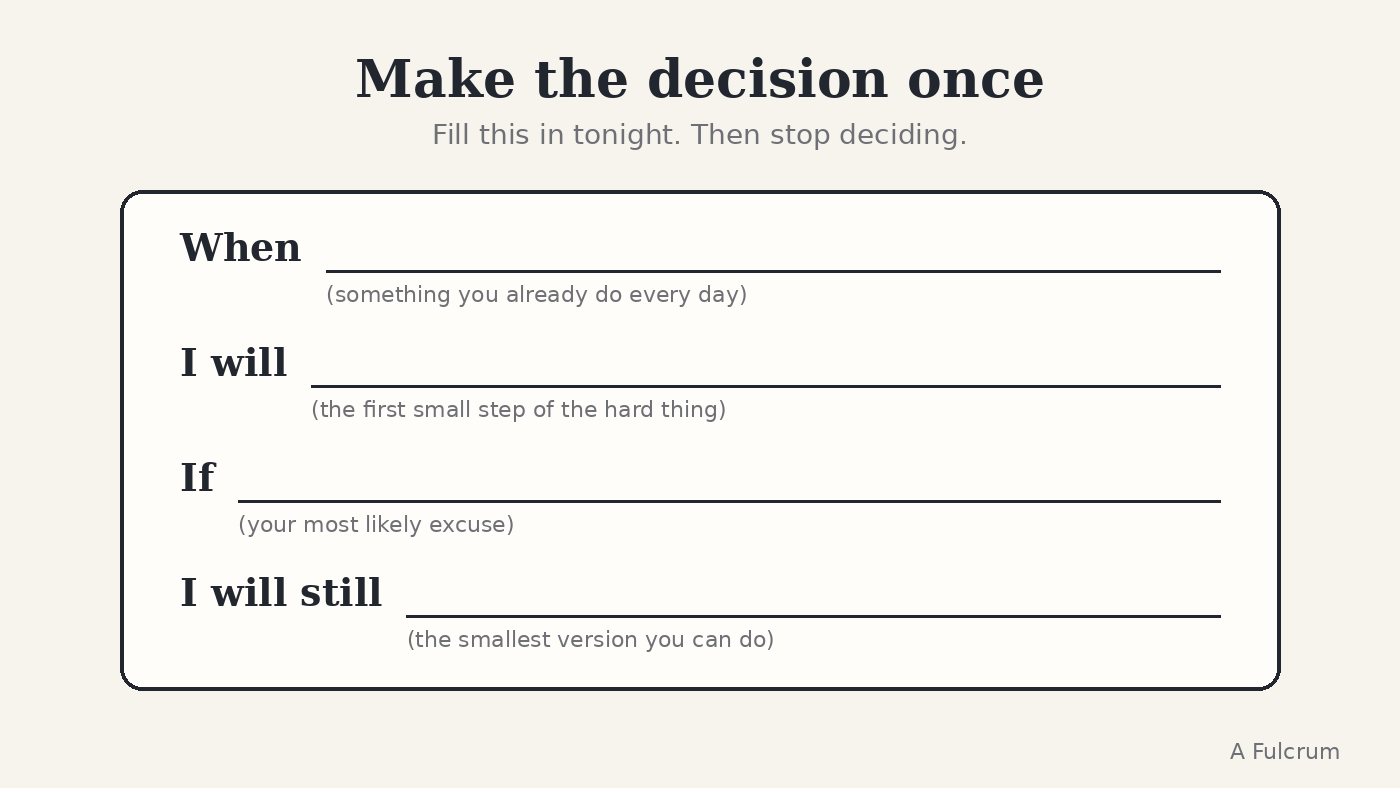
Write yours in plain, concrete terms:
- “When I finish my first coffee, I put my running shoes on.”
- “When I sit at my desk, I open the project draft before I look at email.”
Then add a fallback for your usual excuse, something like “If I’m short on time, I run for ten minutes instead of none.” When the trigger arrives, the choice has already been made and there’s not much left to argue about.
2. Set It Up the Night Before
At 6 a.m. you’re groggy and easily pulled off course. At 9 p.m. you usually have more to give, so let the evening version of you do the setting up:
- Workout clothes on the chair by the bed.
- Laptop open at the document you need to write.
- Phone charging on the other side of the room.
The phone matters more than it looks. If it’s the first thing you touch, notifications, news and other people’s demands get to you before you’re properly awake. And it costs you even when you leave it alone. In a 2017 study, Adrian Ward and colleagues at the University of Texas found that people did better on memory and reasoning tests when their phone was in another room than when it sat on the desk, even switched off and face down.
3. Stop Treating Feelings as Instructions
Feelings carry information, and you can take note of them without doing what they say. We tend to treat motivation as the entry ticket: no feeling, no action. In practice the arrow often points the other way, and the motivation turns up once you’ve started.
The usual model: motivation → action → results.
What tends to happen: action → motivation → results.
You don’t need to feel energetic to tie a lace, or inspired to write a bad first sentence. When the mood check starts up, notice it, skip the debate, and take the smallest first step on your plan. Give yourself permission to stop after five minutes. In my experience you rarely do.
4. Protect Your Baseline Capacity
Some mornings the resistance is physical. You’re tired, properly tired, and a tired brain runs more mood checks and finds more excuses.
There’s decent evidence behind that. In a 2007 study from UC Berkeley and Harvard, Seung-Schik Yoo, Matthew Walker and colleagues found that people kept awake for about 35 hours showed roughly 60% more amygdala reaction to upsetting images, with a weaker link to the prefrontal cortex that normally keeps that reaction in check (there’s a plain-English write-up here). A habit plan won’t last long against months of short nights.
So guard the basics: a regular bedtime, screens out of the bedroom, and some movement most days, even a 20-minute walk. If you’re running on empty, sort that out first.
5. Post-Mortem Your Slips without Self-Flagellation
You’ll miss days. Most people do, and I certainly have.
What counts is what happens next. Most of us reach for a verdict: “I’m lazy.” “I’ve got no discipline.” It feels like owning up, but it gives you nothing to work with.
On a production line, when a defect reaches final inspection, a decent engineer doesn’t write “operator lacked character” on the report and close it. They dig for the root cause, find the gap in the process and change it. Where I work that’s a CAPA, and the same move works at home.
When a routine breaks, you can ask “Am I weak?”, which goes nowhere and lets the slip repeat. Or you can ask “What let this happen?” and go and find the friction. Write one plain sentence about what got in the way:
- “Late meeting ran past 8 p.m.”
- “Kit was in the wash.”
- “Checked my phone in bed.”
Then fix that one thing.
Consistent Habits: The Whole Setup at a Glance
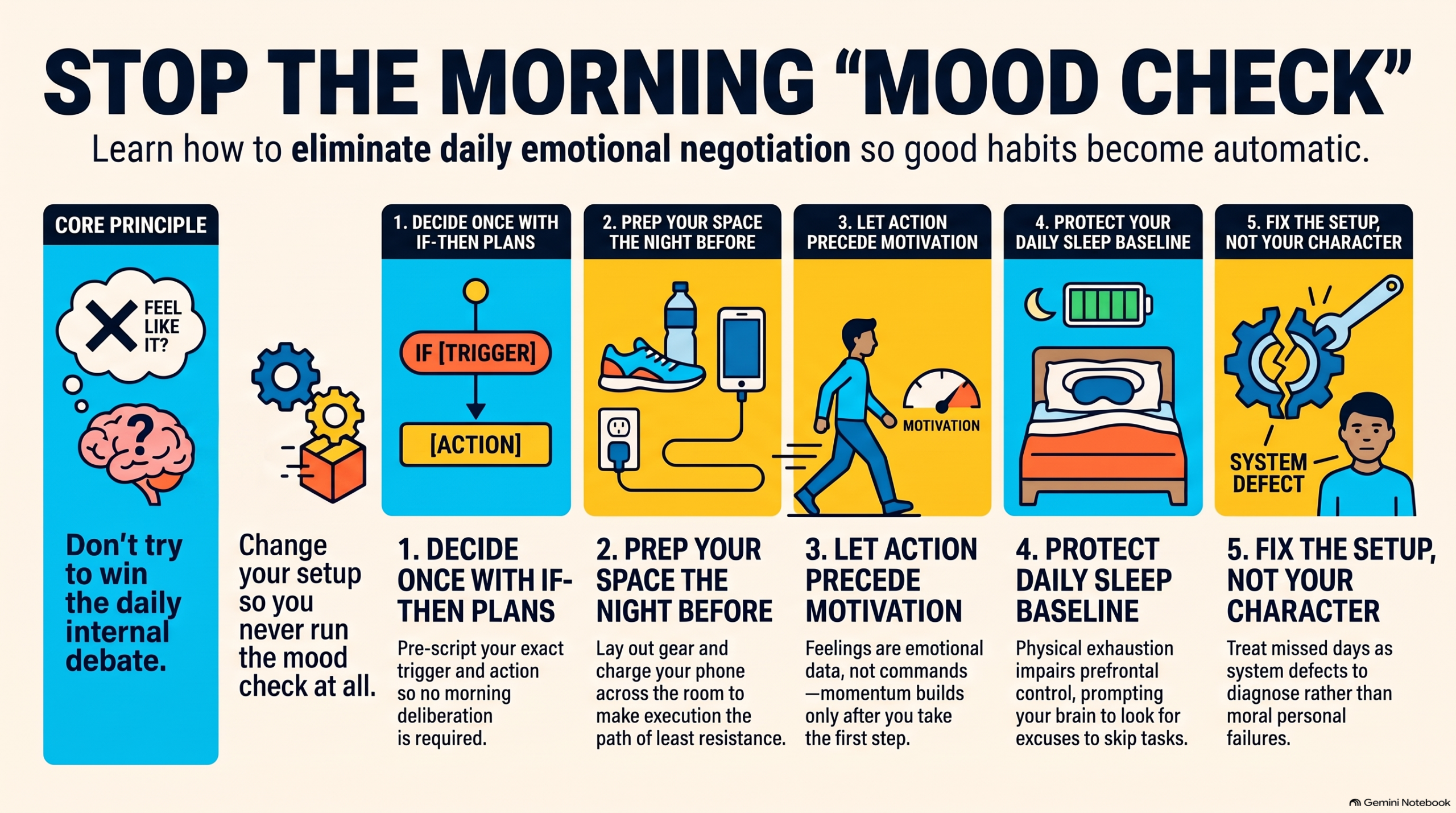
https://youtu.be/JIE-kf4Zb6Y
Moving Before the Argument Finishes
The people who seem endlessly consistent have mostly set their lives up so the mood check gets very little airtime. That operator didn’t go through some personal transformation. Somebody changed the bench.
You can do the same with your own mornings and build consistent habits that hold up on the bad days as well as the good ones.
Tomorrow the alarm will go and the voice will start its usual routine. Let it talk. Get moving before it finishes; the shoes are already by the door.
If this one landed, you might like what decades of stopping failures taught me about willpower and how to break a habit without willpower.