

This is the long, slightly nerdy version: what forty years in quality assurance taught me about how people lose their independence. If you want the human version first, it’s on Medium: I’ve Watched People Retire for 40 Years. Most of Them Never Really Left. Or watch the nine-minute video below.
Retirement village brochures are very good at what they do.
Spotless lounges. A minibus on Thursdays. Chair yoga, a craft table, a calendar so full it looks like a school timetable. The promise underneath is simple enough: hand over the bother of daily life and you get to keep the good part.
I can see why it sells. I can also see what it leaves out, because I’ve spent most of my working life looking at processes that measure what’s easy to see and miss what matters. A full calendar is easy to see. Whether the person living by it still feels capable is not.
We put a lot of effort into keeping older bodies moving and older diaries busy. We put far less into a plainer question: what happens to someone when every small job that used to prove they were useful gets quietly taken away? I touched on a younger version of this in Everything in My Life Got Easier, and I Got Worse at Living It. Old age is where that bill comes due.
Ageing mostly drifts
In my trade a process fails one of two ways. It breaks suddenly, or it drifts. Drift is the nasty one, because every single reading still looks acceptable.
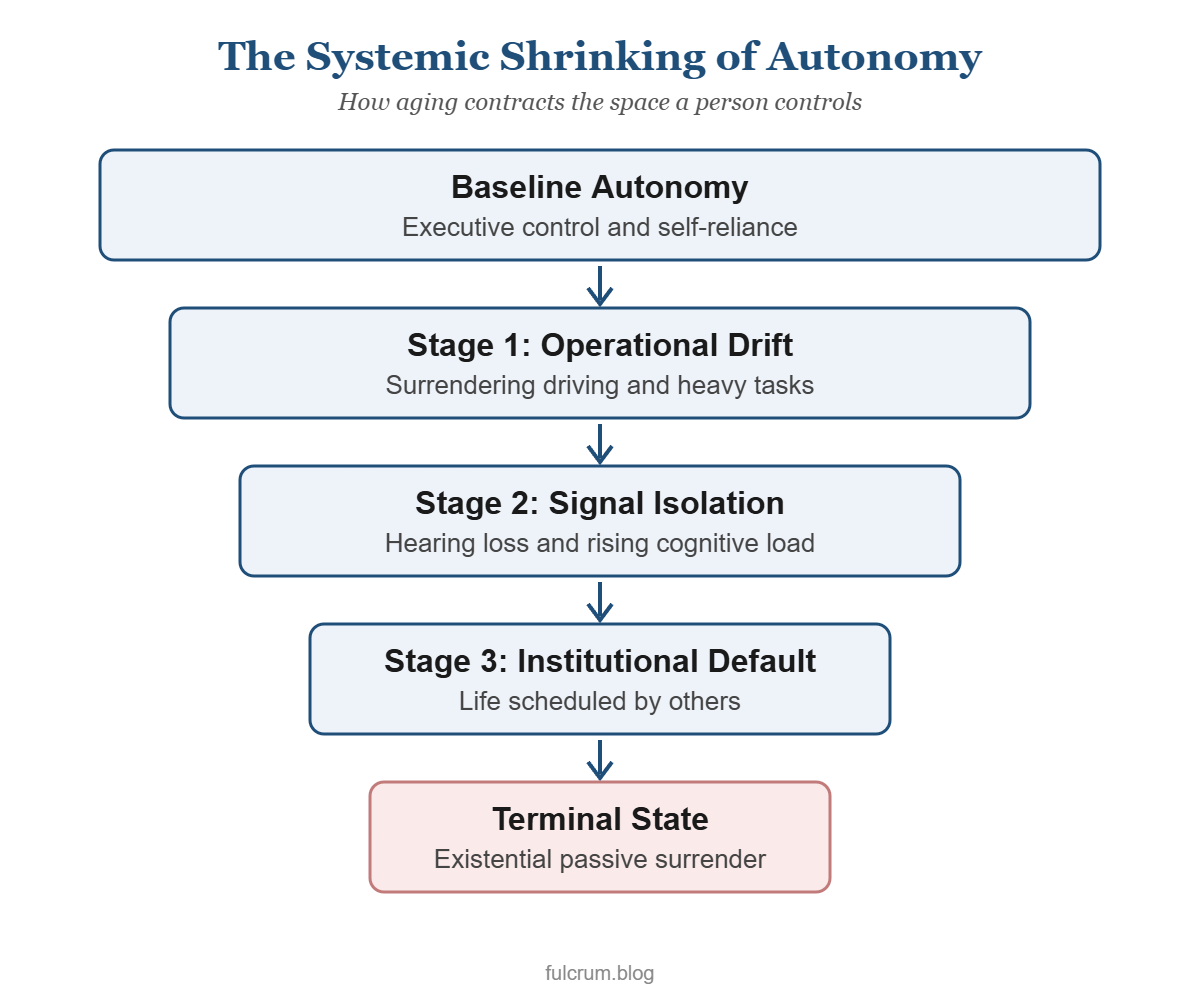
Ageing is mostly drift. Night driving goes first. Then the motorway, then the car. Following a conversation in a busy room takes a little more effort each year. A forgotten name used to be a joke at your own expense, and at some point it stopped being funny.
We call these inconveniences. I think that word lets us off lightly. Each one is a small piece of a person’s say over their own life, handed back and not returned.
When a machine on a line starts to falter, a decent engineer doesn’t scrap it at the first wobble. They fit an interlock, a poka-yoke, something that lets it keep running safely inside its new limits. Willpower never made my fix list in forty years; guards and checks did. I wrote about that in I Spent 40 Years Stopping Catastrophic Failures (there’s a version here on the blog too).
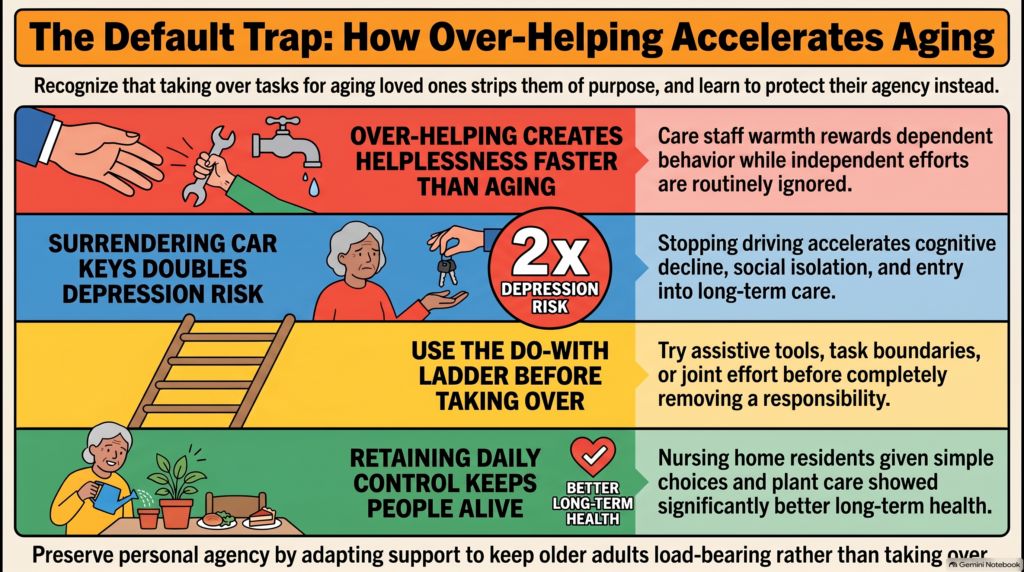
With people we tend to do the opposite. At the first sign of struggle, somebody takes over. Husbands, wives, sons, daughters, care staff: they fetch, lift, drive and decide, and almost all of it comes from love. It’s the same bargain I described in ChatGPT Saves You Ten Minutes. Nobody Mentions the Tax It Charges Later. Whatever you stop doing for yourself, you slowly stop being able to do.
In The Counterfeit Architecture of Care I argued that we mix up doing things for someone with being close to them. Here the cost is more practical. Take away every bit of effort and you also take away the daily evidence that the person can still manage. In 1976 Ellen Langer and Judith Rodin tested something close to this in a Connecticut nursing home. Residents given small choices and a plant to look after became more active and alert than a comparison group whose needs were simply handled for them. It was one home and a small study. The idea has stuck in gerontology ever since.
When the job was the identity
Think of someone who spent forty years being the one who sorted things out. An engineer, a quality manager, a joiner, the person the family rang when the boiler went. For people like that, work does a lot more than pay the bills, and leaving costs far more than the salary, which is the trap I wrote about in I Got the Raise. Then I Couldn’t Afford to Leave.
Now put that person somewhere every routine is handled. Meals arrive. Transport is booked. A maintenance man with a clipboard fixes the dripping tap. On paper, life just got easier. In practice the one thing that told him he was still useful has been switched off, and nobody held a meeting about it. I made the case for keeping some of that difficulty in Make Your Life Harder on Purpose. Some friction holds the roof up.
Hearing is where this gets quietly brutal. The World Health Organization counts age-related hearing loss among the big drivers of isolation in later life, and the 2024 Lancet Commission on dementia lists untreated hearing loss among the leading risk factors you can actually do something about.
Picture a dining room with hard floors and twenty conversations. Following one of them takes real work. When the effort stops paying off, people start to fake it: nodding when they’re not sure, laughing a beat after everyone else, then drifting out of the conversation altogether. From across the room they look included. I caught myself doing a milder version of the same thing when I quit being a “low-maintenance” friend for two months. Looking fine and being fine turned out to be different readings.
If you’re reading this because of a parent, the Substack version of this piece is the practical one: a five-question check-in, a ladder for helping without taking over, and the exact words for the car-keys conversation.
Three people at breakfast
Mark Sanford, a retired academic who writes on Medium from inside his own retirement community, describes a breakfast table I haven’t been able to stop thinking about. Three residents, whom he calls the three reticents. Apart from “good morning” and “see you later”, they barely speak through the whole meal.
The easy reading is that they’re content, or just not chatty. Reading his description with an investigator’s head on, I could list at least four causes, and any one of them would produce the same silence:
- A pile of medication that dulls everything a bit.
- Hearing that makes every conversation hard work.
- Grief nobody has asked about, for a husband, a wife, a house, a car.
- A deliberate choice. Some people would rather keep their privacy than trade it for forced cheerfulness, and that’s their call.
You can’t tell which from the outside. And finding out would mean intruding on the very people you’re trying not to intrude on. That’s the bind.
People don’t usually stop caring first and then withdraw. More often so much has been taken away that withdrawing is the one decision still left to them. Psychologists have a name for where that road ends: learned helplessness.
Counting the wrong thing
When a resident goes quiet, the usual fix is to add something. Another quiz. Another visiting singer. A brighter newsletter. Attendance gets counted, attendance goes up, and everyone feels better.
We have a name for this in quality: metric substitution. You can’t easily measure whether someone feels known, so you measure how many events they turned up to, and then you forget the number was only ever standing in for the real thing. It’s Goodhart’s law in a cardigan. Offices do the same, which is roughly what I meant by procrastination in a suit.
Bingo doesn’t touch grief. If someone has lost a wife of fifty years, or their legs, or the job that told them who they were, a cheerful timetable can start to feel like pressure to look happy for the benefit of everyone watching. I said more about that in Stop Chasing Happiness. Become Load-Bearing.
Fixing, and the other thing
The Stoics, Epictetus especially, drew a hard line between what’s up to us and what isn’t. I leaned on that line in I Stopped Renting My Own Mind. Old age keeps moving it, and rarely in your favour. The career goes. Then some strength. Then the car. Kierkegaard was writing about the unease that comes with that back in 1844.
Sooner or later the question arrives: who am I when I can’t produce the things that used to prove it?
Some of what goes can be kept longer with a bit of ingenuity, and it’s worth trying hard before anyone decides something has to stop. Some can’t. For those losses the job changes from fixing to witnessing. Witnessing doesn’t try to reverse anything and doesn’t hand out silver linings. It mostly looks like this:
- Letting someone tell the same story again, all the way through, without correcting the details.
- Naming what’s gone. “That must be strange, not being the one they ring.” Then leaving it there.
- Remembering who they were before their world got smaller, and saying so.
Showing up for the ordinary days is rarer than showing up for the crisis. I wrote about that in The People Who Can Do Your Funeral But Not Your Wedding and The Real Test of Love Isn’t a Crisis. It’s Good News. Old age is mostly ordinary days.
Three things to try on your next visit
- Pause before you help. Ask yourself whether you’re stepping in for their sake or to make your own afternoon easier. If it’s the second, wait.
- Swap the general question for a specific one. “How are you feeling?” gets the weather. “I was thinking about that extension you built in ’79” gets a person.
- Let the silence sit. You don’t have to fill it or steer it somewhere cheerful. Being there is most of the job.
The third one is harder than it sounds. It’s the same skill I wrote about in You’re Not Anxious. You’ve Just Been Trained to Absorb Everyone Else’s Stress: staying steady in someone else’s bad patch without taking it home.
The last chapter
Youth and middle age are mostly about getting bigger: more ground, more skill, more say. Old age asks you to get smaller and keep your dignity while you do it. Some people manage it through storytelling or mentoring or simply watching. Others fight the current to the end. I don’t think either is failing.
I retire next spring, so this isn’t abstract for me. I’ve been testing my own plans the way I’d test a process, with a 90-day trial before committing to a life and 90 days of tracking my biological age. Money matters too, and I’ve argued that quiet money buys years. But years without any say in them are a poor return.
Maybe the most useful thing any of us can do for someone in that last stretch is to give up on engineering it back to efficiency, sit down next to them, and say something like:
I can see what this is costing you.
I can see you’re still you.
I’m not going anywhere.
Over to you
I’d like to hear from people who’ve been on either side of this:
- Where have you seen help arrive too early, in your own life or with a parent?
- If you’ve had someone witness a loss rather than try to fix it, what did they actually do?
There’s more on ageing and identity in the Aging archive. If you want the practical toolkit for a parent, it’s on Substack; the 60-second version is on YouTube; and the essay from the leaving side of the desk is on Medium. If this was useful and you’d like to support the writing, there’s a tip jar on Ko-fi.