

The Sunday night that started it
It was the last Sunday in October, the kitchen dark except for the laptop, and I was counting tabs. Twenty-two.
A novel stuck two chapters from the end. A spreadsheet for a product I’d sketched in August. Half an essay. Something about sourdough I can’t account for.
I felt rich, in the way a lottery ticket makes you feel rich on a Saturday afternoon.
Then the other thought turned up.
When did I last finish anything that scared me?
I could list plenty I’d started in the last twelve months. The finished ones took longer to think of.
This is about keeping doors open, why it tends to catch people who pick things up quickly, and the one fix I’ve found that doesn’t mean burning the safety net you’ve spent a working life building. There’s a printable one-evening worksheet in the Medium version, if you’d rather work through it with a pen.
The trap is being able to start almost anything
If you pick things up quickly, you’ll know the feeling. The start of a project is the good bit, when very little has been tested, and no one has bought it, read it, or said no.
The spreadsheet has no rows yet, and the novel hasn’t got a protagonist anyone dislikes. Behind every open door is a room you haven’t yet spoiled with your own decisions.
Then the middle arrives. It’s slow and repetitive, and it’s usually the first point where the work starts telling you things about yourself you’d rather not hear.
That’s often when a clever person notices another door.
I call this hallway living: keeping five rooms half-furnished so you don’t have to move into any of them. It passes for curiosity. Most weeks, for me, it’s fear of the middle wearing a sensible coat.
Why “the middle” is where clever people stall
The middle of any project is unflattering. The novel you imagined turns out to need a subplot you can’t plot. The product you sketched needs a sales page you don’t know how to write. The course you started needs a module on something you only half understand.
Each is a small humiliation, survivable on its own. They tend to turn up together, though, and that’s when another door starts to look attractive.
The next thing hasn’t had time to embarrass you yet. So you walk out of the room you’re in and start down the hallway.
Starting is cheap for clever people. That’s most of the trouble.
Keeping doors open: why people pay for doors they don’t plan to use
In 2004, two MIT researchers, Jiwoong Shin and Dan Ariely, published a game that is almost unfairly on the nose. The paper appeared in Management Science under the title Keeping Doors Open: The Effect of Availability on Inventory.
Inside the Shin and Ariely door game

Students sat in front of three doors on a screen: red, blue, green. They had 100 clicks to spend. Clicking inside a room paid out a little real money, with each room paying out on a different distribution. Sensible play was obvious enough: try the three rooms, find the best one, stay there.
In some rounds, though, a door you ignored began to shrink. Leave it long enough and it disappeared.
The students kept dashing back to rescue doors they had no plan to use. In one version, their earnings fell by around 15 per cent. Charging them a cash fee to switch rooms didn’t cure it.
As far as the paper tells it, the students understood the rules well enough. They dashed back anyway.
What the 15 per cent earnings drop actually tells us
Shin and Ariely concluded the students cared less about flexibility than about the small sting of watching a door close. People will pay to avoid that sting, which makes keeping doors open feel cheaper than it is.
Fifteen per cent of some game money isn’t much. Fifteen per cent of a 40-hour week is six hours, every week.
I read that and thought straight away of my Sunday night.
Most of the doors I keep open, I’m paying rent on.
Someone with no Plan B sees fewer doors
A competitor with nowhere else to go is an unpleasant thing to be up against. The founder who has sunk the savings into one product rarely has better vision than you. When the middle gets hard, there’s just no other room to slip into, so they keep going.
The first draft of this essay stopped there and told you to burn your safety net. That was bad advice, and I’d have ignored it myself.
Why the focused competitor is hard to beat
They’re rarely smarter. They’re stuck, facing the right way, with the door behind them bricked up, so they make the room work.
With five doors open you can always leave, and most of us do, somewhere around the middle.
Their lack of options ends up working in their favour, more often than I’d like.
I wrote the first draft as a sermon, then counted my own doors
I’ve spent the best part of forty years in regulated manufacturing on a steady salary. On the side I publish across seven platforms, I’m writing a novel, and there’s a retirement date circled on my calendar. By the first draft’s logic, I’m the problem.
I’ve also argued on this site that one salary is one point of failure, and I haven’t changed my mind.
So which is it? Probably both, once you separate the two jobs people give the phrase “Plan B”.
The two jobs we give the phrase “Plan B”
One job is a floor: savings, an income, a skill you could sell in a bad month. The floor is what keeps you in the room when the work goes hard.
The other is a hatch: the quiet exit you take the minute the work goes flat. The hatch is what pulls you out of the room before you’ve finished anything in it.
A floor tends to make me braver. The hatch mostly turns me into a tourist in my own projects.
Keep the floor. The hatch is the bit to weld shut.
I still pay £12 a year for a domain I bought for a podcast that never got past a test recording. That’s a hatch with an annual renewal.
Floor vs hatch: a working definition
The test I use: would I keep this thing if I were certain the project in front of me was going to succeed?
- A floor would still be there. The savings, the second income, the skill you could sell: none of these stop being useful because the novel sold or the product launched.
- A hatch evaporates the moment you stop needing the escape. The unused domain, the half-finished side course, the LinkedIn profile you only polish when the day job is grim: these are exits.
A hatch is mostly what I build when I’m avoiding the building.
The evidence turns up in the dull runs
For years the habit in pharmaceutical manufacturing was three consecutive good batches and a signed report. The FDA’s 2011 process validation guidance pushed further, treating validation as a lifecycle that runs on into routine production, so a process keeps having to earn trust long after anyone has stopped being excited about it.
What pharmaceutical manufacturing teaches about finishing
A good first batch mostly tells you the setup crew were paying attention. The useful information comes later, on a wet Tuesday with half the team on holiday, when the raw material lot is at the edge of spec and the operator on shift started two weeks ago.
If you only watched the first three batches, you’d certify a process you don’t actually understand. You’d be doing what the clever person does at the start of every project: mistaking a clean run for proof of the system.
Most of my working life has been spent close to that kind of paperwork. The processes I’d trust are the ones I’ve watched run in bad weather.
Projects behave the same way, in my experience.
Each time I’ve switched rooms, I’ve had to start the evidence again.
The sampling stage with the exit sign left on
David Epstein’s Range makes the best case against this. He argues that in messy, unpredictable fields, people who sample widely often do better than early specialists, and on sampling I think he’s right.
His generalists did eventually pick something and stay long enough to get good, though. The ones who did well knew when to stop sampling.
Hallway living is the sampling stage with the exit sign left on. It feels like Range, but the sampling has no end date. (I wrote a blunter version of this through Apple’s 1997 product cull, over on Substack.)
The question I ask myself: are you sampling to find the room you’ll commit to, or are you sampling to avoid committing to the room you’ve already found?
The first is Range. The second is the hallway, and I’ve done plenty of both.
A few ways out of the hallway
Four moves that have worked for me, plus one I’m still testing. None of them touch the floor; they’re aimed at the hatch. The longer six-step version, with the closing note I use, is in the Medium essay.
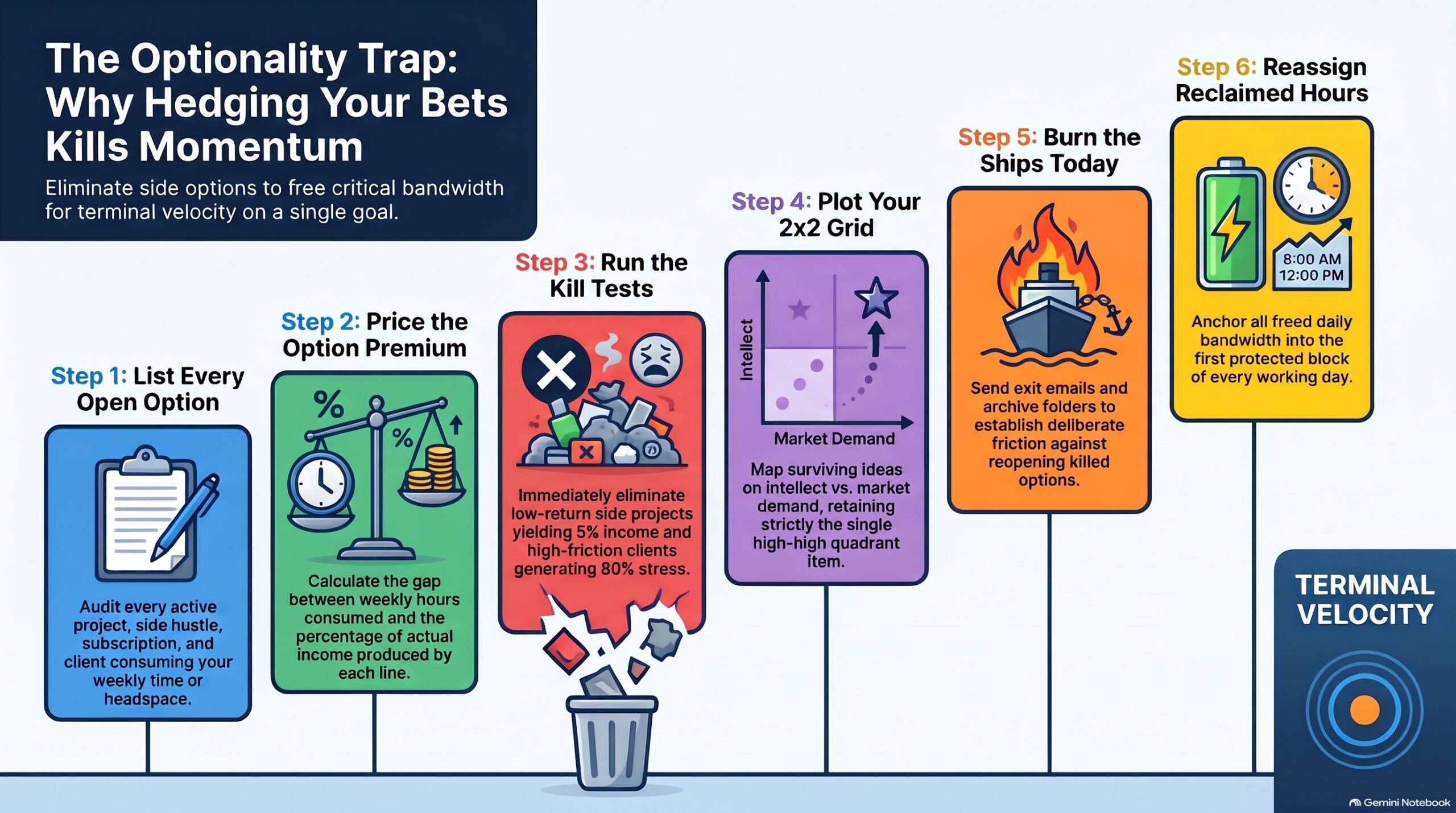
1. Count your doors on paper
Write the open projects, courses, side ideas and half-plans on one sheet. If you haven’t touched something in a month, you’ve probably left that room already; hallway living just stops you admitting it. Cross it out and see what happens. Usually not much.
Nothing collapsed when I did it. The novel didn’t get any less publishable because I stopped pretending I’d ever write about sourdough.
2. Name your hatch
For the room you’re staying in, write down what you actually do when the work goes flat. Mine is open a fresh Google Doc and start outlining the next essay instead of finishing the one in front of me.
Then make it awkward to reach. Delete the bookmark, or tell someone who will ask.
You can always reopen a Google Doc, so I don’t try to remove the hatch. I just make it a little more annoying to reach, which is usually enough.
3. Decide the run length before you judge anything
Twelve essays. Thirty gym sessions. Ten sales calls. Whatever fits. No verdict until the run is done. Halfway through, my feelings mostly report on the halfway point.
This is the move I’ve found most useful. If I commit to twelve essays before I’m allowed to judge them, the seventh essay doesn’t get compared to the third. It just gets written. The verdict happens at the end, when there’s something to verdict on.
4. Close one door on purpose
Pick something you’ve kept alive out of guilt and let it go properly. The sourdough starter I’d been feeding for nine months without baking a single loaf went in the bin on a Monday morning. Shin and Ariely’s students would recognise the sting. Time how long it lasts.
I got a shelf back.
The one I’m still testing
A weekly door count. Every Sunday, the open projects on one sheet, the ones I touched that week ticked, the ones I didn’t crossed out. It’s the same move as #1, run every week instead of once. It’s early days, so no verdict yet; the run-length rule applies to me too.
Sunday night, again
The next Sunday, same kitchen table and same lamp, I counted again: nine tabs. I closed the product spreadsheet without saving a copy, which felt reckless for about as long as it took the kettle to boil. The novel stayed open. So did the salary. The floor wasn’t what needed closing.
It was a bit like walking into a room and pulling the door to behind me.
If you want to try it this week: the six-step version, with the worksheet and the closing note, is on Medium. The 90-day protocol (calculator, kill tests and exit scripts) is for paid subscribers on Substack. November’s a good month for it, before next year’s plans quietly add three more doors.
Key takeaways
- Hallway living is usually fear of the middle dressed as curiosity. The sampling just never ends.
- Keeping doors open has a price, even for doors we don’t plan to use. Shin and Ariely’s students paid 15 per cent of their earnings to avoid the sting of a closing door. Plenty of us pay it every week.
- The floor and the hatch are different. Keep the floor: savings, income, a sellable skill. Weld shut the hatch: the unused domain, the half-started escape route, the project that exists only to give you somewhere to go.
- The evidence shows up on the dull runs. A clean first batch tells you very little. The proof of a project is whether it survives the wet Tuesday with half the team on holiday.
- You can leave the hallway without burning the floor. Count your doors, name your hatch, decide the run length, close one door on purpose.
Frequently asked questions
What is the MIT door game?
The MIT door game is a behavioural experiment published by Jiwoong Shin and Dan Ariely in Management Science in 2004. Participants clicked on three on-screen doors to earn small amounts of money; some doors shrank and disappeared if ignored. Participants kept rescuing unused doors even when it cost them about 15 per cent of their earnings.
What does “keeping doors open” mean in psychology?
In behavioural terms, keeping doors open is a preference for maintaining optionality even when the option is no longer useful. Shin and Ariely found people will pay real money to avoid the small emotional sting of a closing door, a finding that maps onto career, project and life decisions far more cleanly than most lab results do.
What is the difference between a floor and a hatch?
A floor is a safety net you’d keep anyway: savings, a second income, a sellable skill. A hatch is an escape route you’d drop the moment you no longer needed to escape: an unused domain, a half-built side project, a polished-but-unused LinkedIn profile. The floor makes you braver. The hatch makes you a tourist in your own projects.
How do I stop hallway living?
Four moves: count your open projects on paper and cross out anything untouched in a month; name the specific escape move you reach for when work goes flat and add friction to it; commit to a run length (twelve essays, ten sales calls) before judging the work; close one door on purpose and time the sting. None of these require burning your safety net.
Is keeping doors open always bad?
No, and Shin and Ariely’s study doesn’t say it is. Sampling widely is useful at the start of a career or project. The problem is the sampling stage with no end date. David Epstein’s Range makes the case for sampling, and is right, but his generalists eventually stopped sampling and committed to a room.
Two pieces either side of this one
- The Safest-Looking Salary Is the Riskiest Bet You’re Making, on why the floor matters.
- Your Productivity System Is Just Procrastination in a Suit, on the hatch in its most respectable disguise.
Further down the corridor
- Stated vs Revealed Preference: A 90-Day Test Before You Commit to a Life
- Everything in My Life Got Easier, and I Got Worse at Living It
- Stop Asking “Do I Feel Like It?” Before the Hard Thing
- I Spent 40 Years Stopping Catastrophic Failures. Willpower Never Made the Fix List.
- Via Negativa: The Ancient Mental Model That Cures Modern Distraction
Sources
- Shin, J. & Ariely, D. (2004). Keeping Doors Open: The Effect of Availability on Inventory. Management Science, 50(5). Read the paper.
- The Tech (MIT), 26 Feb 2008: coverage of the door game and the 15 per cent earnings drop.
- U.S. Food and Drug Administration (2011). Process Validation: General Principles and Practices. Guidance for Industry. FDA guidance.
- Epstein, D. (2019). Range: Why Generalists Triumph in a Specialized World. Riverhead Books.