

Quiet life. That’s the phrase I never once tested before nearly spending a decade chasing its opposite. It was 11:42 PM on a Tuesday, and I was doing arithmetic on a life I had never once sampled.
My laptop screen cast a cool blue glare across the desk. Open in front of me were three tabs: a real estate listing for a high-rise city apartment, a speculative financial model calculating the revenue needed to justify a London zip code, and a draft of a pitch deck for a business expansion I wasn’t even sure I wanted. Outside the window, the quiet night passed unattended. Inside my head, I was somewhere else entirely—rehearsing a version of myself for an audience that didn’t exist, inside a future I’d been told to want since before I was old enough to vote.
Here is the part that took me embarrassingly long to notice: I had never checked if I actually liked any of it.
In my mid-twenties, after graduating during the aftermath of the Great Financial Crisis, I went into business with my dad. We bought industrial laundry equipment, refurbished it, and resold it. At 24, while my peers were ostensibly climbing corporate ladders in metropolitan centers, I was driving through dreary industrial parks in a beat-up car, discussing the operational capacity of used commercial washers and dryers.
Every time I stepped onto a factory floor, a voice in my head protested: “This is temporary. You’re supposed to be in the middle of the action. You’re supposed to be in the skyline office, wearing the suit, hosting the late-night business dinners.”
I had watched too many episodes of Mad Men and Suits. I had absorbed a complete, pre-packaged vision of status, and I spent years treating my actual daily existence as an embarrassing footnote—a temporary purgatory to endure until I claimed the loud, impressive life I was owed.
It took me a decade to admit something blindingly simple: I didn’t actually want that life. I just thought I was supposed to want it.
1. The Installed Dream: Stated vs. Revealed Preference
Ambition arrives early, and it arrives finished. Long before you have the wisdom to evaluate what actually makes a human being happy, you absorb a fully rendered blueprint of success. The algorithm feeds it to you; movies romanticize it; your peers echo it. By the time you reach adulthood, the dream doesn’t feel like something that was installed in you. It feels like you.
Economists have a name for the gap between the two: revealed preference theory, which holds that a person’s true preferences are shown by what they actually choose, not by what they claim to want.
To understand why this trap is so pervasive, it helps to borrow a distinction economists rely on:
- Stated Preference: What you say you want—the aspirations you declare at dinner parties, write in journal entries, and defend to your friends.
- Revealed Preference: What your actual, unprompted choices show you want when nobody is watching.
| Stated Preference (The Inherited Dream) | Revealed Preference (The Actual Daily Truth) |
|---|---|
| Skyline offices & late nights | Quiet mornings with coffee |
| Constant travel & high burn | Uninterrupted blocks of deep work |
| Perpetual expansion & noise | Low friction, predictable routine |
| External validation & status | Autonomy over the weekly schedule |
Most people spend their entire lives defending a Stated Preference they have never actually purchased. They have never lived a real, unvarnished month of that life and then chosen, freely and knowingly, to buy a second month.
Because the wanting stays theoretical, it remains immune to criticism. It sits in the back of your skull like a phantom, whispering that you are missing out on the “real” thing while your actual life passes by outside the window.
As Seneca bluntly put it:
“It is not the man who has too little who is poor, but the man who is always after more.”
The trap isn’t wanting things. The trap is burning your finite energy on things you don’t even like, simply because society declared them valuable.
2. Why You Can’t Think Your Way Out (The Necessity of Sampling)
Here is the most frustrating part: You cannot reason your way out of an inherited dream.
You can read every Stoic philosopher who ever warned against luxury. You can write long journal entries about intentional living. Yet, the unverified desire persists. Thinking about the quiet life will never substitute for actually testing it.
Philosopher Epicurus famously split human desires into two categories:
- Natural Desires: Finite, easily satisfied needs like basic shelter, warm food, modest friendship, and meaningful work.
- Empty Desires: Manufactured wants—like fame, excessive wealth, or grand status symbols—that have no natural baseline. No amount of feeding ever satisfies an empty desire because the vessel has no bottom.
The operational problem is that, from the inside, an empty desire feels identical to a real one. It carries the same emotional urgency, the same pull, the same conviction. You cannot separate them through pure introspection.
The only way to dismantle an empty desire is to sample it.
An untested desire never dies quietly; it has to be taken out and driven.
When I finally got my taste of the loud metropolitan life by moving to London, I had the exact picture I had spent a decade romanticizing: the high energy, the endless options, the feeling of being in the “center of things.”
And within a few months, the data came in: I hated it.
The constant sensory overload didn’t yield fulfillment; it yielded mental fragmentation. The status didn’t reduce my anxiety; it multiplied it. But that sample was worth everything. It transformed an abstract fantasy into concrete data. Now, whenever a fleeting craving for a louder life strikes, I don’t romanticize it. I check it against reality. I’ve been there. I know what it feels like at 2:00 PM on an ordinary Tuesday, stripped of the cinematic soundtrack.
3. Resilience vs. Fragility: Reclaiming the Quiet Life
The standard objection to the quiet life is that it represents a compromise—a polite consolation prize for those who couldn’t make it in the high-stakes arena.
That perspective is entirely backward.
The loud life is structurally fragile and enormously expensive to maintain. It depends on a continuous stream of external validation: the title holding, the audience staying attentive, the room remaining impressed, the income scaling to match the rising burn rate. Cut off the external validation, and the system wobbles, because the returns were never truly yours—they were rented from the crowd.
Conversely, a quiet life built around low overhead, durable relationships, deep autonomy, and work you would do without an audience is a position of supreme leverage.
It is the same trade-off behind quiet money: trading applause for years, and choosing a quiet life over a rented one.
| Loud Life (High Burn / High Noise) | Quiet Life (Low Overhead / Deep Focus) |
|---|---|
| External Validation | Internal Alignment |
| Fragile Dependencies | Resilient Sovereignty |
| High Friction | Low Friction |
| Result: Rented Satisfaction | Result: Owned Tranquility |
A quiet life is cheaper to run, harder to knock over, and grants you immense optionality when shock events occur.
A Necessary Admission
To be clear: a quiet life can also be abused. There have been stretches in my own journey where my “quiet life” wasn’t a conscious strategic choice; it was simply self-protection with better branding. It was hiding disguised as moderation.
The distinction lies in intent:
- Default Quiet: Retreating from the world out of fear, friction-avoidance, or resignation.
- Chosen Quiet: Actively declining unnecessary noise to reserve your energy for what actually matters.
When chosen, quiet stops meaning small. Quiet means undistracted. And in an economy running on outrage and continuous interruption, being undistracted is the ultimate competitive advantage.
4. The 90-Day Sampling Protocol
Instead of committing a decade to an untested ambition—or spending years arguing with yourself in your head—you need an empirical system to test your desires cheaply and deliberately.
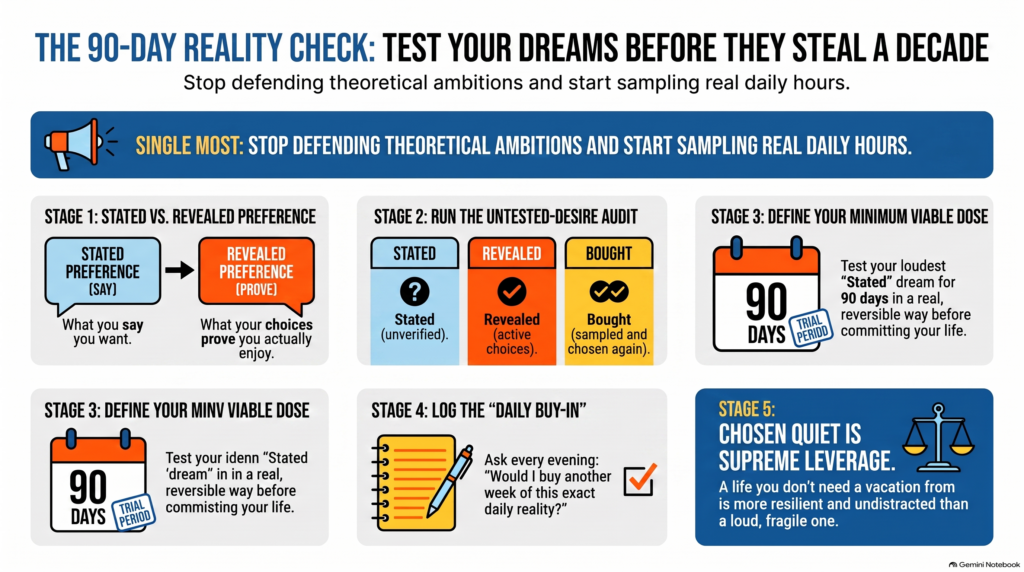
Here is the 4-step framework to audit and sample an ambition, and test the quiet life, before handing it your life.
| Step | Action |
|---|---|
| 1. Run the Audit | Categorize desires into S, R, or B. |
| 2. Define the Dose | Design a real, 90-day reversible test. |
| 3. Instrument It | Daily check: “Would I buy this week?” |
| 4. The Closing Script | Keep the real parts; return the rest. |
Step 1: Run the Untested-Desire Audit
Set a timer for 20 minutes. List every major “big life” ambition you currently hold (aim for 5 to 8). Next to each item, assign a single letter:
- S (Stated): You have only ever talked about it, dreamed about it, or consumed media about it. You have never lived a real, ordinary week of it.
- R (Revealed): Your actual, unprompted choices show you moving toward it automatically when no one is watching.
- B (Bought): You have genuinely sampled the daily reality of it, and you are choosing to double down with open eyes.
Almost every source of chronic existential friction in your life lives in the S pile. Those are the unverified dreams costing you present-tense hours in exchange for an unverified future.
Pick the single loudest S. That is your test subject.
Step 2: Define the Smallest Honest Dose (The 90-Day Window)
You do not need to blow up your life, resign from your job, or sell your home to test a dream. You need to construct the Minimum Viable Dose: the smallest honest sample of the quiet life you can run.
Rules for a valid test:
- It must be real, not a simulation. Don’t read books about being an entrepreneur; launch a tiny, real product and try to make ten actual sales. Don’t browse real estate in a new city; rent a small apartment there for a month and work your normal hours.
- It must be reversible. Sublet, don’t sell. Moonlight, don’t quit. Test the waters without destroying your underlying foundation.
- It must last roughly 90 days. The first two weeks of any novelty are an illusion—the hedonic spike masks the true texture of the routine. By day 45 or 60, the novelty wears off, and the actual daily reality emerges.
Write your dose as a single sentence:
“For 90 days, I will [minimum real version] so I can experience the actual daily hours, rather than the highlight reel.”

Step 3: Instrument the Experience
Every evening during the 90-day test, record a single metric in a digital note. Answer one question:
“If I were offered the exact daily reality of this past week for the next five years, would I buy it?”
(Yes / No — followed by a 5-word explanation)
You are not journaling your emotions; you are logging revealed preference in real time.
Look for the ultimate signal: A life you actually want is one where you stop needing a vacation from your own week. If you spend the 90 days counting down the hours until the weekend, your answer has arrived early.
Step 4: Execute the Closing Script
At Day 90, make the implicit explicit. If the test reveals that the dream was purely inherited, say it out loud—to yourself, and to those invested in your status:
“I actually tried [the path]. Not the fantasy of it—the real daily version for three months. What I discovered is that I value [specific elements worth keeping], but I don’t want [the cost/noise required for the rest]. I’m not chasing the whole package anymore. I’m keeping the parts that are mine and returning the rest.”
You aren’t renouncing ambition. You are returning expectations that were never yours to carry in the first place.

5. Where the Protocol Breaks (And the Reality of Choice)
No framework is bulletproof, and the quiet life is no exception. It is worth acknowledging where this approach reaches its limits:
- Undosable Decisions: Some commitments cannot be sampled in 90-day doses. You cannot sample parenting, nor can you sample certain high-stakes, unhedged career bets that require absolute, multi-year immersion. For those, you must accept real uncertainty like an adult and make a principled leap.
- The Perpetual Sampler Trap: If you execute this protocol on every minor impulse, you risk becoming a professional dabbler—someone who endlessly samples options but never stays long enough to build anything meaningful. The audit is reserved for your loudest 2 or 3 lingering ambitions, not an excuse to avoid commitment.
Ultimately, the goal is not to eliminate ambition, but to ensure your ambition is anchored in the present tense.
Most people live as if the present moment is an inconvenience—a stepping stone on the way to a hypothetical future where their “real” life begins.
As Anthony de Mello wrote:
“You don’t have to add anything in order to be happy; you’ve got to drop something.”
You don’t need the grand title, the penthouse, or the crowded calendar to start living. You need to drop the illusion that your life is happening anywhere other than right now, while you brew your morning coffee, take a daily walk, or execute your craft at a quiet desk.
The Dalai Lama captured this paradox when asked what surprised him most about humanity:
“Man sacrifices his health to make money, then sacrifices his money to restore his health. He is so anxious about the future that he does not enjoy the present; the result being that he lives in neither the present nor the future. He lives as if he is never going to die, and then dies having never really lived.”
Conclusion: Evaluating Life from the Inside Out
Your goals are allowed to change. The dream you held at 20 was built on incomplete data about who you were. As you learn who you actually are, your operational definition of success must update.
Contentment and ambition are not opposing forces. You can love your daily schedule, protect your quiet hours, and still build deeply impressive work over a decade.
Marcus Aurelius reminded himself of this balance in his personal journals:
“Very little is needed to make a happy life; it is all within yourself, in your way of thinking.”
If the life you are building feels peaceful, sustainable, and clear on the inside—even if it looks modest or unimpressive from the outside—you aren’t missing out. You have won the game. Stop looking at it from the outside. That’s the quiet life: not a retreat, but the ultimate leverage.