
Further down: a 30-second test you can run on someone you love, a 1976 experiment with a houseplant, and a concert pianist in his eighties who found a way round the whole problem.

Your mother hands you her car keys in the hospital car park and says you might as well hang on to them.
She says it the way she’d mention the weather. You put the keys in your pocket and drive her home. Neither of you says out loud that she has just given up the thing that let her go wherever she liked for fifty-odd years.
Nobody asks whether she could still manage daylight, or the four miles to the shops. The keys simply stay in your pocket, and the question is never raised again.
That question, what ageing parents are quietly allowed to keep, is the one this whole piece is about. I’ll come back to it.
If you’ll see an older parent over Christmas, that’s when you’ll notice what has changed since the summer, so it’s worth reading this before you go. (Prefer to watch? There’s a nine-minute video version.)
The Brochure Version
Retirement brochures are beautifully designed. Spotless lounges, a minibus for outings, chair yoga on Tuesdays, and a calendar so full it looks like a school timetable. The promise underneath is simple: hand over the bother of daily life, and you keep the good part.
It’s a persuasive design. Like most systems, it measures what’s easy to see. I’ve written before about how a life with every pause engineered out of it can get easier and worse at the same time. A brochure retirement is that idea taken to its logical end.
Mark Sanford, a retired academic who writes from inside his own retirement community, made the point recently in The Darker Side of Growing Old. We talk easily about what’s still working, he wrote, and far less about what is slipping away.
Nobody writes a plan for the year the car keys go.
Drift, Not Collapse
Most things fail in one of two ways. They fail suddenly, or they drift. Drift is the dangerous one, because each small change still looks acceptable on its own.
Ageing is mostly drift. Night driving goes first, then the motorway, then the car. Following a conversation in a noisy room takes a bit more effort each year. A forgotten name used to be a joke, and somewhere along the way it stopped being funny.
Each of those small contractions carries a cost that rarely gets counted. Take the car keys. A systematic review from Columbia University pooled five studies of older people who had stopped driving. Giving up the car was associated with almost double the risk of depressive symptoms. Across the wider evidence, it was also linked to faster declines in physical, social and cognitive function, and to a higher chance of moving into long-term care.
No single change sets off an alarm, and that’s exactly why nobody acts until the pattern is obvious.
The Swiss Cheese of a Life
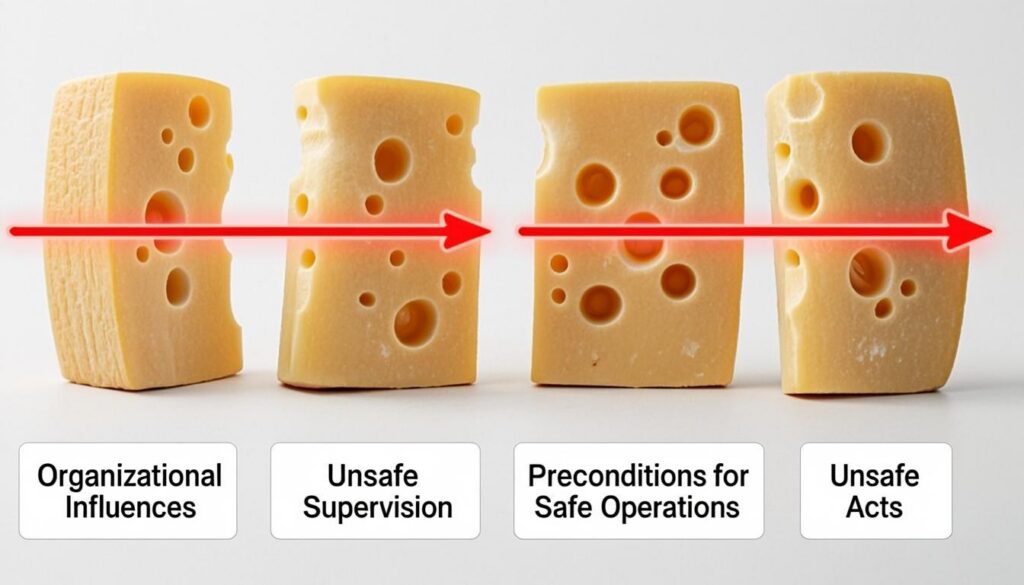
One of the most useful pictures I know of how things go wrong is the psychologist James Reason’s Swiss cheese model. A disaster gets through when the holes in several layers of defence happen to line up. One slice with a hole in it is survivable. It’s the same picture behind why willpower never once made my fix list: you don’t trust any single layer, you stack them.
A life in later years rests on slices too. I count five:
- Proof: being good at something that matters
- Need: someone depending on you by name
- Rhythm: a shape to the day that you didn’t have to invent
- Tribe: people you see without having to arrange it
- Title: a short answer to “and what do you do?”
The 30-second test. Think of someone you love who is getting older, or think of yourself. Score each slice: 0 if it has gone, 1 if it’s thin, 2 if it’s solid. Add the five numbers together.
8–10: well defended. 5–7: some holes are starting to line up. Under 5: read the rest of this carefully.
Put your number in the comments, along with which slice was lowest. You’ll see you’re far from the only one.
Giving up the car takes a bite out of Need and Proof. Retirement takes Title and Rhythm on the same day. Losing a husband or a wife can hole three slices at once.
Fading hearing eats into Tribe, one dinner at a time, and its cost is larger than most families realise. The 2024 Lancet Commission on dementia identified fourteen modifiable risk factors. Together they account for an estimated 45 per cent of cases. Untreated hearing loss sits at the top of that list, jointly with high LDL cholesterol, at about 7 per cent each. Social isolation in later life adds another 5 per cent.
The darker side of growing old is the year the holes line up.
The Default Trap
This is the part that’s uncomfortable for those of us doing the caring.
When an old bridge starts to show its age, nobody closes it at the first crack. They lower the weight limit, add a support, slow the traffic down. The bridge stays open.

With people, and with ageing parents above all, our instinct is the opposite. At the first sign of struggle, we take over. We carry the shopping, do the driving, fill in the form, and make the phone call. It comes from love, and much of it is needed. But each task lifted away is also a small, daily confirmation that the person no longer has to be capable.
There’s research behind this. In the 1980s and 1990s the German psychologist Margret Baltes spent years watching how care staff behaved towards the people they looked after. She called the pattern she found the dependency-support script. Dependent behaviour got a quick, warm response, while attempts at independence went largely unremarked.
An Australian team later used her observation method in a residential home, logging 2,848 resident–staff interactions. Residents were alone for 40 per cent of the time they were observed. When residents did something for themselves, the most common staff response was no response at all. When they acted dependent, the most common response was to support that dependence.
Nobody in those studies was being unkind. That’s what makes the finding hard to sit with. (I cut a YouTube Short on this bit, if you need something to send a brother or sister who’s doing the caring with you.)
Kindness that removes all the friction quietly removes the proof as well.
Picture a man who spent forty years as the one who fixed things: the boiler, the gutter, the neighbour’s car. Then put him somewhere every one of those jobs is handled by a maintenance man with a clipboard. On paper his life just got easier. In practice the only daily evidence he had of being useful has been switched off. He has gone from load-bearing to optional, and nobody held a meeting about it.
The Plant Experiment
In 1976 two psychologists, Ellen Langer and Judith Rodin, ran a small experiment in a nursing home in Connecticut.

On one floor, the administrator gave a short talk. Residents could arrange their rooms as they liked, decide how to spend their time, and choose and look after a houseplant. On another floor, the talk stressed how the staff would take care of everything, including watering a plant given to each resident.
Three weeks later, the first group were happier and more active. Eighteen months on, they still had better health ratings, and a smaller proportion of them had died.
The study is small, it was run in a single home, and the plant on its own can’t be credited with the difference. But it planted an idea that gerontology has never let go of. A sense of control may be part of what keeps people well, at eighty as much as at forty. It changed how care homes everywhere talk about choice.
Why Withdrawal Looks Like a Choice
When an older person stops going out, we reach for an explanation. She’s stubborn. He won’t help himself.
When something goes wrong, the first explanation offered is nearly always “human error”. It is nearly always incomplete. The real cause sits further back, in whatever had already worn away before the mistake happened. I once took the blame for a $740K mistake precisely because the name nearest the failure is rarely the cause of it.
“She can’t be bothered” is the human-error answer.
Staying in may be a reasonable decision about a world that now costs more than it pays back. And the cost of that decision is serious. In a 2015 meta-analysis, Julianne Holt-Lunstad and colleagues found that social isolation, loneliness and living alone were each linked to a raised likelihood of early death, in the range of a quarter to a third. They found no difference between being objectively isolated and simply feeling it.
That last point matters at every crowded table. Someone can be in a full room and still be counted among the isolated.
Friendships drift the same way. When I spent two months refusing to be a “low-maintenance” friend, I learned how quietly a Tribe slice thins when everyone agrees to catch up “whenever”.
Counting the Wrong Thing
When a resident goes quiet, the usual response is to add something: another quiz night, another visiting singer, a brighter newsletter. Attendance gets counted, and attendance goes up.
There’s a name for this: metric substitution. You can’t easily measure whether someone feels known, so you measure how many events they turned up to. Then the number gets mistaken for the thing it was meant to stand for.
The same happens with the cheerful stories of “successful ageing”, like the ninety-year-old marathon runner. They’re lovely, and they quietly set a pass mark. Set the bar at a ninety-year-old marathon runner and most people will fail it.
What Rubinstein Knew
There’s a better model than the marathon runner. It comes from Paul and Margret Baltes, and its best-known example is the pianist Arthur Rubinstein, who kept giving concerts into his eighties.
Rubinstein did three things. He selected: he played fewer pieces. He optimised: he practised those pieces more. And he compensated: he could no longer play fast passages at his old speed, so he slowed down just before them. The contrast made the fast parts sound as fast as ever.
Baltes and Baltes called it Selection, Optimisation and Compensation. It’s the old bridge again. You don’t close it. You narrow what it carries, look after it carefully, and add support where it’s weakest.
The question worth asking is what can still be kept, and how, before anyone decides what has to stop.
From Fixing to Witnessing
The Stoics drew a hard line between what’s in our control and what isn’t. (Epictetus’s version of it once stopped me sending an £11,000 email.) Old age moves that line, year by year, and rarely in our favour.
Some of what’s lost can be put back, or kept going longer, with the right support. Some of it can’t. For those losses, the job changes from fixing to keeping someone company in what’s gone. You name it plainly, you don’t rush them towards a silver lining, and you remember who they were before the world got smaller.
That takes a different kind of person from the one who handles the logistics. I’ve written about the people who can do your funeral but not your wedding: superb in a crisis, absent for the ordinary days. Old age is mostly ordinary days.
When the loss can’t be undone, being seen by someone who doesn’t look away matters more than any timetable of activities.

I’m a few months from retirement myself, next spring, and I’ve been keeping a list of the hundred rules I actually use on the way there. Now I’ve started thinking hard about the years ahead, both mine and those of the people I care about.
Remember the keys in the car park? Further down is what I’d do differently: the seven rungs between “keep driving” and “give me the keys”, and the exact words to open that conversation.
If someone in your family is facing the car-keys conversation this year, send this to them first.
Five Practical Tools for Ageing Parents and Their Families
Five tools follow, for anyone with ageing parents or with their own later years in view. There’s a pre-mortem for your own later years, a five-question check-in for someone you love, a ladder for helping without taking over, a script for the car-keys conversation, and a slice-by-slice replacement menu with UK contacts.
Tool 1: The Ageing Pre-Mortem (for yourself)
The pre-mortem comes from the psychologist Gary Klein. You imagine the project has already failed, and then you explain why. People spot causes far more readily looking back from a failure than they do trying to predict it. You don’t wait for things to go wrong before working out why they might.
- Write the failure statement. “It is five years from now. My later life has gone badly. This is what happened.” Write for ten minutes, in the past tense, without stopping.
- Score your five slices from 0 to 3.
- 0: the slice depends entirely on something you’ll lose (a job, a car, a person)
- 1: a vague intention (“I’ll do more walking”)
- 2: a named replacement, not yet started
- 3: already running, and supported by something that will outlast the losses
- Pick the weakest slice and ask “why?” five times. Stop at the answer that makes you slightly uncomfortable.
- Apply Rubinstein to it. Write down what you’d select (keep), what you’d optimise (invest in), and what you’d compensate with (the workaround).
- Add one safeguard. Choose one commitment that needs you by name, on a fixed schedule, where your absence would be noticed.
- List five drift signals. Adapt these examples:
- Three days running without leaving the house before noon
- Two invitations turned down in a row
- Unable to name one thing you’re looking forward to this week
- Projects started and abandoned
- “What’s the point” turning up in your own vocabulary
- Give the list to one person and get a yes. Use this script: “I’ve written down the signs that I’m drifting. Will you keep a copy, and if you see two of them, tell me straight, even if I’m short with you?”
Re-score every six months. Book a hearing check now, before anyone has to suggest it. And if you’d like the cheap end of the evidence on staying well, my 90-day biological-age experiment found the least expensive habits did the most.
Tool 2: The Slice Check-In (for someone you love)
Use one question per visit, slipped into ordinary conversation. Then listen far longer than feels natural.
| Slice | Question | Listen for |
|---|---|---|
| Proof | “What are you still better at than any of us?” | A quick answer, or “nothing now” |
| Need | “Who’s relying on you at the moment?” | Names, or silence |
| Rhythm | “What does a good day look like for you these days?” | Any structure at all |
| Tribe | “Who have you seen this week, apart from me?” | Real names, versus the TV or no one |
| Title | “If someone asked about you, what would you want them to know?” | Whether they speak in the past tense only |
Rules:
- Don’t fix anything on the spot. And ask about the good things too: how someone responds to good news tells you more about the relationship than how they handle a crisis.
- Write one line on your phone after each visit.
- Act when the same slice comes up thin twice, not on one bad day.
- If siblings are involved, share out the slices between you, so nothing falls through because everyone assumed someone else had it.
Watch the Tribe slice especially for hearing. Signs include the television creeping louder, phone calls getting shorter, and conversation dropping off in noisy places. A GP can refer them for a hearing assessment, and it’s one of the most worthwhile appointments you can help arrange. The NHS symptoms page is a good, unalarming thing to send them.
Tool 3: The Do-With Ladder (helping without taking over)
Before you take a task off someone, go down this ladder from the top. Stop at the first rung that keeps them safe.
- They do it, unchanged. It’s slower, and you wait.
- They do it, with an aid. Grab rail, magnifier, big-button phone, a delivery slot booked online but chosen by them.
- They do it, with limits. This is Rubinstein’s rung: daylight driving only, local roads only, cooking but not frying.
- They do it, you check. They fill in the form, and you read it over before it goes.
- You do it together. Their decisions, your hands.
- You do it, they direct. You carry the ladder up to the gutter; they tell you where the blockage is.
- You do it. Only when every rung above would be unsafe.
Then take one more step: for every task you take over, hand one back that needs them. It might be checking the grandchild’s maths homework, labelling the old photographs, or being the one who knows how the recipe really goes.
Review the ladder every few months. Rungs can go back up as well as down, for example after a cataract operation, new hearing aids, or a stretch of physiotherapy.
Tool 4: The Car-Keys Conversation
Driving is the clearest case of the Default Trap, and the evidence on what giving it up costs is strong. So treat this as a decision to make together, in stages, rather than a single handover in a car park.
Before you talk:
- Write down what you’ve actually seen, with dates. Avoid general impressions.
- Find out what’s available locally: community transport, bus routes, taxi accounts, and which friends drive.
Opening line:
“I’m not asking you to stop driving. I’d like us to work out how you keep driving safely for as long as possible.”
Offer rungs, not an ending. Suggest daylight only, local roads only, no motorways, or an independent assessment.
The assessment route (UK):
- Driving Mobility’s accredited centres offer older-driver assessments. They’re designed to keep people driving for as long as they safely can.
- If the referral comes through the NHS, for example via a GP, the assessment is free at most centres. A self-referral is usually paid for.
- An independent assessor saying “you’re fine” or “you’re not” also takes the decision out of the family argument.
If driving does have to stop:
- Plan the replacement mobility before the last drive, so there’s no gap.
- Ask yourself which slice the car was holding up, and replace that too. Often it’s Need: being the one who gave lifts.
If they’re seriously unsafe and refuse every option: Age UK’s guidance is that you can write to the DVLA in confidence.
Tool 5: The Slice Replacement Menu
When a slice comes up thin, pick one replacement and run it for four weeks before judging it. It’s the same principle as the 90-day test I’d give any new life plan: you find out what you actually like by doing it, not by deciding it.
| Slice | Replacement ideas |
|---|---|
| Proof | Teach a skill to a grandchild or neighbour; record a “how we used to do it” video; take on a repair or craft project with a finish date |
| Need | A regular lift-giving or befriending role; caring for a pet or plant (Langer and Rodin’s lesson); being the family archivist |
| Rhythm | A fixed weekly anchor (same café, same day, same time), the same idea that rescued my working day; a morning walk with a named route |
| Tribe | A small regular group over a big occasional one; volunteering; hearing checked first, if conversations are a strain |
| Title | A role that comes with a name: treasurer, organiser, guide, reader, “the one who knows” |
UK contacts worth having:
- Age UK Advice Line: 0800 678 1602, 8am–7pm, every day of the year. It’s free and confidential, and families and carers can call too.
- The Silver Line Helpline (Age UK): 0800 4 70 80 90, for anyone feeling lonely, at any hour.
- Driving Mobility: use the “find a centre” page for older-driver assessments.
- Community transport: search the directory on GOV.UK.
Copy-and-keep log
LADDER & CHECK-IN LOG, for: ____________TASK CURRENT RUNG (1-7) COULD IT GO UP? TASK HANDED BACK
____________ ___ ______________ ________________
____________ ___ ______________ ________________CHECK-IN: DATE ______ SLICE ______ WHAT THEY SAID ______________ THIN? Y/N
REPLACEMENT TRIAL: SLICE ______ WHAT ______________ START ______ HELD AT 4 WKS? Y/N
HEARING CHECKED? Y / N DATE ______Save this post. Pull it up before your next visit, and again before your own leaving do.
What’s one thing you took over for someone you love that, looking back, they could still have done themselves?
If you’d like the next one by email, I send the essays out on Substack, and paid subscribers there get the printable versions of tools like these. I also publish on Medium. And if this piece helped, a coffee on Ko-fi keeps the research going.
Sources
- Chihuri S. et al. (2016). Driving cessation and health outcomes in older adults. Journal of the American Geriatrics Society.
- Livingston G. et al. (2024). Dementia prevention, intervention, and care: 2024 report of the Lancet standing Commission. The Lancet 404: 572–628.
- Baltes M.M. & Wahl H.-W. (1992). The dependency-support script in institutions. Psychology and Aging 7(3): 409–418.
- Edwards H. et al. (2003). Resident-staff interactions: a challenge for quality residential aged care. Australasian Journal on Ageing 22(1): 31–37.
- Rodin J. & Langer E.J. (1977). Long-term effects of a control-relevant intervention with the institutionalized aged. JPSP 35(12): 897–902. See also Perceived control in the lives of older adults, The Gerontologist (2014).
- Holt-Lunstad J. et al. (2015). Loneliness and social isolation as risk factors for mortality. Perspectives on Psychological Science.
- Baltes P.B. & Baltes M.M. (1990). Selective optimization with compensation (the Rubinstein example).
- Reason J. (2000). Human error: models and management. BMJ.
- Klein G. (2007). Performing a project premortem. Harvard Business Review. (overview)
- Age UK, Worried about someone’s driving? and Advice Line; Driving Mobility; GOV.UK community transport; NHS hearing loss symptoms.