

Stop trying to silence your inner critic. Put it on the right shift and it becomes the sharpest editor you’ll ever have.
It’s twenty to seven on a Saturday. Your coffee has gone cold, and you’re one paragraph into the piece you’ve been circling for a fortnight. Your shoulders are already up round your ears.
Then the voice.
Who do you think you are? Anyone who reads this will see straight through it.
You delete the paragraph. Rewrite it, delete that too. By half past eight you’ve got forty-one words and a sudden urge to clean the oven.
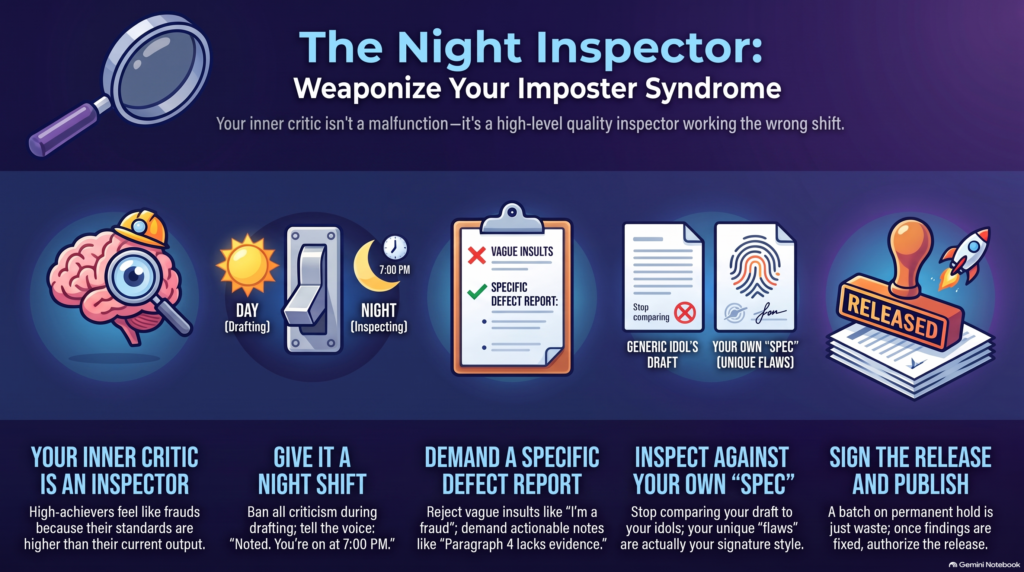
Anyone who has worked in quality assurance would recognise that voice. It finds one flaw and rejects the whole batch, which is roughly what lot inspection does when it hits a critical defect. Your inner critic is an inspector, and a good one, working the wrong shift. Call it the night inspector. Put it on the right shift and it stops holding you back and starts giving you an edge.
(Rather watch than read? There’s a full video version on YouTube, and a 60-second Short if you’re between meetings.)
The voice gets louder as your work gets better
The standard advice treats imposter syndrome as a malfunction. Every feed has a version of it: your inner critic is lying, so drown it out with affirmations and a self-compassion script. Call it the drown-it-out school. I’ve spent thirty years in quality assurance and never seen a problem solved by shouting over it.
The research that named the problem points somewhere else. In 1978 the psychologists Pauline Clance and Suzanne Imes described what they called the impostor phenomenon in more than 150 high-achieving women, many holding doctorates or respected professional posts. They were convinced they weren’t really bright and had simply fooled everyone. Success didn’t cure it. Each new achievement only raised the price of being found out.
Quality departments know a version of this. A trainee inspector passes almost everything, because they can’t yet see what a defect looks like. The strictest inspectors on any site are the experienced ones. Their eye got sharper first, and the strictness came with it.
The voice calling you a fraud is proof your eye has outrun your hands.
So drowning it out is the wrong move. You’d be silencing the most experienced person on your staff.
An inspector who interrupts the build becomes the defect
Anyone who has run a production line learns that where you put the check matters as much as the check itself.
Stop a skilled operator every two minutes to challenge work that isn’t finished, and quality goes down. They lose their place in the sequence and steps get skipped. Soon the interruptions are causing the very faults everyone is hunting for.
Nobody sensible runs a line that way. Production builds, and inspection happens at defined points, at the end of a batch and again before release. The standard never moves. Only the timing does.
Your inner critic has never heard of timing. It clocks on the minute you open a blank page and challenges each sentence before the next one exists. You’d never tolerate that on a production line. And yet there it is every morning, stood behind your chair at the kitchen table.
Left on days, the critic produces exactly one thing, which is silence. Essays that never get finished, parked in a drafts folder. (Endless tweaking has a cousin, by the way: the productivity system that’s really procrastination in a suit.) Nobody can reject a piece you never publish. Nobody can read it either.
The night inspector works after production. It gets the finished batch, full authority and a sharp pen. What it doesn’t get is access to the line while the day shift is building.
Firing the inspector fails just as badly
The drown-it-out school has an answer to all this: switch the voice off altogether.
Factories know how that ends. A line with no final inspection ships quickly, and it ships its defects straight to the customer, who finds them for you. Writing goes the same way. Silence the critic completely and you get volume, along with the paragraph that repeats itself and the ending that wanders off. I found that out the hard way during ninety days of letting ChatGPT do the drafting. Readers are the least forgiving inspectors there are, and they don’t file reports. They just leave.
The fix sits between those two failures, and it comes down to timing.
Four rules that move your critic onto nights
- Give it a shift pattern. This is the one-minute part, and it does most of the work. Before you draft, write down when inspection happens: drafting until nine, inspection at seven tonight. When the voice turns up early, tell it the time. You’re on at seven. Engaging with what it says mid-draft is how it gets a foot on the line.
- Demand a defect report. In a regulated plant, a non-conformance that just says “product is bad” gets sent straight back. A usable report records what failed, where, how many, and against which requirement. Hold your critic to that standard. “Paragraph four claims something you haven’t supported” is a finding you can fix. “You’re a fraud” wouldn’t get past a trainee auditor.
- Quarantine the batch. In pharmaceutical manufacturing, finished product doesn’t ship the moment it’s made. It sits in quarantine until quality has reviewed it. Give your draft the same gap, overnight at the very least. Whoever reads it tomorrow will see things the person who wrote it tonight simply can’t.
- Make it sign a disposition. Every inspection ends in a decision. Rework it, accept it as is, scrap it, send it back. Nothing sits on hold forever, because a batch nobody will release costs you exactly what a scrapped one does. Once the night inspector has logged its findings and you’ve dealt with them, it signs the release, and you publish.
Product on permanent hold is just waste with paperwork.
I’ve turned those four rules into a fill-in shift sheet you can paste at the top of your next draft. It’s in the Substack edition of this essay.
Your critic keeps checking you against someone else’s drawing
Moved to nights, the voice gets more useful, which is the last thing most people expect. Looking at a finished piece instead of a half-built sentence, it stops shouting about who you are and starts talking about the work. That example could be anyone’s. The ending wanders off.
One finding will keep coming back, though. You’ll never write like them. Them being the essayist you reread, or whoever sits at the top of your field.
Run that through a defect report and it collapses at the last column. Against which requirement? Your critic is inspecting your work against someone else’s drawing, so every place you differ gets logged as a non-conformance. Swap in your own drawing and most of those findings turn into the one feature your work has that theirs can’t copy.
Their version already exists. Nobody needs a second-rate copy of it. Your background and your particular blind spots add up to a specification only you can build to, and that kind of specific, ordinary detail is what earns a reader’s trust now that anyone can generate the smooth, generic version.
That’s the unfair advantage. Most people either obey the voice or spend years trying to drown it. You’ve given yours proper hours and the right drawing, and put it to work.
Keep the critic. Change its hours.
So go back to that Saturday. Leave the forty-one words alone and write badly until lunch. Fifteen hundred words, plenty of them wrong.
At seven that evening, the night inspector clocks on. It finds a paragraph that says the same thing twice and an example that could have been anyone’s. Then, right at the end, a closing line that asks the reader a question when it should have answered one. Fair findings, all fixable before bed.
Then it does something you’ve never let it do before. It signs the release.
The voice is still there. It just doesn’t work mornings any more.
This essay also runs on Medium, and the Substack edition carries the night inspector’s shift sheet. If this saves you one Saturday of oven-cleaning, you can buy me a coffee on Ko-fi. It keeps the next one coming.
Read next: The conviction gap, on getting from knowing to doing, and why your smartest ideas get ignored.