

This matters now because most advice on toxic friends is about the obviously unkind ones. This is about the well-meaning kind, who only show up when your life is on fire. A shorter cut of this essay is on Medium, and there is a video walkthrough on YouTube if you would rather watch than read.
The night the redundancy email landed, Priya was at my door in fifty minutes. Rain coming off the Mersey in sheets, her coat dripping onto the hall tiles, a carrier bag with wine and paracetamol and, for reasons neither of us questioned, a lemon drizzle cake. She sat on my kitchen floor until gone three. She let me say the same three sentences maybe forty times over. When I finally fell asleep on the sofa she texted my sister so someone would check on me in the morning. If you had asked me that night, I would have told you Priya loved me more than almost anyone alive. I was wrong. It took two years and one small piece of good news to show me exactly how wrong. The good news, when it came, was modest. A thing I had wanted for the better part of a decade, and had been turned down for four times, finally came good. I texted Priya about it before I texted almost anyone. Three sentences. An exclamation mark, which I do not hand out lightly. She replied nine hours later. Ah nice one x. Nine hours. Nice one. From the same woman who had crossed a flooded city at midnight to sit on my floor.
Here is what I need you to understand. That is not a contradiction. That is a pattern, it has a name, and once you have the name you will start seeing it everywhere, including in people you were certain adored you. I call it performative care. Some people do not love you. They love the part of themselves that gets to rescue you, and that part only has a job when something in your life is on fire.
A fire brigade is not your friend
Think about what a fire brigade actually is. Magnificent in the emergency. Necessary. Loud, fast, brave, and gone the moment the flames are out. Nobody expects the crew to stay for breakfast. Nobody is wounded when they pack up the hoses and drive back to the station, because their entire relationship with your house was the fire. Some people relate to you the way a fire brigade relates to a building. Hand them a crisis and they are extraordinary. But hand them an ordinary Wednesday, a slow afternoon, a quiet stretch where nothing is wrong and nothing needs saving, and they evaporate. Not out of malice. There is simply nothing for them to do, because rescue is the only dialect they speak, and ordinary life does not require rescuing. This is performative care in its purest form. The people who actually love you are the ones who turn up when nothing is on fire.
You test love with disaster. You should test it with joy.
We have this backwards, all of us, and there is research that says so. The psychologist Shelly Gable spent years studying something she called capitalisation, which is the very ordinary act of telling someone your good news and watching what they do with it. She found that people respond in one of four ways, and only one of them builds a relationship.
- Active and constructive. They light up. They ask questions. They want the detail, the texture, the daft grin you are trying to hide. This is the response that quietly holds people together over years.
- Passive and constructive. A warm but understated “that’s nice, well done.” Kind, and forgettable, and it leaves you slightly deflated without knowing why.
- Active and destructive. They find the downside. “Won’t that mean longer hours? Are you sure about the money?” They meet your good news by managing it.
- Passive and destructive. They barely register it and change the subject to themselves. The ah nice one x of the world.
Gable’s uncomfortable finding is that this response to good news predicts the health of a relationship at least as powerfully as support during the bad times, and often more. We spend our lives auditing who shows up to the funeral. We should be watching who shows up to the celebration. Anyone can pity you. Pity is cheap and it flatters the giver. Being glad for you asks something harder. It asks them to want your life to be good even when yours getting better does nothing for them.
You do not find out who loves you when you are breaking. You find out when something goes right.
I talk through all four response types on camera too, with a couple of examples that did not make the final cut here. Watch the video breakdown if that is an easier way in.
Friendship is not built in the emergencies. It is built in the hours.

The unglamorous hours are the relationship. Everything else is weather.
There is a reason the crisis feels like the real thing and the ordinary Wednesday feels like nothing. The crisis is vivid. It has a shape. The ordinary hours have no shape at all, which is precisely why we discount them, and precisely why they are the whole game. Jeffrey Hall, a communication researcher at the University of Kansas, tried to put a number on it. Tracking how new relationships actually deepened, he estimated it takes roughly 50 hours of time together to turn an acquaintance into a casual friend, around 90 hours to become a proper friend, and more than 200 hours before someone becomes a close friend. Crucially, he found that hours spent simply co-existing, sitting near someone at work, did not count for much. The hours that built closeness were the unstructured ones. Hanging about. Talking rubbish. Being in each other’s ordinary day.
Sit that next to the anthropologist Robin Dunbar‘s famous estimate that we can sustain only around 150 stable relationships at all, of whom perhaps five are genuinely close. The maths is brutal. You have a tiny number of close slots and each one costs hundreds of hours of the exact currency performative care refuses to spend. A fire-brigade friend will give you a dramatic, memorable, expensive-looking three hours in a crisis. They will not give you the 200 slow, cheap-looking hours that actually make a person close to you. And they know, on some level, that the crisis buys them the credit of closeness without the cost of it.
How performative care reads, up close
It is rarely dramatic. That is what makes it so hard to catch. It hides inside behaviour that looks, from the outside, like the real thing.
They shrink your good news
You bring them a strange, specific, hard-won win, and they meet it with a flat line and a change of subject. They had endless words for your worst night and three for your best one. Watch the first three seconds after you tell someone something good. The face does not know how to lie in the first three seconds.
Their warmth is reactive, never sustained
In the room, it is all eye contact and belly laughs and you leave certain the friendship is thriving. Then you walk out and the connection powers down like a light on a motion sensor. Weeks pass. Months. You cannot square it, because the last time felt so real. It was real. It was just switched on by your presence and off by your absence, and that is not the same as being held in mind.
The apology becomes the whole relationship
“God I’m so sorry, I’ve been useless, let’s catch up soon.” They pay this fee, sincerely, and they pay it instead of ever actually turning up. An apology is not a relationship. It is a coin dropped in a meter to keep the account from being cut off. It buys them another month of your patience and costs them nothing they would miss. That is performative care wearing an apology as its costume. This is what performative care looks like day to day. Logistics are cheap. Attention is expensive. Somebody can drive you to the airport, lend you a drill, sit with you in A&E, and still never once ask how you are actually doing and then wait, without flinching, for the honest answer.
Turn it round before you build a case
Now the uncomfortable part, because it would be too easy to read all this and start drawing up a list of everyone who has failed you. I have been the fire brigade too. I have been magnificent at other people’s disasters and absent from their ordinary weeks. I have driven across a city for a friend in freefall and then not asked, for half a year, about the quiet things that were slowly going right for them. Rescue made me feel like a good person. Presence just felt like time. Performative care is not a villain you spot in other people. It is a default setting, and I had it running for years without ever checking what it cost the people I claimed to love. That is performative care, running quietly in the background.
What the dying keep telling us
Bronnie Ware spent years nursing people through their final weeks, and she wrote down what they said once the noise of ordinary life had fallen away. The regrets were not about money, or status, or the job. One of the five she heard again and again was that they wished they had stayed in touch with their friends. Not their contacts. Their friends. The people who knew them. Here is what I think that regret actually is, underneath. It is not the ache of having had too few people. It is the ache of having spent finite, unrepeatable hours on performative care instead of the real thing. Of mistaking the fire brigade for the family. Of feeling loved on paper and lonely in practice. You have a fixed number of Wednesdays. You are spending some of them right now.
How to stop mistaking rescue for love
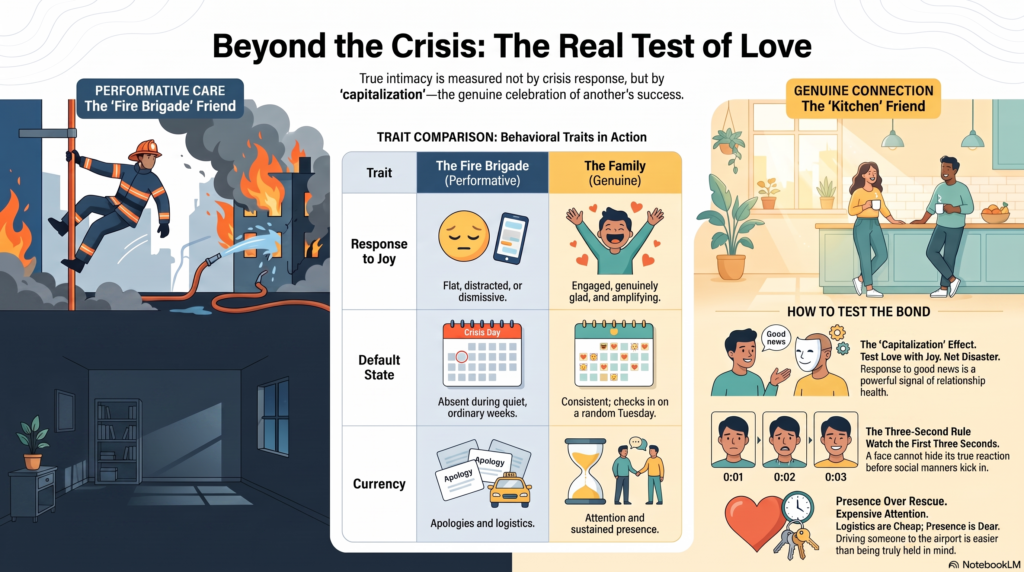 You cannot turn a performative friend into a real one, because performative care is a pattern, not a flaw you can argue someone out of. But you can stop pouring yourself into the wrong containers, and you can become the right container for the people who have earned it. Five practices, starting this week.
Lead with something good and watch the first three seconds. Before you decide anything about where a relationship stands, bring the person a small, specific win. Not a fishing-for-reassurance win. A real one. Watch what their face and their timing do before their manners catch up. That flicker is the truest data you will ever get about a bond.
Count the ordinary contacts, not the dramatic ones. Look back over the past year and ask who reached out when nothing was wrong. Not who came to the funeral. Who texted you on a nothing Tuesday about a nothing thing. That list, and not the crisis list, is the list of people who actually keep you in mind.
Bank the hours on purpose. Hall’s research is oddly freeing once you accept it. Closeness is not chemistry, it is accumulated ordinary time. Pick the two or three people you want in your close five and put recurring, unglamorous hours in the diary. A standing walk. A Thursday phone call. The relationship is the hours.
Stop accepting the apology as payment. When someone offers “so sorry, let’s catch up soon” for the fourth time, stop counting it as contact. It is not contact. Reply warmly, expect nothing, and quietly move them from the friend column into the fond-acquaintance column where they have been living all along. That is not bitterness. It is filing something under its real name.
Be the kitchen friend to someone on purpose. Pick one person this week whose life is not on fire and turn up in their ordinary day anyway. Ask about the thing that went right for them. Be glad, out loud, at full volume, in the first three seconds. Presence is a muscle. Most of us have only ever trained it for emergencies.
The night on the kitchen floor, seen properly
I still think about Priya on my floor at three in the morning. I am not ungrateful for it and I will not pretend it was nothing. She showed up in the storm, the storm was real, and so was she, that night. But I stopped mistaking a rescue for a relationship, and I stopped mistaking performative care for love. I stopped waiting for the woman who crossed a flooded city to also, just once, cross the room for my good news. She was never going to. That was never the deal. I was the one who had misread the deal for years.
These days I spend my Wednesdays differently. I text the kitchen friends when nothing is wrong. And when somebody I love brings me their good news, I try very hard to be the first three seconds they were hoping for, because that, and not the drama, and not the soup, and not the lemon drizzle cake, is what love turns out to be made of. The joy and the sorrow, both. You need the people who can do both. Most of us have been quietly settling for the half who can only manage one.
Read the original, shorter cut of this essay on Medium, or watch the video version on YouTube.
Frequently asked questions
What is performative care?
Performative care is care that is switched on by drama and switched off by ordinary life. The person shows up impressively for a crisis, then goes absent once there is nothing to rescue. It resembles love because it involves visible effort, but it is closer to a role the person enjoys playing than an ongoing investment in you.
How can you tell if a friend actually cares about you?
The antidote to performative care is simple: watch how they respond to your good news, not just your bad. Psychologist Shelly Gable’s research on capitalisation found that an active, engaged response to someone’s wins predicts the strength of a relationship at least as strongly as support during hard times. If a person is warm in your crises but flat about your joys, that gap is the answer.
Is someone who helps you a lot but never really talks to you a real friend?
Not necessarily. Favours are cheap relative to attention. Someone can drive you to the airport, lend you tools, and help you move house without ever wanting to actually know you. Practical help is real and worth having, but it is not the same as presence, and it is a mistake to read logistics as love, which is exactly how performative care disguises itself.
Why do some people only show up during a crisis?
A crisis offers a clear role and a fast hit of feeling useful. Ordinary friendship offers neither. It asks for hundreds of unstructured hours with no drama and no obvious payoff. Some people are drawn to the emergency precisely because it lets them feel close without paying the slow cost of actual closeness. That trade-off is the engine behind performative care.
How many hours does it take to build a close friendship?
Communication researcher Jeffrey Hall estimates roughly 50 hours to become a casual friend, around 90 to become a friend, and more than 200 hours to become a close friend, and that the hours that count are unstructured and social rather than time simply spent side by side. Closeness is accumulated ordinary time, which is exactly the currency performative care refuses to spend.